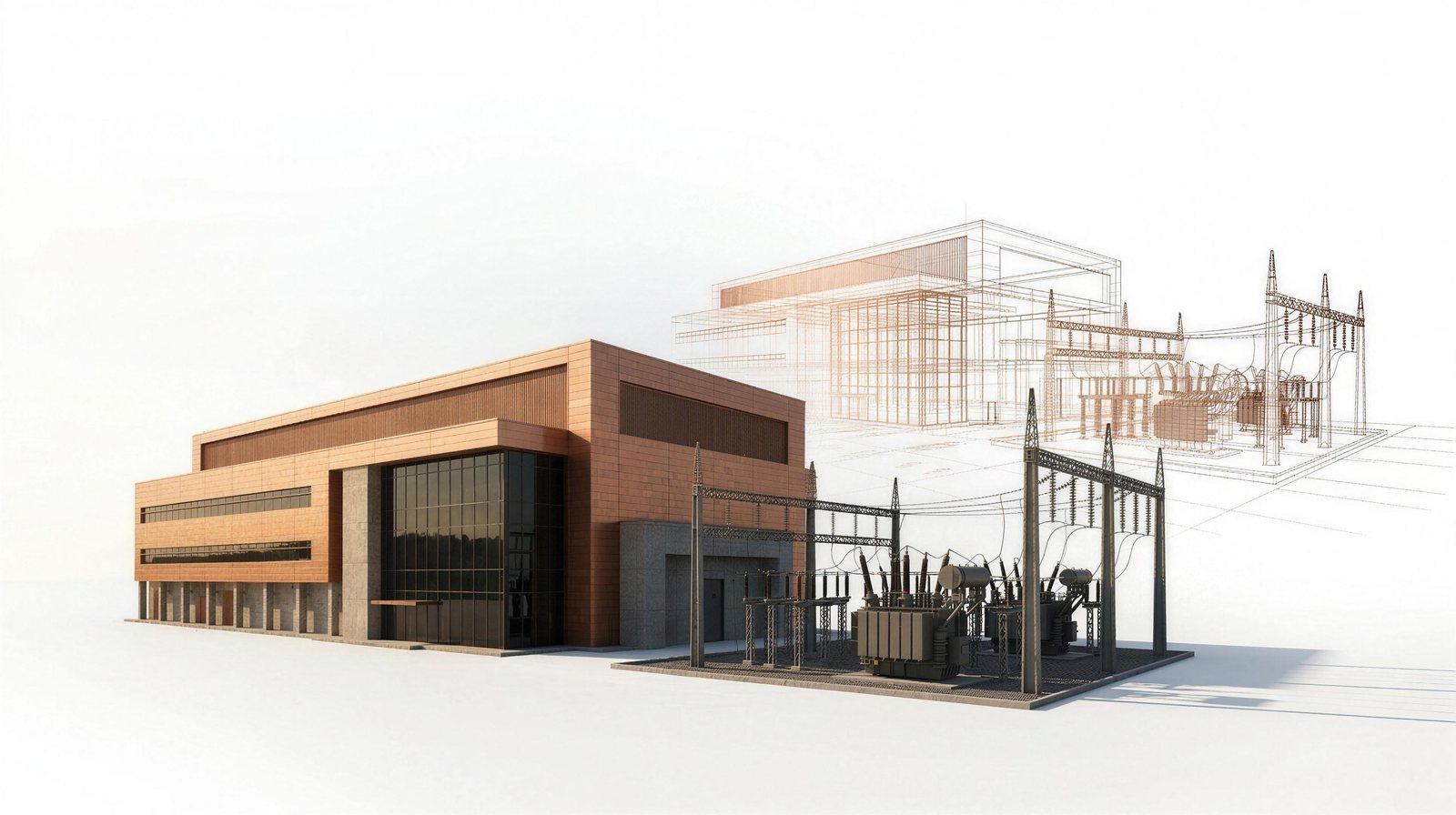
Drive through Santa Clara, California, and you can stand outside two finished data centers that do not work. One belongs to Digital Realty. It got its planning permission in 2019. Six years later it still has no grid connection. The other is a 48 megawatt Stack Infrastructure building. It is done, sealed, and empty. Both are waiting on a $450 million Silicon Valley Power upgrade that will not finish until 2028 (Data Center Dynamics). The concrete is cured. The switchgear is installed. There is no electricity.
At about $13.3 million per megawatt for a fully built American data center (Bloomberg via EnergyConnects), those two buildings are roughly $1.28 billion of completed capital earning nothing. That is the investors' problem, and investors have other options. The people without other options are the ones who were counting on what comes after the ribbon cutting. The commissioning techs who were going to be hired. The security contractor who bid the guard shack. The city general fund line that a working building would have filled. The apprentice who was told there would be five years of work here.
This piece is about who pays for the wait. It is not the investor. The investor moves to the next county. The people who pay are the county budget office, the crew, and the kid in the apprenticeship class.
We built two tools at SAVRN to see this clearly. One is a moratorium tracker that maps every place a community has voted to slow data centers down. The other is a delay watchlist that follows named projects stuck in the queue, with the receipts. The trackers show you where the delay is. This essay puts a price on it.
And it changed how I read the fight. In town after town, the anger is aimed at the building. It should be aimed at the wait.
The data center is not the thing taking money out of your town. The delay is.
01The transfer nobody voted for
Start in Loudoun County, Virginia, because Loudoun has already done the arithmetic on itself. Data centers paid Loudoun $1.14 billion in fiscal year 2026, up from $460.5 million in FY2021. They now fund 42% of all local tax revenue, heading past 60% within three years (Loudoun County Fiscal Strategy FY27–FY30).
Now run the county's own downside. A 25% shortfall in that revenue is a $284 million hole. Closing it means raising the real property rate from $0.805 to $1.027 per $100, which pushes the average homeowner's tax bill from $6,280 to $8,008. That is $1,728 more a year (Loudoun County Fiscal Strategy). It is a real bill, mailed to a real house in Sterling or Leesburg, because a substation upgrade in Ashburn ran three years late.
Loudoun believes this enough to self-insure against it. The county built a Revenue Stabilization Fund of $114 million, rising toward $230 million by FY2028, with cumulative set-asides near $1.6 billion by FY2030 (Loudoun County Fiscal Strategy). Read that plainly. One of the wealthiest counties in America is putting a billion and a half dollars in a mattress because it no longer trusts the delivery date.
That is the transfer this essay is about. Delay does not just cost the developer. It moves a bill onto everyone standing around the developer, and most of them never got a vote.
02What the wait costs the building
Take one 60 megawatt data center, built or nearly built, waiting on a grid connection. Here is what the wait costs the asset itself.
That number is not a guess. A building in a holding pattern does two things at once. It earns nothing, and it pays to exist. On the earning side, a stabilized building at $200 per kilowatt per month is worth $144 million a year in rent at 60 MW (Gridreadiness), and Northern Virginia asking rents run to $235 (CBRE). On the paying side, the building still carries construction debt, insurance, a skeleton crew, and a property tax bill. Add the lease it cannot collect to the interest, insurance, tax, and standby crew it still pays, and the carry runs $512,463 a day (SAVRN model; CBRE, Gridreadiness).
The demand is not in question. Primary-market vacancy was 1.4% in the second half of 2025, and Northern Virginia hit 0.3% in the first quarter of 2026 (CBRE). Every delayed megawatt is a leased megawatt not delivered.
The part that stings is the tax bill. A building that cannot energize still gets assessed. Loudoun values data centers on the income approach, on what a working facility would earn, not on what this one earns (Loudoun County 2026 Data Center Guidelines). So the bill shows up before the revenue does.
And there is a threshold where delay stops meaning "later" and starts meaning "never."
Development capital targets a 15 to 20% return, because it carries construction, leasing, and interconnection risk (CREFC). A stabilized, energized, de-risked building returns 7 to 9%. At 8.8%, six months of queue asks development money to accept a stabilized return while carrying every development risk. No allocator signs that. The project is not delayed. It is repriced out of existence, and it moves.
The repricing
Six months in the queue drops the return out of the band that funds new construction
And it does move. Digital Realty has 24 MW of certain power in Ashburn but can build 200 MW in Manassas (Data Center Frontier). Capacity relocates. The tax base goes with it, the jobs go with it, and the county that spent three years in hearings gets nothing.
03Delay is now the normal case
None of this would matter much if delay were rare. It is not.
57% of data center projects hit a construction delay of three months or more in 2025, and the average wait for a grid connection in primary markets is over four years (JLL 2026 Global Data Center Outlook). Cushman & Wakefield says operators seek two to three year timelines but often face delays of five years or more (Cushman & Wakefield).
The bottleneck is physical. It is copper and steel, not spreadsheets. Critical electrical equipment runs 18 to 36 month lead times (Wood Mackenzie). In PJM, the grid region serving 67 million people, it now takes more than eight years to bring new generation online. In 2008 it took less than two (RMI). Equipment makers are going back to customers holding year-old purchase orders and adding 20% price increases just to hold the delivery slot (Wood Mackenzie).
So the delay is not a rare accident to a few unlucky projects. It is the default condition of the largest privately-funded build in the country right now.
04What a delayed building denies the people around it
The construction phase is the biggest thing most towns ever feel from one of these projects. It is also exactly the phase delay pushes out.
A typical large facility puts around 1,500 workers on site at peak (JLARC, McKinsey). Iowa's IMPLAN study gives clean per-dollar coefficients: about 2,360 total job-years and $177 million in labor income for every $1 billion of construction spend (Technology Association of Iowa). Virginia's JLARC found the construction phase alone supporting 59,000 jobs, $4.3 billion in labor income, and $6.4 billion in state GDP every year (JLARC).
These are good paychecks. A journeyman electrician on a data center job clears about $116,000 (JLARC). Construction wages carry a 20.4% premium over the private sector average (AGC). Permanent operations jobs pay two to three times the local average in most host counties, often with no degree required (Mangum Economics). In a rural parish or a county of 25,000, thirty jobs at double the local wage is the difference between a graduating class that stays and one that leaves.
The multiplier fight, on the level
This is where industry studies and academic work split hard, and any credible number has to show the whole range instead of grabbing the biggest one.
| Source | Multiplier | Method |
|---|---|---|
| Ohio interim report | 2.58 | State, IMPLAN |
| McKinsey | 4.5 | Reference |
| Georgia | 6.0 | State |
| PwC for Data Center Coalition | 7.5 | National, industry-funded |
The sharpest check comes from outside the industry. Brookings ran a synthetic-control study of 93 data center counties against roughly 3,000 controls over two decades. It found data-processing employment up 56% over the first decade, but in a typical county that is only 100 to 200 jobs, with wages unchanged and home prices up 2 to 5% (Brookings). The Arizona Data Center Coalition, an industry group, concedes the point and states plainly that naive estimates overstate the effect by roughly three times (Arizona Data Center Coalition).
So this analysis uses 2.58 as the low case, 4.5 as the middle, and 7.5 as the high, and it leans on the low end, because the low end is closest to the peer-reviewed evidence. If you carry the 7.5 figure into a county hearing by itself, you will be taken apart, and you will deserve it. Every number below leads with the conservative column for that reason.
05What one year of waiting costs a community
Put it together for one 60 megawatt building, for one calendar year in which it waits instead of runs. The model keeps two things apart that a careful analyst has to keep apart. There is the money the developer burns while the asset sits. And there is the community activity that does not happen around it. Ten coefficients in this model were corrected downward on August 19, before any of it was published.
The community's share breaks into pieces a county can name. In a single year of delay it forgoes about $23.5 million in public revenue, which is roughly 293 teacher salaries at $80,000. It forgoes $7.3 million in local operations wages, plus its share of value added and local contracting on top. Almost none of that is the multiplier talking. Most of it is property and income tax, tied to statutory rates, which is why the community number barely moves when you swing the model from its conservative setting to its aggressive one. The floor holds.
Who pays for the wait
Every day one idle 60 MW building sits, $674,203 goes uncollected
Delay also pushes out a one-time prize the county was counting on. The construction phase of a 60 MW building runs about 3,713 job-years and $212 million in wages, close to $456 million of one-time economic activity (SAVRN model). A one-year slip does not vaporize that. It moves it. But it moves it out of this budget year, and if the project reprices and relocates at 8.8%, it moves it out of the county for good.
This is where the word defensible has to be earned. The Base case does not use the 7.5 multiplier that industry decks reach for. It uses a blended 4.5, with a conservative floor at Ohio's 2.58, and it leans on tax revenue that does not scale with any multiplier at all. The audit corrected a permanent-jobs figure that had been overstated tenfold, and a community-value-per-kilowatt figure overstated about sevenfold. Cite this version in a hostile room. It was built to survive one.
06What it looks like when nobody has to wait
Richland Parish, Louisiana, is the control group. It is what this looks like when the power is there and the project moves.

One year into Meta's Hyperion build, as of December 2025: 3,700 construction workers on site, 5,000 expected at peak, more than 500 permanent operations jobs, and the number that matters to the machine shop and the sandwich place, more than $875 million contracted with Louisiana businesses across 160-plus local firms, 84% of them in northeast Louisiana (Meta). Add more than $300 million in local roads, water, and wastewater, and roughly $650 million in projected power-bill savings for existing customers over 15 years.
Northeast Louisiana is not a wealthy place. Eight hundred seventy-five million dollars routed through 160 local firms in twelve months is a generational event there. Louisiana's entire 2023 data center tax contribution, spillover included, was $376 million (PwC). One parish, moving fast, is rewriting that number.
The difference between Richland Parish and Santa Clara is not demand, and it is not capital. Vacancy in Northern Virginia is 0.3%, and hyperscaler capital spending consensus for 2026 is $527 billion (CBRE, Goldman Sachs). The difference is a queue, a transformer, and a set of administrative choices.
07The national bill
Now scale it. Wood Mackenzie projects U.S. data center capacity going from about 24 gigawatts in 2026 to 110 gigawatts in 2030, which is 86 gigawatts of additions (Wood Mackenzie). Delay that pipeline by a single year and here is the deferred output.
For scale, the entire U.S. automotive ecosystem is 4.9% of GDP (Auto Innovators). A one-year slip of this one pipeline is a loss on the order of a large slice of an industry we build national policy around.
And this sector is not a side story. AI and data-center investment accounted for 39% of all U.S. real GDP growth through the third quarter of 2025 (St. Louis Fed). In 2025, AI data center spending added more dollars to GDP growth than all U.S. consumer spending, the first time that has ever happened (Fortune). The plain reading from Fortune is that without this build, GDP might have contracted. The thing sitting in the queue is currently holding up the American economy.
08The apprentice and the forty-person shop
Two people feel this before any economist does. The apprentice, and the small contractor.
Becoming a licensed journeyman electrician takes at least 8,000 hours of on-the-job training, usually three to five years. The IBEW track is five years and 10,000 hours (Quartz). So an apprentice indentured in 2025 does not get licensed until 2028 to 2030. Here is the mechanism that should worry every workforce board in the country. Contractors indenture apprentices against booked work. When projects slip, backlog falls. When backlog falls, indenture slows. When indenture slows, the 2030 journeyman cohort shrinks. And a smaller 2030 cohort is what causes the next round of delays. Delay feeds itself through the labor pipeline, and the welding instructor at the community college is the first to see it, in a class roster that came in eleven students short.
The training money is already committed and it is contingent on shovels moving. Meta put $115 million into a workforce academy with guaranteed placement at Meta construction sites. Google put $50 million into an AI Opportunity Fund reaching more than 300,000 workers, and funded the electrical training alliance to add capacity for 2,741 more apprentices by 2030 (Quartz, Google). Read the fine print. These programs sit near active construction. When the project pauses, the training attached to it pauses. And unlike a building, a training cohort that scatters cannot be reactivated on a schedule.
Then the small contractor. ABC reports that contractors working data centers carry 11.0 months of backlog. Contractors without one carry 7.8 (ABC). That 3.2-month gap is the measurable value of data center work to a construction firm, and it is also the exposure. Picture the 40-person electrical shop in New Albany or Newton County that reorganized the whole company around a data center program. It hired twelve people, bought two more bucket trucks, and took on a working capital line. It is carrying 11 months of visibility that disappears if energization slips two years. EMCOR, the largest specialty contractor in the country, posted record revenue on data center work and can absorb that (The Hardwire). The 40-person shop cannot. It lays off the twelve, sells a truck, and the next time a hyperscaler comes to town it bids the job as a stranger.
Roughly 47% of the employment impact of one of these projects lands outside the fence line, at the supplier, the equipment yard, the hotel, and the diner (Technology Association of Iowa, JLARC). Those are businesses with no contract, no notice, and no recourse when the schedule slips. The woman who leased a second food truck for the jobsite gets no letter from the utility.
09The fix is a signature, not a subsidy
Here is the turn that should reframe the whole community fight. The money is already raised. In our middle case, the 86-gigawatt pipeline is roughly $0.97 trillion of private construction spend, funded and waiting. Compare that to CHIPS, where Washington put up $33.08 billion in grants and up to $7.15 billion in loans to unlock $645.3 billion of private semiconductor investment and 525,000 jobs (SIA). Here, the private capital does not need unlocking. It needs a working interconnection process and a place to plug in.
So the ask is not "give data centers more." It is "stop paying them to announce, and start paying them to energize." That is a deal a community can drive, and it is the opposite of a moratorium. Four moves do most of the work.
Make the incentive contingent on delivery. Georgia's auditors found a 289% economic return but only a 4% fiscal return on its sales-tax exemption (Georgia Department of Audits). Brookings found incentives running as high as 62% of total investment in colocation counties (Brookings). So restructure the exemptions as milestone-vested credits. Nothing at announcement. A tranche at substantial completion. The bigger tranche at first megawatt energized. That turns a subsidy for press releases into a subsidy for delivery. It also makes a speculative queue position worthless, which is exactly the attrition Ohio watched when its pipeline fell from about 30 gigawatts to 13 after a tariff (MGrid).
Get a real community benefit agreement, tied to the critical path. As of mid-2026 there was exactly one fully executed, publicly posted data center community benefit agreement in the country, in Lancaster, Pennsylvania (FAS, Columbia Law). Its best feature is a template: a $10 million letter of credit that reduces by $2.5 million for each data center that comes online in compliance. Copy that structure and point it at schedule. Post security at rezoning, release it at energization milestones, and forfeit a tranche for every quarter past the committed date that is not the utility's fault.
Make the delay clause symmetric. AEP Ohio's tariff already makes a customer reimburse 100% of buildout costs for a cancellation or a delay of more than 12 months (AEP Ohio). A customer facing utility-caused delay can only petition the commission. That asymmetry tells developers their schedule risk is priced and the utility's is free. Write automatic relief for utility-caused delay into the tariff, so the developer is not the only party on the clock.
Sell the bridge, not just the wire. Amazon put 100 MW of onsite fuel cells at a New Albany site so the building could start operating while the grid caught up. That was worth an 18 to 24 month head start over waiting on interconnection (EEI, MGrid). Behind-the-meter power turns a two-year wait into a running, paying, hiring facility. This is the part we build at SAVRN. We treat power as the asset, not the afterthought, so the load can energize on its own schedule instead of the queue's.
10Point the anger at the queue
I keep coming back to those two buildings in Santa Clara. Roughly $1.28 billion of finished capital, waiting on a $450 million upgrade due in 2028. Then Loudoun, stacking up $1.6 billion in a fund because it no longer trusts the calendar. Then central Ohio, where 28 months of moratorium turned 30 gigawatts of interest into 13. And then Richland Parish, where nobody had to wait, and $875 million landed in 160 local businesses in twelve months. The difference between those places was never demand, and it was never capital. It was the wait.
So the community should still be at the podium, and it should still be angry. The only mistake is the direction. A moratorium does not stop a data center. It relocates one, and it takes the tax base, the jobs, the apprenticeship class, and the food truck with it. The thing worth fighting for is not "no." It is "build it, energize it, and here is the deal: nothing until it turns on."
Every day of delay is a community-scale economic loss. This is not an operator problem. It is a national economic development problem, and it is sitting in a queue.
On the numbers. Every figure here carries its source, and the underlying model was audited line by line. Ten coefficients were corrected downward before publication, including a permanent-jobs figure that had been overstated by a factor of ten and a community-value-per-kilowatt figure overstated by about seven. The Base case uses a blended 4.5 multiplier with an Ohio 2.58 floor, and most of the community revenue is anchored to statutory tax rates, so it does not move with the multiplier at all. One 60 MW building, one year of delay, still costs its community and its developer $246 million.