The SAVRN AI workforce — the company that runs on agents.
SAVRN is operated by a workforce of 95 software agents across 23 divisions. They catch the schedule slip while it is still an argument, hold the quality gate before a unit ships, find the idle capacity that should have been sold, and answer the auditor from the record instead of from memory. This is what each one is worth to the business — and which phase of the project each one works.

Why we built the workforce this way.
We wrote the full debate: the thesis that agents are becoming the operating layer for small business, the seven strongest arguments against it, a response that says plainly which ones land, and where SAVRN comes out. What the research shows — and how we do it.

The workforce is built a phase ahead.
Five books, one shelf.
Start with how a desk is made, then read the rosters. Every agent in the company appears in one of these volumes.

How an Agent Is Made
The specification, the gate review, the build queue and commissioning — how a desk exists at all before it does a day of work.
The AI Workforce
The desks running the company today, across every division — role, mission, cadence and the phase each one works.

Science
Seven connected systems — carbon, water, heat, hydrogen and biology run as one circular plant.

Delivery & Power Systems
The desks that build a campus, and the ones that run what it generates afterwards.

Business Operations
The ledger, the log and the lease — the desks an auditor asks for first.
Not a chatbot. A job that keeps showing up.
The value is not that an agent can answer a question. It is that the same check runs at the same standard every time, on a cadence, whether or not anyone remembered to ask for it.
A standing brief
Each agent carries a written mission and a numbered list of responsibilities, and runs against that document rather than against whatever it was last asked. The book states the business outcome first, then the same responsibilities the agent actually works from.
A governed scope
Every desk has an explicit data scope, an allowed tool set, and a list of forbidden actions. Work that crosses a boundary goes to a human for approval rather than proceeding on the agent's own authority.
A cadence, or on demand
Some desks wake on a schedule — every few minutes, hourly, daily, monthly. Others only run when work is handed to them. Both are printed on the agent's page, so you can see what the company is actually doing while nobody is watching.
23 divisions. One workforce.
Every division below opens straight to its chapter in the book.

Strategy & Orchestration
Keeps one factory's lessons from being relearned at the next, and catches conflicts while they are still arguments rather than missed dates.

Development & Construction
Turns each new site into a replay of the last one instead of a re-invention — and catches build quality while it is still cheap to fix.

Power, Cooling & AI Factory Operations
Decides how much sellable compute comes out of every megawatt-hour, and keeps the floor running while it does.

Finance, Capital & Commercial Structuring
Makes the money side of a factory hold up under stress — before the commitment, not after it.

Procurement, Inventory & Supply Chain
Protects the schedule and the margin from a supply market that cares about neither.

Security, IT & Platform
Keeps the platform defensible, and provable, while it is running.

Sales, Customer & Growth
Turns refined capacity into contracted revenue, and keeps the customer after the signature.

Marketing, Brand & Ecosystem
Builds demand and credibility without adding the headcount usually required to carry them.

Internal Services
Keeps the company legible to itself — its people, its obligations, and the numbers behind both.

Manufacturing QC (Intelliflex)
No unit leaves Fort Worth without a signature behind every gate it passed.

IQMP — Strategy & Governance
Runs quality as a governed program with its own director, policy and numbers — not as an inspection step at the end.
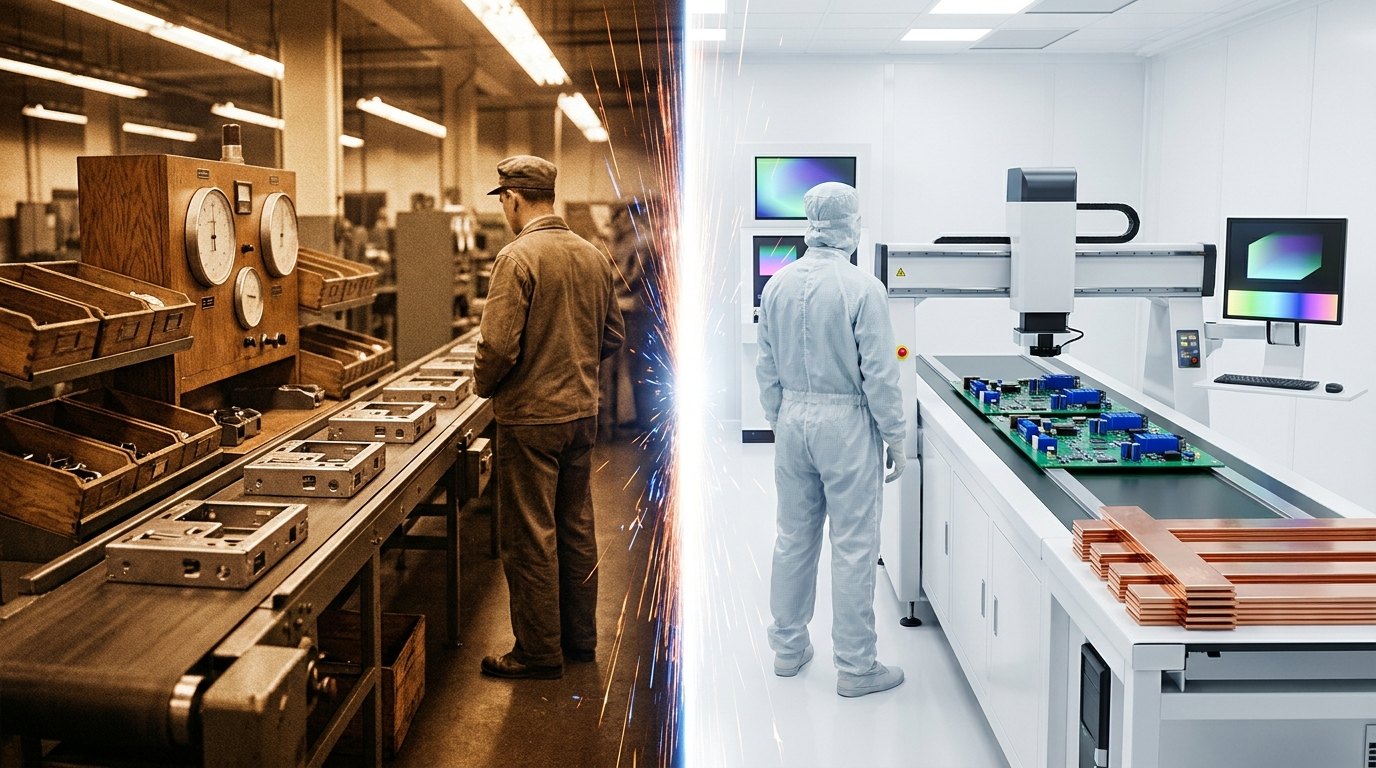
IQMP — Manufacturing Quality
Watches the assembly motion itself, continuously, instead of only checking the result.

IQMP — Supply Chain Quality
Stops a supplier's problem from becoming the customer's problem.

IQMP — Field Quality & Deployment
Closes the loop between what the factory built and how it actually behaves once it is on site.

IQMP — Data & Analytics Quality
Makes the numbers that everything else is judged by trustworthy.

IQMP — Customer Quality
Gives the customer one place to raise a quality problem, and a record of what happened next.

IQMP — Compliance & Certification
Keeps the right to ship — continuously, not at renewal.

IQMP — Corrective Action & CI
Makes sure a problem that happened once is designed out, not merely fixed.

IQMP — Technology & Integration
Wires quality into the systems people already work in, so it cannot be skipped.

IQMP — Risk & Resilience
Spends attention on the failures that have not happened yet.

Brand & Sales Content
Every document that leaves the building looks and reads as though it came from the same company.

Executive Owner Layer
Extends the owner's attention without ever spending the owner's authority.

Personal Agent Desks
The same governed pattern, pointed at one person's work.
The workforce is the product.
The same platform that runs these desks is the one we hand to customers. If you want to see what it looks like from the inside, start with the platform — or talk to us about running your own.