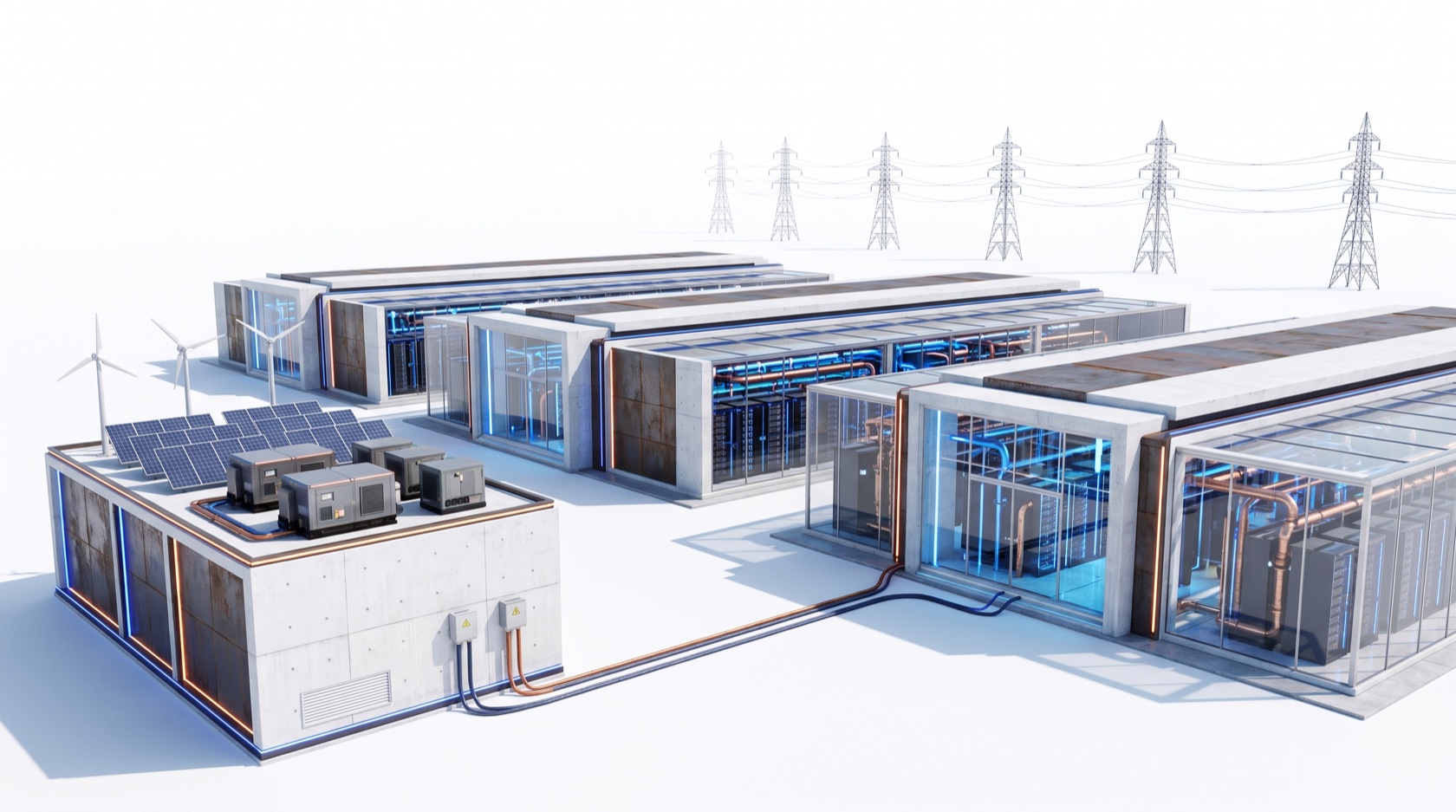
On August 17, 2026, six grid operators file the answers that will govern how every large AI campus in the United States connects to the grid for the next decade. This is the Show Cause Response deadline set by the Federal Energy Regulatory Commission on June 18, 2026 — a single 60-day window in which PJM, MISO, SPP, CAISO, ISO-NE, and NYISO must either demonstrate that their existing tariffs are just and reasonable or propose the tariff changes that fix what FERC has already found deficient (JD Supra national preview, McGuireWoods client alert). Ninety days ago, in “The Quiet Rewrite,” we called this the convergent framework and the 24-month window. August 17 is the day that framework stops being a forecast and becomes a filing.
The stakes are not academic. FERC's own language frames the orders as national industrial policy: how the transmission system is “studied, planned, expanded and operated is critical to the United States winning the AI race and onshoring manufacturing” (McGuireWoods). Chairman Swett described the six-order structure as the way to “spearhead lasting reform much more expeditiously” than a nationwide rulemaking. Read that as: the Commission decided the interconnection queue is too slow to survive the AI capex cycle, and that a nationwide notice-and-comment rulemaking is too slow to fix it. So it opened six parallel Section 206 proceedings and put every organized market on a stopwatch.
This is a field report from inside those six dockets, written for the operator, the university host, and the capital partner trying to underwrite a 2027 or 2028 energization date. Every date, every threshold, every docket below is sourced. And every one of them cuts the same way: the tariff being rewritten is the tariff the SAVRN campus never touches.
From issuance to filing: the show-cause clock
01The one-day rewrite
On June 18, 2026, FERC issued six tailored Section 206 show-cause orders — one to each FERC-jurisdictional RTO/ISO — finding the tariffs of all six “deficient in how they handle large load interconnection” (JD Supra). Each order directs the grid operator to “justify how their existing tariffs provide for the interconnection of large and co-located loads to the electric grid or to propose revisions to their tariffs” (McGuireWoods).

The six dockets are open and numbered:
| RTO / ISO | Docket |
|---|---|
| PJM | EL26-67-000 |
| SPP | EL26-68-000 |
| NYISO | EL26-69-000 |
| MISO | EL26-70-000 |
| CAISO | EL26-71-000 |
| ISO-NE | EL26-72-000 |
Each order requires each RTO/ISO to demonstrate that it already uses, or proposes to adopt, reforms in five categories (McGuireWoods, Electron Economics):
- Faster, standardized application and study processes for large loads.
- Greater transparency on network-upgrade costs and cost recovery — to keep new-load costs from shifting onto other ratepayers.
- Rates and terms for large loads served by co-located generation.
- New transmission services for flexible large loads.
- Study processes for generation serving electrically proximate load.
Read those five together. Categories three, four, and five are all describing the same architecture from three different angles: generation and load that sit on the same site, connected first to each other and second — if at all — to the transmission system. FERC did not settle who pays for the AI grid on June 18. It made every organized market design its own answer to that question in 60 days.
02Why “informational” reports were the real preview
On July 20, all six grid operators filed the Informational Reports FERC ordered as a first step. Read together, they are what one national practice team called a “rare, coast-to-coast snapshot of the regulatory landscape for data centers, AI campuses, and other large loads” (JD Supra). They also previewed the split every developer should expect on August 17.
- PJM (EL26-67): described stakeholder initiatives and accepted reforms aimed at ensuring resource adequacy for new large loads and increasing the pace of adding generating capacity. Centerpiece: the Critical Issue Fast Path for Reliability Backstop Procurement.
- SPP (EL26-68): argued its existing stack — ERAS, Provisional Load, HILLs, HILLGA, CHILLS, PDA, CPP — “collectively addresses resource adequacy for new large loads” and that “no immediate tariff overhaul is required.” All 65 Load Responsible Entities satisfy Summer 2026 resource-adequacy requirements, with an East BAA reserve margin of 17.1% and roughly 5,752 MW of excess accredited capacity.
- NYISO (EL26-69): acknowledged emerging risks from large load growth and an aging generation fleet.
- MISO (EL26-70): acknowledged that the “concentrated, fast-moving nature of new large load demand requires new tools.”
- CAISO (EL26-71): described its coordinated resource-planning framework and transmission-expansion efforts.
- ISO-NE (EL26-72): outlined existing and potential proposals to ensure adequate generation for new large loads.
The market's read is that August 17 will be “the defining moment”: some operators will file concrete tariff revisions, others will defend existing frameworks, and others will seek abeyance to make a Section 205 filing later in the fall (JD Supra). PJM has already taken the third path.
On July 28, 2026, PJM moved to hold EL26-67 in abeyance for 90 days and to file its Section 205 response by early-to-mid November 2026 (PJM, Motion for Abeyance in EL26-67). The practical meaning is direct: the largest of the six markets will not put substantive tariff revisions on the table on August 17 — it will put a schedule on the table, and the real filing lands in November. What no one disputes is that the tariff you sign in 2027 will not be the tariff on the books today.
03The PJM template: the 50 MW line and the December 18 cutoff
The clearest read on what “reform” actually means on the ground comes from PJM, which has been under a parallel FERC show-cause order for eight months already.
On December 18, 2025, FERC issued a unanimous 5-0 order finding PJM's existing tariff “unjust and unreasonable” on the basis that it “lacked consistent rules for co-located load at generating facilities” (Electron Economics). The order, cited in FERC's docket as PJM Interconnection, L.L.C., 193 FERC ¶ 61,217 (2025), directed PJM to create three new transmission service options for co-located customers — firm contract demand, non-firm contract demand, and an Interim Network Integration Transmission Service — and to fix a set of behind-the-meter generation (BTMG) netting rules that FERC concluded were shifting costs onto standard ratepayers (White & Case).
Where the 50 MW boundary bites: the co-located one-line
PJM filed compliance on January 20 and February 23, 2026 in Docket ER26-5181, and the numbers that came out of that filing now define the operator playbook across every market watching the August 17 rewrite (White & Case, POWER Magazine):
- The 50 MW line. Any BTMG configuration above 50 MW loses the right to net its self-supply against transmission charges under the old rules. Retail BTMG is capped at a cumulative nameplate rating of 50 MW or less.
- The December 18, 2025 grandfather cutoff. Facilities above 50 MW are eligible to be permanently grandfathered only if operating under a contractual arrangement in effect before December 18, 2025. PURPA Qualifying Facilities operational before that date are also exempt. Everything else, “regardless of development stage or existing term sheets, faces the new framework” (Electron Economics).
- The emergency-generation exemption. On-site backup generation is excluded from the 50 MW cumulative nameplate calculation — so a campus can maintain large diesel or natural-gas backup arrays for reliability without tripping BTMG netting restrictions, provided those units do not provide energy for standard retail netting.
- The “Necessary Studies” process. Generators serving co-located load are required to reduce their Capacity Interconnection Rights and bear all upgrade costs (POWER Magazine).
- The timing. PJM's Point of Change in Ownership definition is being litigated by Vistra and Constellation, which filed protests on March 16, 2026 arguing that transmission owners can manipulate facility boundaries to block grandfathering eligibility. An April 2026 FERC action required further revisions. The full mechanism, PJM concedes, “likely won't be active until 2027” (POWER Magazine).
A 300 MW AI campus with a 400 MW on-site gas plant is a fundamentally different asset before and after that number. After, it is transmission-charged as if the generator did not exist — and “behind the meter” as a financing construct collapses into a real-estate arbitrage that FERC has now told PJM to close.
Every developer signing a term sheet in 2026 for delivery in 2028 is signing into the new framework, not the old one. The five other RTOs are watching PJM's compliance dockets the way underwriters watch a comparable transaction. On August 17, several of them will publish their own version of the same line.
04The queue reality: PJM Cycle 1 and 200 GW of ambition
Behind the tariff rewrite is the queue rewrite. On April 27, 2026, PJM closed the application window for Cycle 1 of its reformed interconnection process. On August 3, 2026, PJM announced that 715 new generation projects, totaling 201.5 GW of nameplate capacity, had qualified to be studied in Cycle 1 out of 811 initial proposals (PJM Inside Lines). The new approach is “first-ready, first-served,” and PJM used HyperQ — an AI tool built by Google's Tapestry — to screen application data.
A load-following queue, not a decarbonization queue
Read the mix. Nearly half the queue's capacity is natural gas. A quarter is storage. Nuclear alone — 24 projects, 17.3 GW — is larger than solar. This is not a decarbonization queue. This is a load-following queue built to serve AI. And PJM has already told the market what it thinks will actually get built: since 2020, PJM has processed more than 300 GW of projects, of which about 100 GW reached signed interconnection agreements and only 51 GW is currently active. Cycle 1 study runs one-to-two years, with completion expected in 2028.
PJM expects electricity demand to increase by up to 70 GW by 2038, driven largely by data centers and other large-load customers, “outpacing the addition of new supply” (PJM Inside Lines). Utilities in the PJM footprint collectively forecast 55 GW of new large-load growth by 2030 and 100 GW by 2037 (White & Case). The queue reform is designed to close the gap. Every operator paying attention knows the arithmetic does not close.
05Batch Zero: ERCOT does the same thing, faster
Texas is not a FERC-jurisdictional RTO, so it is not one of the six show-cause dockets. It is running its own version of the rewrite on a parallel timeline. On June 18, 2026 — the same day FERC issued the six show-cause orders — the Public Utility Commission of Texas approved Planning Guide Revision Request 145 and Nodal Protocol Revision Request 1325, effective July 11, 2026 (Krishnan Rangachari, “The Data Center Reckoning”). PGRR 145 and NPRR 1325 replaced ERCOT's project-by-project Large Load Interconnection Study with “Batch Zero” — a single, system-wide study evaluating all qualifying large-load requests (75 MW and above) together.
The scale explains the process. Evaluating 438,000 MW project-by-project was, as one analyst put it, a queue “too large to be evaluated project-by-project without collapsing under its own backlog.” The Batch Zero schedule runs from mid-July 2026 technical submissions, to an August 7, 2026 inclusion notice, to full study results with year-by-year 2028–2032 capacity allocations on January 29, 2027, to binding interconnection agreements on March 1, 2027 (Krishnan).
Under Texas's SB 6 (2025), large loads such as data centers must accept curtailment during grid emergencies as a condition of interconnecting at all — the statute sets a 75 MW demand threshold and lets ERCOT direct a large load to deploy on-site backup generation or curtail (SB 6, Sec. 37.0561). ERCOT operationalizes that mandate through load elections of its own: a load that declines firm dispatch obligations (a “PCLR” election) or does not pair with onsite generation (a “WLPUN” election) is capped at a lower firm-capacity level (Krishnan). “Curtailment isn't a matter of ongoing negotiation in ERCOT's model. It's a statutory precondition.”
Same rewrite. Different acronyms. Same conclusion: the grid-tied AI campus is now a longer, harder, more expensive path.
06The PJM capacity signal
PJM's Board is not waiting for August 17 to price the shortfall. On July 27, 2026, PJM's Board of Managers proposed a package aimed at both procuring more capacity and reallocating the cost and risk of new large loads (Krishnan).
The backstop ceiling sits 68% above the last cleared price
Structurally more important than the auction: PJM's Board will direct staff to exclude incremental new large loads, relative to the 2028/29 forecast, from the demand counted in future capacity auctions — unless the large load lines up its own capacity supply. In PJM's own words, “existing consumers should not bear higher capacity costs caused by new large loads that do not bring, or otherwise contract for, the new supply necessary to serve them” (Krishnan).
On June 30, 2026, PJM's Members Committee endorsed the backstop procurement package and rejected all eleven proposed “Connect and Manage” curtailment options — none reached the required two-thirds sector-weighted threshold. Stakeholders backed a “Large Load Registry” instead, under which PJM would track large loads by site and whether they bring their own supply, and hand the data to state regulators.
The signal to any AI campus developer in PJM is unambiguous. Bring your own generation, or price yourself into the backstop.
07The reliability overlay: NERC Level 3 and the August 3 gate
Sitting on top of the market-design fight is a reliability-standards fight the market is only starting to price. On May 4, 2026, following a Board of Trustees vote on April 16, the North American Electric Reliability Corporation issued a Level 3 Essential Action Alert titled Computational Load Modeling, Studies, Instrumentation, Commissioning, Operations, Protection, and Control (NERC, Renewable Energy World). The alert names seven Essential Actions for Transmission Planners, Planning Coordinators, Transmission Owners, Balancing Authorities, Reliability Coordinators, and Transmission Operators — from annual stability-margin studies in areas with computational load, to a formal commissioning process, to dynamic fault-recording instrumentation, to interpersonal-communication capability between operators and each large load.
Acknowledgment was due May 11, 2026. Formal responses were due by midnight Eastern on August 3, 2026 through the NERC Alert System (ERCOT LLWG briefing). NERC has stated its intent to file revised registration criteria and Reliability Standards for large loads on or before December 31, 2026 (NERC filing in RM26-4).
Two operator-facing implications matter. First, commissioning any large AI facility from 2026 forward will land inside a formal computational-load process that did not exist twelve months ago — TO-authored, TP/PC-studied, and dynamic-fault-recorder instrumented. Second, the underlying finding of NERC's March 2026 white paper is that existing NERC Reliability Standards, industry processes, and requirements are “inadequate for the reliable integration of emerging large loads, including computational loads, onto the BPS” (NERC Large Loads FAQ). Mandatory Reliability Standards updates are landing by year-end.
August 17 sets the market design. August 3 already set the reliability floor. Both point at the same architecture.
08What the six-order stack means for the operator
Read all of it together — Section 206 orders in EL26-67 through EL26-72, the December 18 PJM order, Cycle 1's 715 projects and 201.5 GW, ERCOT's Batch Zero and 438,000 MW of queued load, the July 27 PJM capacity package, and the NERC Level 3 alert — and the signal is coherent.
- Every market is pricing new large load as a source of cost causation.
- Every market is moving to require that large loads bring, or contract for, the supply that serves them.
- Every market is compressing the interconnection study window while raising the technical bar to enter it.
- Every market is codifying curtailment obligations — through tariff (PJM), statute (ERCOT SB 6), or reliability standard (NERC's coming December 31 filing).
- Every market is doing this while the queue-to-signed-agreement ratio, on PJM's own data, is roughly 33%.
The grid-tied AI factory business case now runs through five gates that did not exist as codified filings 18 months ago. Each gate is a source of delay, cost, and cost-shift risk. Each is being priced into the underwriting of every 2027, 2028, and 2029 energization.
What the grid-tied campus must clear — and what a SAVRN campus does instead
| The gate | Grid-tied AI campus | SAVRN off-grid campus |
|---|---|---|
| Section 206 tariff Aug 17 | Files into a transmission-service tariff being rewritten in real time. | Takes no transmission service to power compute. A landlord's problem, not a tenant's. |
| BTMG netting rule 50 MW / Dec 18 | Above 50 MW, netted as if the generator did not exist. | Does not net; does not draw. Carve-outs are not the design margin. |
| Interconnection cycle Cycle 1 / Batch Zero | Waits in a one-to-two-year queue; ~33% reach signed agreements. | Enters no queue. Generation and load are behind the same fence. |
| Reliability commissioning NERC Level 3 | New TO-authored computational-load process; standards by year-end. | Compute behind a private, closed-loop system. A small, controllable BPS interface. |
| Capacity cost allocation Backstop / Registry | Cost allocated to loads that don't bring their own supply. | Brings its own supply as the entire premise. |
09The SAVRN answer
SAVRN is the operator of an off-grid sovereign AI infrastructure campus model — owned power generation, owned compute, closed-loop liquid cooling — deployed in 6 to 12 months versus the 24-to-48-month industry standard. The campus is designed to island from the grid on day one. The transmission service is not undersized; it is not part of the design.
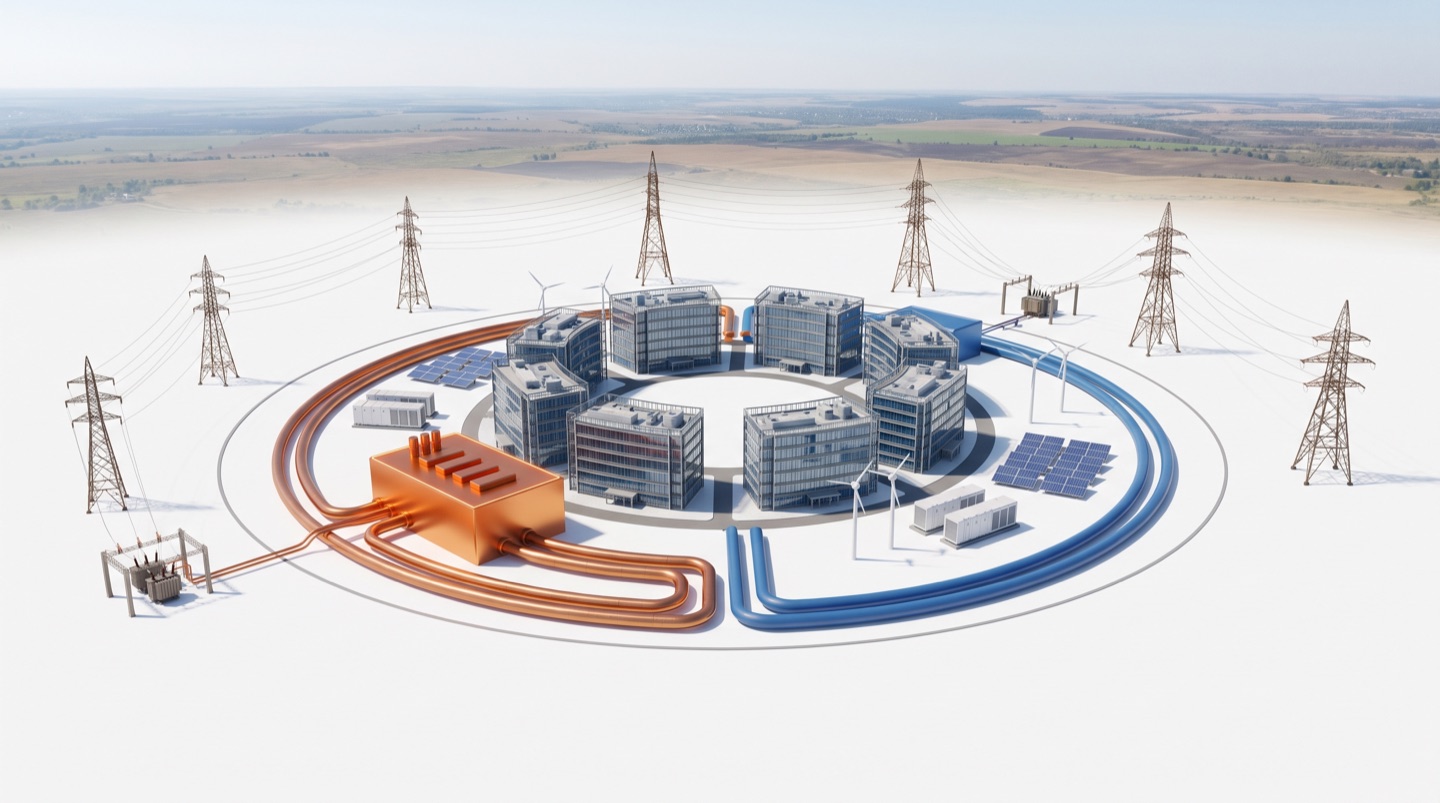
The industry timeline the July 20 informational reports described — Section 206 tariff filings August 17, protests through September, compliance orders through fall, “and eventually interconnection-study and financing consequences” (Electron Economics) — is a two-to-four-year path to a codified answer. SAVRN campuses are being energized inside that window.
The reason a SAVRN campus is fast is the same reason it is a good neighbor: we own the power. Because we generate on site, we skip the queue — and because we skip the queue by islanding from the grid, we never draw the town's capacity to do it.
The town's grid, its rates, and its queue position are untouched by our arrival. The tariff being rewritten is the tariff we never touch. On August 17, six grid operators file the answer to a question SAVRN campuses are architected not to ask.