
The Two Most Valuable Assetsin the AI Race Are Not What You Think
After building large infrastructure across North America, the founder of SAVRN makes a falsifiable case: every input in the AI stack — models, compute, energy, land, hardware — is a commodity on a measurable clock. Only two things compound, and they turn out to be one.
 Chad Everett HarrisFounder, SAVRN
I take all the parts and I spread them out on a table, and I look at them. Power. Land. Cooling. Racks. Interconnect. Backup batteries. Manufacturing. Infrastructure. IT hardware. Fiber and fiber connections. Language models. And then I put them back together in a unique environment, and what comes out is a first-of-its-kind.
After developing large infrastructure across North America, I will be the first one to tell you: everything I worked on and built is a commodity. I am not being modest, and I am not being contrarian for sport. I am describing exactly what I see.
Here is the thesis. In the AI race, there are only two assets that produce durable advantage: proprietary data and critical thinking. Not the model. Not the energy. Not the real estate. Not the hardware. Everything else on that list is a commodity — an input that anyone with capital can acquire on roughly the same terms, at a price that is falling or a scarcity that is universal.
That claim sounds like a slogan. It is not. It is falsifiable, and most of it has already been tested. What follows is the evidence, including the places where the evidence cuts against me.
The reaction is the same every time. Half the room decides I have lost my mind. A man who spent a career building physical infrastructure, now calling all of it a commodity — either false modesty or a quiet breakdown. The other half decides the opposite. Both are reacting to the same sentence, and the gap between the two reactions is the point. An argument everyone nods along to changes nothing; it was already priced in. This one is not.
So I will state it strongly. Not to provoke — provocation is cheap. But the claim is either true or it is not, and softening it to keep the room comfortable only hides which. If it does not make a serious operator briefly angry, I have not said it clearly enough.
The clock on every layer
Commoditization is not a mood. It has a measurable rate. For each layer of the AI stack, you can ask a specific question: how long does an advantage at this layer survive before a competitor with money can buy the same thing? Call it the half-life.
Model capability has a half-life measured in months. Epoch AI tracks the gap between the best closed model and the best open-weight model continuously. In their original 2024 assessment, the best open models trailed the best closed models by roughly a year, with a 90% confidence interval of 5 to 22 months, and about 15 months on training compute. By their May 2026 update, the average gap had compressed to about 4 months, or 8 points on their Epoch Capabilities Index — which they note is comparable to the gap between two successive releases from the same closed lab. The entire open-versus-closed distinction is now roughly the size of one product cycle at a single company.12
Stanford's AI Index reaches the same place from a different angle. As of March 2026, the top four models sat within less than 25 Arena points of each other, down from 97 points a year earlier. The top US model led the top Chinese model by 2.7%.3
I want to be honest about one wrinkle, because a serious reader will find it. The same Stanford data shows the specific closed-to-open gap widened from 0.5% in August 2024 to 3.3% in March 2026. So the correct claim is not "the gap shrinks every quarter." The correct claim is that the gap is small and bounded — single-digit percentage points, or a few months — and it has been for years. Bounded is enough. A four-month lead is not a moat. It is a product cycle.3
A four-month lead is not a moat. It is a product cycle.
Inference price has a half-life measured in weeks. This is the most brutally documented number in the entire industry. a16z measured the cheapest model capable of hitting a fixed MMLU score of 42 — GPT-3's original level — and found it fell from $60 per million tokens in November 2021 to $0.06 by November 2024, a 1,000x decline in three years. They put the ongoing rate at roughly 10x per year for equivalent performance, and noted it is faster than compute cost declines during the PC revolution or bandwidth declines during the dotcom buildout.4
Epoch AI's independent analysis across six benchmarks found rates of decline for a fixed capability threshold ranging from 9x to 900x per year, with a median around 50x. Restricting to data since January 2024, the median accelerated to roughly 200x per year. Their anchor data points are concrete: GPT-3.5-level performance on MMLU cost $20.00 per million tokens in November 2022 and $0.07 by October 2024. On GPQA Diamond, GPT-4-0314's score of 33.0 cost $37.50 per million in March 2023; by December 2024, Phi-4 beat that score at $0.12.5
Look at what that chart actually says, because it is subtler than "AI is getting cheap." The frontier does not get cheaper. What collapses is the price of last year's frontier. Every capability you have today will be free to your competitors inside of two years. That is not a prediction. It has happened three times in a row.
Read each bar as one capability tier: what a frontier model cost when it first hit that score, and what the cheaper model that matched it cost a year or two later. GPT-4’s March-2023 score was matched by Phi-4 in December 2024 at $0.12 — a ~310× drop. The frontier never gets cheaper; last year’s frontier does.45
Compute has a half-life of roughly one generation. Here I have to be precise, because the naive version of this claim is wrong and will get you dismissed. H100 rental prices did collapse. They launched around $4.70 an hour in early 2023 and spiked above $8 during the shortage. By mid-2026 they had fallen to a median near $3 an hour across a basket of providers, with peer-to-peer marketplaces as low as $1.49. AWS cut P5 on-demand pricing 44% in June 2025. Neocloud economics look like a commodity business: McKinsey put GPU-rental gross margins, after labor, power, and depreciation, at 14–16% — lower than most retailers.6
But committed contract pricing moved the other direction. SemiAnalysis found one-year H100 contract rates rose about 40%, from $1.70 per GPU-hour in October 2025 to $2.35 by March 2026, because on-demand capacity sold out and holders stopped releasing it. And the newest silicon is genuinely scarce: TSMC's CoWoS advanced packaging capacity has been sold out through 2025 and into 2026, with NVIDIA holding an estimated 50–60% of global CoWoS capacity for 2026–2027. SK Hynix's CFO said the company had "already sold out our entire 2026 HBM supply." Micron said the same for 2025 and 2026.78
So the honest statement is not "compute is a commodity." It is: each generation of compute commoditizes on a roughly 12-to-18-month clock, and the newest generation is never commoditized. Which is the same clock as model capability. That is not a coincidence, and I will come back to why.
Every layer with a queryable or purchasable interface commoditizes on a clock you can measure. Only the newest silicon resists — and only until the next generation ships.1236789
None of these is a business. They are all rent.
The energy objection, which is the only one that matters
If you are going to attack this thesis, attack it here. I know that, because I build here.
The counter-evidence is real and I am not going to soften it. Lawrence Berkeley National Lab's interconnection queue data shows the median time from interconnection request to commercial operation for projects completing in 2025 was about 61 months — up from 36 months in 2015 and 22 months in 2008. Active queue volume stood at 2,061 GW at year-end 2025. Of all capacity that entered queues between 2000 and 2020, only 13% reached commercial operation while 75.7% withdrew.1011
Data center real estate is tighter. CBRE reported Northern Virginia vacancy at 0.3%, Atlanta at 1.0%, Dallas-Fort Worth at 1.8%, Chicago at 2.2% as of Q1 2026 — all-time lows despite a 33% year-over-year inventory increase. National vacancy hit 1.4% amid a 36% supply increase. JLL found North American vacancy holding at a record-low 1% with 92% of under-construction capacity precommitted. EPRI projects US data centers reaching 9% to 17% of total US electricity by 2030, up from 4–5% today. The IEA projects global data center consumption more than doubling to roughly 945 TWh by 2030.1213141516
Every one of those numbers says power is scarce. And I am telling you power is a commodity. Both are true, and the reason both are true is that people confuse scarcity with advantage.
Oil is the most traded commodity on earth. It is also finite, geographically concentrated, and expensive. Scarcity is not what makes something a commodity. Fungibility is. A commodity is an input that is undifferentiated at the point of delivery and clears at a market price. By that definition electricity is the purest commodity in the entire AI stack. An electron from a fuel cell is indistinguishable from an electron off a combined-cycle plant. Nobody has ever bought a differentiated megawatt.
Now read the LBNL numbers again with that lens. There are 2,061 gigawatts standing in the same line. Three-quarters of the projects that enter that line withdraw. Everyone in the queue has capital. Everyone in the queue has lawyers. Everyone in the queue is getting the same 61-month answer. If power were a source of competitive advantage, money would convert into power and the well-capitalized would separate from the rest. Instead the well-capitalized are standing in line with everyone else, and 0.3% vacancy in Northern Virginia means that everyone with a checkbook is trying and failing simultaneously. A constraint that binds every participant identically is the definition of a commodity input, not a differentiator.

A constraint that binds every participant on the same terms cannot separate the well-capitalized from the rest. The advantage is never the megawatt; it is how the route to it was structured.10111213141516
Here is where the advantage actually sits, and I say this from having done it: two developers with identical balance sheets and identical sites get radically different outcomes based entirely on how they structured the approach. Behind-the-meter versus front-of-meter. A brownfield with existing interconnection rights versus a greenfield entering the queue at position 400. Bridge generation while you wait. Fuel cells at the pad. Load flexibility as a negotiating asset with the utility. Curtailment economics. Whether you bought the transformer eighteen months before you needed it.
None of those are assets. Every one of them is a judgment call made before any capital was committed. The scarcity of power does not refute my thesis. It is the cleanest demonstration of it I have. The commodity is priced identically for everyone; the route to it is priced by how well you think.
One test explains the whole stack
Once you have the half-life table, the obvious question is why the numbers cluster the way they do. Why is it four months for models and twelve to eighteen for compute and three to six for wrappers? What determines the clock?
The answer is a single question: can it be copied without the owner's participation?
Compute can be rented. Energy can be purchased. Land can be bought. Models are the interesting case, because until recently people assumed a frontier model was protected by the billions spent training it. It is not. It is protected by nothing, because a model that answers questions through an API will answer enough questions to teach a competitor how to be it.
That mechanism is called distillation and it is now documented at scale. Anthropic's technical disclosure named DeepSeek, Moonshot AI, and MiniMax and quantified the activity at roughly 24,000 fraudulent accounts generating more than 16 million exchanges, targeting reasoning, coding, and agentic capabilities specifically. OpenAI formally told the House Select Committee on China it had evidence DeepSeek used "unfair and increasingly sophisticated methods to extract results from leading US AI models" including obfuscated third-party routers to conceal query origins.18
The cost of doing this is not meaningful. Dropbox's engineering team demonstrated logits distillation on small models using about 35,000 samples at a cost of $3.50 to $18 per model, gaining 4% to nearly 14% on benchmarks. Academic work on distillation from frontier open models found that synthetic data during distillation lets 8B and 70B models match or surpass the zero-shot accuracy of a 405B model on some datasets with standard fine-tuning.1920
As one legal analysis of the trade-secret dimension put it: "the distiller does not need to steal weights or breach servers. Access to the teacher model's API is sufficient."17
That is the whole engine of commoditization in this industry. Anything with a queryable interface teaches its replacement. Which means the test for whether an asset is durable is not how much it cost, or how scarce it is, or how hard it was to build. The test is whether it can be extracted by someone who never had access to it.
Anything with a queryable interface teaches its replacement.
Two things pass that test.
Asset one: proprietary data, but not the kind on your balance sheet
I need to kill something first, because the naive version of "data is the moat" is wrong, and if you build a strategy on it you will lose.
The formal economics say data volume alone does not produce durability. Hagiu and Wright modeled data-enabled learning and found that with the S-shaped learning curves that are typical — little value from initial data, then rapid gains, then saturation — moving both firms toward maximum learning decreases the incumbent's competitive advantage. An entrant with strictly less data can win if its learning curve is steeper or reaches a higher ceiling. Their conclusion is blunt: "with asymmetric learning curves, increasing dominance does not necessarily hold in our setting."21
The practitioner critique is harsher and more specific. Casado and Lauten at a16z pointed out that most claimed data network effects are merely scale effects. Data, they argue, inverts the usual economics: “the cost of adding unique data to your corpus may actually go up, while the value of incremental data goes down”. Their concrete example comes from work on support chatbots: the coverage curve asymptotes around 40% of query intents — after which “there is actually no advantage to collecting more data at all.” That is a single-domain study and should not be treated as a general law, but the direction is right. They also describe a startup with a handful of engineers that used synthetic data to beat two incumbents whose corpora had been collected over decades — because the legacy data was not suited to the actual problem.22
If you own a large lake of data because your company is old, you do not have a moat. You have storage costs.
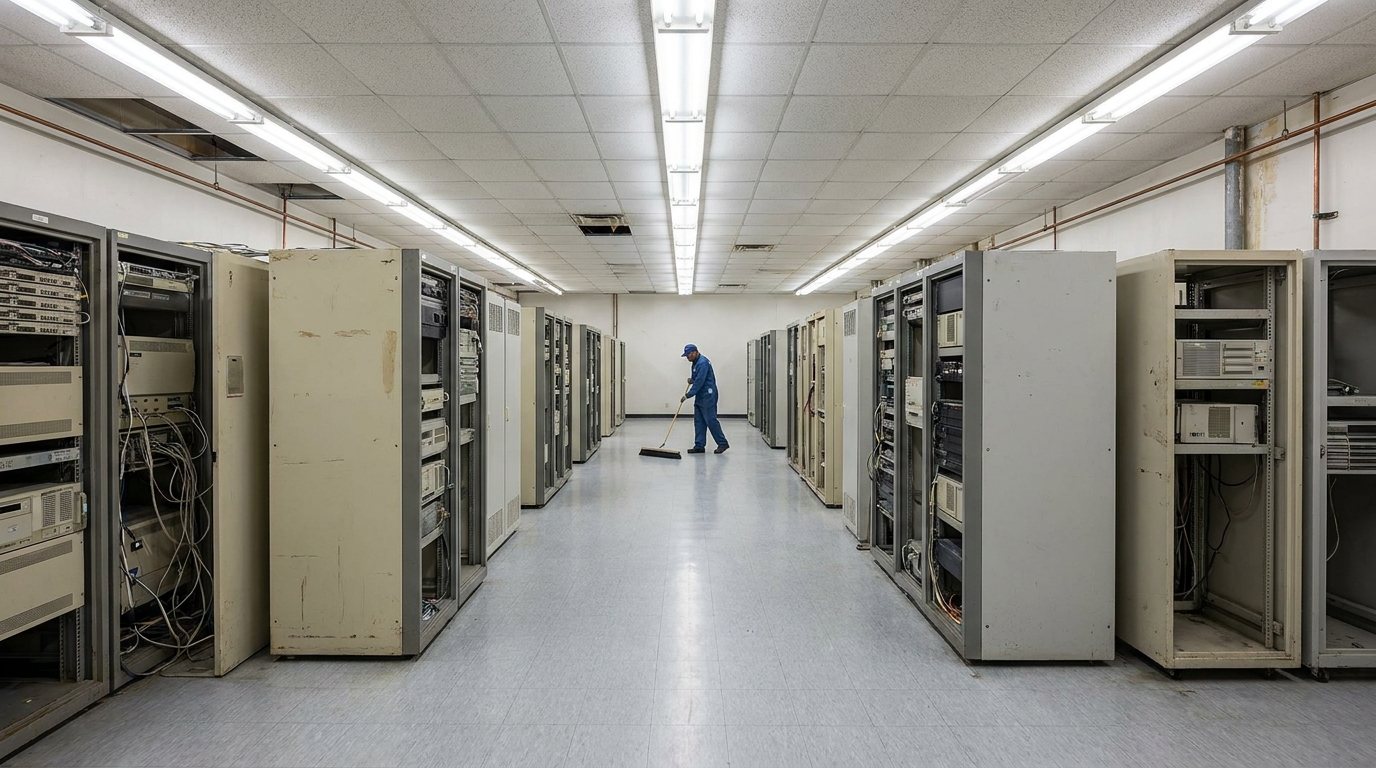
Decades of accumulated records look like an advantage and behave like overhead. Age is not exclusivity; volume is not gatedness. What competitors can structurally replicate — or simply outgrow with cleaner, better-fitted data — was never a moat to begin with.
What actually passes the test is narrower and better. Four conditions, each of which is in the evidence:
It has to be structurally exclusive. The a16z piece concedes the exception and names it: Equifax, LexisNexis, Experian have dominated for decades because of exclusive access to sources competitors structurally cannot replicate. Not large data. Gated data.22
It has to be legitimately acquired. This used to be a compliance footnote. It is now a nine-figure line item. A federal judge approved Anthropic's $1.5 billion settlement covering roughly 500,000 works at approximately $3,000 per book — the largest known settlement of a US copyright case. And the legal nuance matters enormously: Judge Alsup's underlying ruling held that AI training itself can be transformative fair use, but distinguished that from how the copies were acquired, ruling that training on pirated data is not protected the same way. The moat is not who has the data. It is who can prove they acquired it cleanly. That asymmetry did not exist three years ago.2324
It has to be continuously refreshed. Static corpora decay. Frontier labs are paying real money for ongoing access, not archives. Reddit's own IPO prospectus disclosed data licensing arrangements with an aggregate contract value of $203.0 million over two-to-three-year terms, of which the Google deal was reported at roughly $60 million annually. News Corp's OpenAI deal was widely reported at over $250 million over five years, though neither party confirmed the figure. These are the best-capitalized, most sophisticated buyers in the market, with every incentive to determine whether they actually need a given source, voluntarily paying for it. That is revealed preference.252627
I will note the honest caveat: those deals are tens to hundreds of millions against frontier training budgets in the tens of billions. The labs are treating licensed data as a complement and a litigation hedge, not as their binding constraint. Anyone who tells you data licensing is where the value is concentrated is reading the deal sizes wrong.
And it has to never be exposed through a queryable interface. This is the condition that ties back to distillation, and it is the one almost nobody states explicitly. Distillation attacks a model's learned capability, not the corpus underneath it. If your proprietary data sits behind an API that generates responses derived from it, you are teaching your replacement. If it sits in transaction logs, sensor histories, operating telemetry, and outcome records that no external party can query, it cannot be distilled — because no other model has ever seen it, and none can.
There is a second-order effect here that I find genuinely underrated. Shumailov and colleagues showed in Nature that training on recursively generated content causes irreversible degradation as distribution tails vanish — model collapse — and they proved divergence mathematically for the Gaussian case. Their conclusion is the sentence that matters most for this argument: "the value of data collected about genuine human interactions with systems will be increasingly valuable in the presence of LLM-generated content in data crawled from the Internet".28
Read that as an asset thesis. As synthetic content floods the public web, the relative scarcity value of genuine human-generated data rises. Not because there is less of it, but because everything around it is getting contaminated. The result is contested in its mechanism — Borji argued it may be a general statistical artifact of repeated resampling — and practitioners note collapse is largely avoidable with real-data mixing, diverse teachers, and quality filters. But the asymmetry stands: your operating data is clean and the commons is not.29
Asset two: critical thinking, and one specific part of it
Now the half nobody can buy.
Start with the well-known result, because it points the wrong direction and I want to deal with it head on. Brynjolfsson, Li and Raymond studied 5,172 customer support agents across 3,006,395 chats with a staggered rollout, published in the Quarterly Journal of Economics. AI assistance raised productivity 15% on average, 34% for novices and least-experienced workers, while the most experienced workers saw small speed gains and small quality declines.30
That study is usually cited as evidence that AI compresses skill differences. On that task, it does. If your work is well-specified execution, the machine will hand your least capable people most of your best people's playbook, and your advantage in having good people evaporates.
Then look at what happens when the task is not execution.
Shin, Polyanskaya, Lucero and Oulasvirta at Aalto ran the experiment I would have designed if I had thought of it. They recruited 456 people, analyzed 280, gave them GPT-4o, and tested four conditions: reframing manually, building on LLM-generated frames, free-form conversation, and a structured nine-step process built on the leading academic method for problem reframing. Fifteen expert evaluators scored the resulting frames. The study was powered at 95% to detect a medium effect.31
The finding: "using LLMs in problem reframing does not aid designers in generating more novel or useful problem frames." No statistically significant quality difference with or without the model. Their conclusion — "there is no benefit to using LLMs in problem reframing."
And then the part that should reorganize how you think about hiring. The tool did not merely fail to help. It widened the gap: experts generated 12.54% more novel LLM-conditioned frames than novices, and perceived 15.69% more agency. The authors flag it as a risk: "increasing the gap between the designers with more and less competence in problem reframing."
Put the two studies side by side. Same technology. Opposite direction.
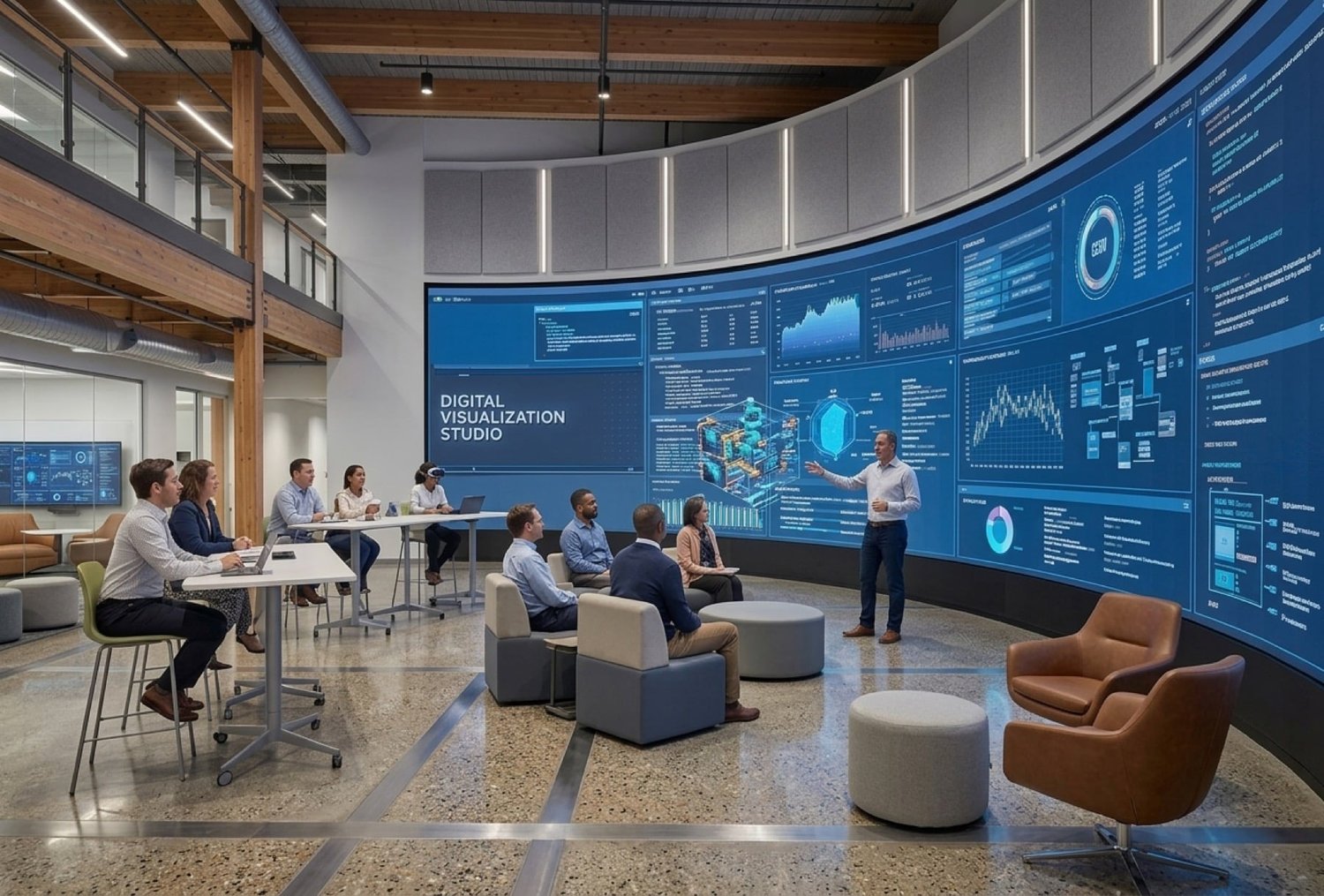
Same tool, opposite direction. On well-specified execution the machine hands your least-capable people your best people’s playbook — the gap closes. On framing an ill-defined problem the expert pulls further ahead — the gap widens. Every dollar spent automating execution lowers the strategic value of your operators; every hour spent improving how they define problems raises it.3031
That is the whole thesis in two rows. AI compresses advantage on execution and amplifies it on framing. Which means every dollar you spend automating execution reduces the strategic value of your operators, and every hour you spend improving how your people define problems increases it.
This is consistent with broader findings. Huang, Jin and Li ran two randomized experiments and concluded generative AI "enhances general human capital (cognitive abilities and education) while diminishing the value of domain-specific expertise", shifting the locus of creative advantage from specialized expertise toward broader cognitive adaptability. And there is a useful precedent from a domain where proprietary data is the ultimate advantage: the Good Judgment Project's superforecasters, working from open sources, outperformed intelligence analysts with access to classified material by more than 30%. Judgment beat exclusive data. That should temper anyone — including me — who wants to treat proprietary data as the senior asset.3233
What framing actually looks like
I want to be concrete about the specific cognitive act I am pointing at, because "critical thinking" is the vaguest phrase in business and I do not want to hide behind it.
The process itself is not exotic. Understand what the problem is. Decide what approach to take. Define what the outcome should be. Execute. Pólya wrote those same four steps in How to Solve It back in 1945 — understand the problem, devise a plan, carry out the plan, look back. They are the same steps in every domain, which is exactly why AI is so useful now: the model supplies the domain content I do not have, and the process is something I already own.34
But the payoff is not spread evenly across those four steps. Almost all of it is in the first one, and specifically in an act that has a name.
Donald Schön called it generative metaphor. In the 1960s at Arthur D. Little, researchers were stuck on why a new synthetic-bristle paintbrush applied paint unevenly. Someone said: a paintbrush is a kind of pump. That is a category error. It is also what produced new bristle designs that bent the right way, because everything the team knew about pumps became available for thinking about brushes. Schön's precise point was that metaphor is a tool for problem setting, not problem solving.35
Kees Dorst formalized what separates a real frame from a slogan. A frame, he argues, is not a metaphor but a complex set of statements: a specific perception of the situation, a working principle that underpins a solution, and a thesis. The thesis: if we view the situation this way and adopt that working principle, then we create the value we are after. He identifies framing as the one step particular to design practice when both the what and the how are unknown.36
What I am describing is a discipline, not a talent, and the distinction is the whole reason it is worth writing down. Talent cannot be hired at scale; discipline can. The discipline has three moves and every one of them is uncomfortable. First, you refuse the problem in the words it arrived in — not because those words are wrong, but because they smuggle in a solution. “Build a gigawatt” already contains the answer “a gigawatt”; the moment you accept the noun you have accepted the building. Second, you go looking, on purpose, for a category the problem does not obviously belong to — because the obvious category is where everyone else is already standing, and it has been picked clean. Third, you follow the wrong category all the way down to a concrete specification and find out whether it holds. Most of the time it does not. That high failure rate is not a defect in the method. It is the reason the method produces anything at all, because a move that worked reliably would already be everyone’s move.
So let me work an actual one, the problem I sit down in front of every day. I am going to show the reasoning rather than the conclusion, because the conclusion is mine and the reasoning is the part that transfers.
The problem as it was handed to me
Build a gigawatt. Fill it with AI compute. Sell the compute. That is the frame the entire industry is operating inside, and it is the frame I started inside too. It is also broken in three places, and every one of the three is documented.
The building outlives its own specification. A hyperscale or AI-focused campus takes roughly 24 to 36 months from groundbreaking to ready-for-service. The critical path is not the building. It is medium-voltage switchgear at 40 to 60 week lead times, and power transformers at 50 to 80 weeks. Now put that construction clock next to the hardware clock. A dense Hopper-era rack drew about 40 kW. GB200 NVL72 draws roughly 120 kW nominal and 130 to 132 kW observed at full load. GB300 lands around 135 to 142 kW. And NVIDIA has already published where it goes next: Kyber racks housing 576 Rubin Ultra GPUs at 600 kW to over 1 MW, arriving in 2027.373839
That is a five-to-eight-fold increase in per-rack power inside a single construction cycle. And it is not only a quantity change — the power architecture itself is being replaced underneath you. NVIDIA is moving the industry off 415 and 480 VAC three-phase distribution to 800 VDC, converting 13.8 kV grid power directly to 800 VDC at the perimeter. It states plainly that full-scale production of 800 VDC data centers will coincide with Kyber rack-scale systems in 2027, supporting racks from 100 kW to over 1 MW on the same facility infrastructure. Schneider Electric's engineers put the reason bluntly: due to the laws of physics, 800 VDC is necessary for single racks from 400 kW up to 1 MW. At 54 V, feeding a one-megawatt rack would require something on the order of 200 kilograms of copper busbar for a single cabinet. The Open Compute Project has already published the specification — Diablo 400, defining a disaggregated sidecar power rack delivering ±400 VDC with a scaling path from 100 kW to 1 MW per IT rack on a single architecture.404142
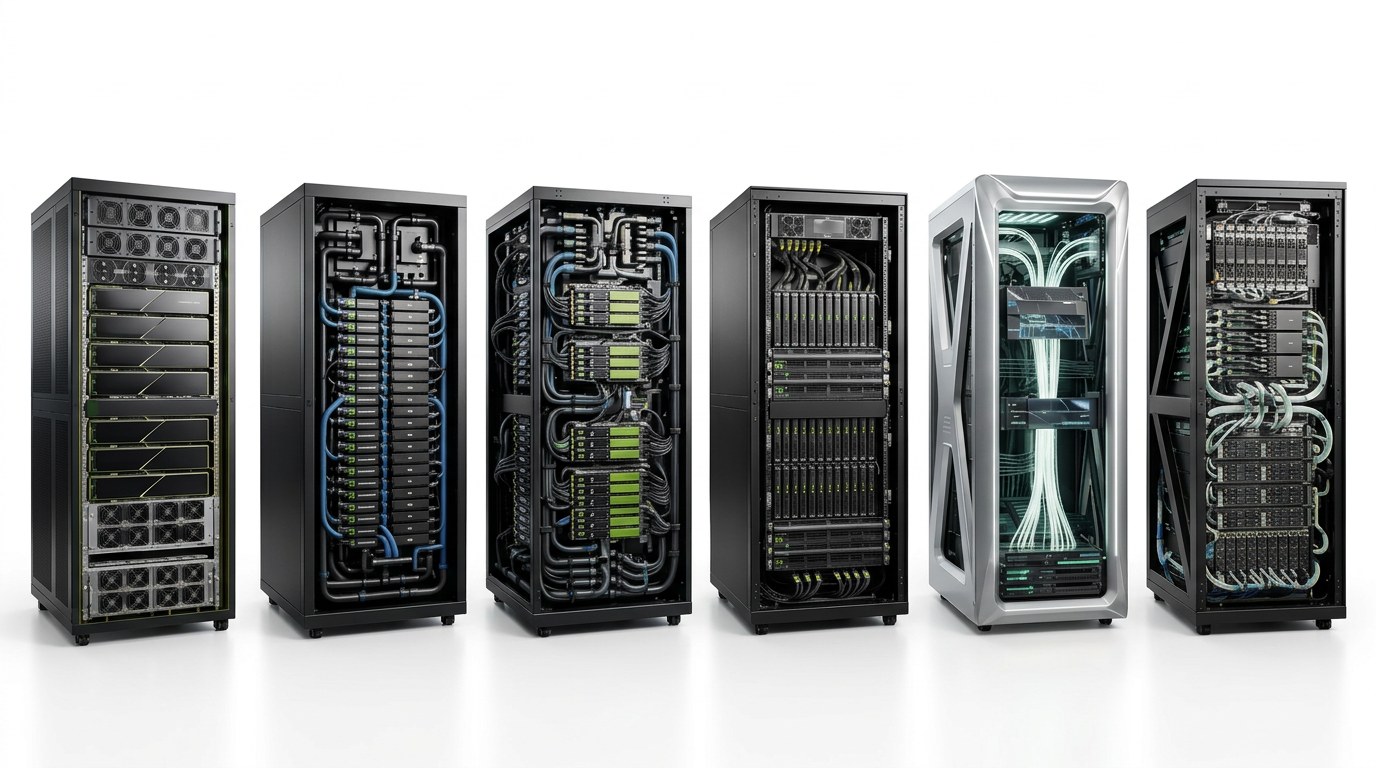
The same footprint, redrawn by physics: Hopper → Blackwell (GB200, then GB300) → Vera Rubin → Kyber, with Feynman and its Rosa CPU as one 2028 generation moving to silicon photonics. Vera Rubin's 190–230 kW is a power mode (Max Q / Max P) on identical hardware, not two products; Kyber's rack count and its 2027 date are contested — SemiAnalysis reports a slip to 2028, NVIDIA says its roadmap is intact; and no Feynman hardware has been shown publicly. The critical path is medium-voltage switchgear at 40–60 week lead times and transformers at 50–80 weeks, specified in month four of a 36-month build.373839404142 Illustrative render; official product images © NVIDIA.
So here is the question that decides whether a gigawatt is an asset or a liability. It gets answered in month four of a thirty-six-month build, usually by someone who was not asked to think about 2029. Are you specifying 800 VDC or 415 VAC? What is your bus voltage? Is your rack ceiling 150 kW — or did you build the thermal and electrical envelope for what is publicly scheduled to arrive the year you open?
Get that wrong and you have not made an engineering error. You have stranded the asset. One industry analysis documents a four-year-old, OCP-grade facility running an efficient 1.15 PUE — a good building by the standards it was designed to. It was structurally disqualified the moment a customer asked for 40 to 50 kW per rack, with retrofit costs running to nine figures and negative ROI. Retrofitting for liquid cooling runs roughly $50,000 to $100,000 per rack and gets you to 40 to 70 kW — short of where a single Blackwell rack already sits. Above that, adding the plumbing, manifolds, and floor loading amounts to reconstruction rather than upgrade.43
Nobody in that story lacked capital, hardware access, or engineering talent. They defined the problem as "build a data center" when the problem was "build a power and thermal envelope that survives three GPU generations."
The demand side moves too. If you underwrite a gigawatt on the assumption that demand for premium frontier tokens grows monotonically at premium prices, read what happened in the last ninety days. Bloomberg reported the end of “tokenmaxxing” — the belief that the answer to every problem is more AI. In a survey of 300 executives, 68% said they overspent their AI budget over the past year. Uber capped employee AI spending at $1,500 a month; Tesla reportedly at $200 a week. UBS analysts talked to about a dozen enterprise IT executives and found roughly 60% of enterprises throttling AI spend — through token pooling, model downgrading, and per-user limits. Their conclusion: “token spend optimization has become a key issue in most organizations.”4445
And then the single most instructive data point in the industry right now. Microsoft is the largest customer of both American frontier labs and OpenAI's largest backer. It is reportedly evaluating Moonshot AI's Kimi K3, a Chinese open-weight model, to run Copilot features currently handled by OpenAI and Anthropic. The reported savings: up to 60% per token — roughly $600 million on every $1 billion of inference spend. Microsoft has confirmed neither the figure nor which features, and it is an evaluation rather than a deployment. But the signal does not depend on the outcome. GitHub Copilot made Kimi K2.7 Code generally available in its model picker on July 1, and added Grok 4.5 on July 28. The most sophisticated buyer on earth is pricing the alternative and building the switch.4647
Read that as an infrastructure operator rather than a technologist. Your revenue model is exposed to a routing decision made by somebody else's procurement team. The tokens still get bought. But which tier of model serves them, at what price, on whose silicon, is now a live variable — and it moves faster than your switchgear lead time.
And the money is unforgiving. Global data center construction cost per megawatt rose from $7.7 million in 2020 to $10.7 million in 2025, with $11.3 million forecast for 2026. A gigawatt is roughly $11 billion of construction before a single GPU is racked — while you stand in that same 61-month interconnection line.48
The reframe
Three problems, all real, all documented, none of which is solved by more capital or better hardware. So I stopped asking how to build a gigawatt and asked what the gigawatt was pretending to solve.
The move that unlocked it was a category error, made deliberately. In my world there are two kinds of things: building materials and financial instruments. Concrete, copper, switchgear, chillers go in one bucket. Tax credits, incentives, abatements go in another, handled by different people, in a different document, at a different stage. So I put them in the same bucket. Treat the incentive as a building material.
That is not a metaphor for a pitch deck. It is a wrong statement that generates a correct design, exactly the way calling a paintbrush a pump generated better bristles. If a credit is a building material, then the question stops being "what incentives can we capture on this project" and becomes "what building can be assembled primarily out of incentives" — and that reverses the entire design direction. You are no longer designing a facility and then financing it. You are letting the available incentive structure specify the facility.
Follow that all the way down and you get something with a shape I did not anticipate when I started. State it in Dorst's IF-THEN form, because that is what makes it a frame and not a slogan:
IF a compute facility is viewed not as an industrial load a community has to absorb, but as a piece of civic infrastructure that happens to sell compute. AND its working principle is to draw nothing contested from its host — no water, no local grid power, minimal footprint. THEN three things follow. The incentive stack becomes the construction budget. The permitting posture inverts from adversarial to invited. And community integration stops being a concession and becomes the product.
That is Sovereign. It generates its own power. It uses no water. The footprint is small enough to site where a gigawatt campus cannot go. And the same envelope that houses the compute houses a learning center — community space, training classes, and direct integration with the community colleges and universities in its area. The incentives and credits fund the facility and the compute. The compute is what gets sold.

The incentive stack becomes the construction budget; the permitting posture inverts from adversarial to invited; and the community learning center stops being a concession and becomes the product.
Sit with what that inversion actually does, because it is easy to read as a marketing story and it is not one. When you design a facility and then finance it, the incentive is a discount applied at the end: you build the thing you were always going to build, and the credits make it cheaper. The building is the noun; the incentive is an adjective. When you let the incentive structure specify the facility, the grammar flips — the credit becomes the noun and the building becomes whatever you assemble to earn it. Those two sentences produce physically different buildings. One is a gigawatt campus with a tax appendix. The other is a small, water-free, grid-light unit. It exists in the shape the statute rewards — sited where the statute wants it, wired to the community the statute is trying to serve. Every one of those features is now a line in the construction budget rather than a cost set against it.
The “draw nothing contested” principle is the load-bearing part, and it is worth being precise about why. Every fight a compute facility has with its host is a fight over a shared resource: the water table, the local feeder, the ratepayer’s bill, the viewshed, the truck traffic. Remove the shared resource and you remove the fight — not by winning it, but by never having it. A facility that makes its own power is not competing with the town for the substation. A facility that uses no water is not on the agenda at the utility board. The permitting posture does not merely improve; it inverts, because there is nothing left to contest. That is a different thing from being a good neighbor. It is being a neighbor with no surface of conflict.
And the learning center is not philanthropy stapled to a data center — which is the version everyone assumes, and the version that earns the cynicism it gets. It is the demand side of the same machine. The training pipeline produces the operators, the operators produce local demand for the compute, and the compute pays for the training. Take the community piece out and you have not trimmed a cost; you have cut the loop that makes the local demand real. That is why I said it stops being a concession and becomes the product. If it is a concession, it is the first thing cut in a hard quarter. If it is the product, cutting it is cutting revenue.
Now look at what one frame did to all three problems.
Obsolescence. A small, modular, resource-independent unit gets replaced, not retrofitted. The 800 VDC question stops being a thirty-year bet made in month four and becomes a specification on the next unit. I am not immune to the hardware curve — nobody is — but I am not stranded by it either.
Demand. I am not underwriting frontier-token premium pricing against a procurement team's routing table. The training pipeline generates its own local demand, and the buyers are in the same county as the compute.
Financing. The credits are the construction budget rather than a rebate applied to one.
One reframe, three problems. That is what I mean by critical thinking. It is not being smarter about power than the next developer, and it is not knowing more about GPUs. It is refusing to accept the problem in the shape it was handed to you.
It is refusing to accept the problem in the shape it was handed to you.
Where my own frame leaks
A frame stays a hypothesis until the thing is built and shown to produce the value. So here is the leak list on my own, which is the artifact I would want to see from anyone pitching me:
The incentive-as-building-material move means my construction budget carries policy risk that a conventionally financed project does not. If direct-pay treatment or credit transferability changes, my building materials change price. "No water, no local power" is a design target that gets harder every time rack density rises — the same curve toward 1 MW racks that strands large buildings puts real pressure on small self-contained ones. Community integration is a genuine operating cost against no direct revenue line, and if it ever degrades into marketing veneer the frame collapses publicly and deservedly. And the deepest one: I have not yet proven that a distributed fleet of small resource-independent units beats one large campus on delivered cost per token. That is an empirical question, it is answerable, and I owe an answer rather than a frame.
Writing that list is not humility. It is the only defense against the specific failure mode of this entire method.
Why this is scarce is measurable. Gentner, Rattermann and Forbus found people recall surface-similar material about 55% of the time and purely structural analogical matches about 12% of the time. Memory is cued by surfaces. A tax credit and a pallet of copper busbar share no surface feature whatsoever — different documents, different departments, different professions, different stages of the project. What they share is relational structure: both are things the building gets assembled out of, both have to be secured before you break ground, and both have a delivery risk that can kill the schedule. Retrieving across that gap is precisely the operation the research says people almost never perform spontaneously, which is why the incentive stays in the finance appendix at nearly every firm in the industry.49
There is a corollary to that retrieval asymmetry, and it explains the reaction I described at the very start. This is not me being clever — it falls straight out of the same numbers. If people reach for surface resemblance nearly five times more often than for structure, then any frame built on a deep structural match is going to sound absurd the first time you say it out loud. It has to. The surface says the two things have nothing to do with each other; only the structure says they are the same kind of thing, and the structure is exactly the part the other person has not checked yet. Their gut votes surface, loudly, and the first verdict is that you have lost the plot. Calling a paintbrush a pump did not sound like insight in the room where it was first said, either. It sounded like a man who had stopped making sense.49
Which means a genuinely good reframe and a genuinely bad idea are indistinguishable at the instant they are spoken. Both violate the surface categories everyone shares. The only thing that separates them is whether the structural match survives when you follow it all the way down — and following it all the way down takes work the listener has not done yet. So the honest sequence for any reframe worth having is fixed: it sounds like madness, then it sounds obvious, and there is no version that skips the first step. If a reframe was greeted as reasonable, it was not a reframe. It was a rephrase of what the room already believed.
I have made peace with the first verdict, because the alternative is worse. The alternative is to only ever advance frames that pass the surface test — the ones that sound sensible immediately — and those are exactly the frames that produce no advantage, because everyone else’s retrieval system approved them too. The uncomfortable arithmetic of this method is that the reactions I want and the reactions that feel good are opposites. If the smartest person in the room thinks the idea is obviously right, it is probably not worth much. If half the room is sure I have lost my mind and the other half cannot stop turning it over, that is the signal that the structure might be real and the surface is doing its ordinary job of hiding it.
And it is trainable, but only one way. Teaching the general steps has failed repeatedly in the transfer literature. What works is forced comparison of pairs. Thompson, Gentner and Loewenstein took 88 management students, split into 22 dyads per condition. One group read two cases and advised on each. The other read the same two cases and was asked what principle captured the parallel. A week later, in a live face-to-face negotiation, the comparison group was nearly three times more likely to transfer the principle. In related work, intensive analogy training produced 50% transfer versus 19% baseline — and simply labeling the abstract principle produced no improvement at all. Gick and Holyoak found the same thing earlier: one analog plus a summary plus the principle plus a diagram all failed, while two analogs produced spontaneous schema induction and raised solution rates from 21% to 45%.5051
You cannot train this by writing "think in analogies" in a handbook. You train it by making people compare two unlike cases and name the shared structure. That is a thirty-minute weekly ritual, and it is the highest-return training you can put in front of an operating company right now.
And it has a failure mode I should name, because I have the exposure. Gavetti and Rivkin, studying how strategists actually reason, found analogy is powerful precisely because it is efficient with scarce information in novel settings — and that "it is extremely easy to reason poorly through analogies" because superficial similarity impersonates structural similarity. Dorst is blunt that a frame remains a hypothesis until the thing is built and shown to produce the value. And distance has a sweet spot — research on analogical distance in engineering design found there is such a thing as too far.5253
That is why the leak list above is not optional and not modesty. A good frame is persuasive precisely in proportion to how well it suppresses the question of where it fails. That is exactly why the question has to be asked on a schedule, in writing, by someone whose job is to ask it. The discipline is not generating frames. It is documenting where the analogy leaks before you commit capital.
The two assets are actually one asset
This is the part I would push hardest if I were arguing with myself.
Proprietary data without judgment is inert. The evidence on this is unambiguous and it is the most solid finding in the whole literature. Brynjolfsson, Hitt and Kim surveyed 179 large public firms and found those scoring high on data-driven decision making had output and productivity 5–6% higher than predicted from their other IT investment — 4.6% per standard deviation. A larger follow-up across more than 18,000 manufacturing plants found a 3% value-added productivity effect, with performance improving after adoption and not before — but also that the differential decreased over time as the practice diffused.5455
Three to six percent. That is the entire measured premium for being a data-driven company, and it decays. Data is not a moat by itself; it is a modest, eroding edge.
What raises it is the human layer. A Management Science study found big-data investment produced roughly 3% faster productivity growth — but only for firms that already had data assets and sat near a cluster of complementary technical talent. The benefit declined as the technology commoditized and the skills became widely available. Tambe found the value of data and algorithms is amplified when the skills to use them are dispersed among domain experts, not concentrated in a central IT function. Markets, he found, assign higher valuations to firms where those skills are decentralized. A survey of more than 30,000 manufacturing establishments found something sharper still: heavy structured management practice erased analytics-derived productivity gains, while approaches that gave frontline workers more voice augmented them.565758
And the reverse holds too. Judgment without proprietary data is just a well-constructed opinion. Treating the incentive as a building material is worth nothing until it meets a specific jurisdiction's actual credit stack, actual interconnection status, actual load profile, and actual enrollment numbers at the college down the road. The frame generated the architecture. Only the data determines whether the architecture pencils, and in most jurisdictions it will not.
So the honest version of my thesis is not "two assets." It is one compound asset: proprietary data that cannot be distilled, in the hands of people who can reframe a problem, inside an organization that lets them act on it. Remove any of the three and the other two stop producing returns. That is why it is hard to copy — not because any single component is unavailable, but because the combination has to be built rather than bought, and building it takes longer than the four-month half-life of everything else in the stack.

Proprietary data without judgment is inert; judgment without data is a well-constructed opinion; and neither produces returns inside an organization that will not act. Being a data-driven company is worth a measured 3–6% — and it erodes as the practice diffuses. The combination has to be built rather than bought, and building it takes longer than the four-month half-life of everything else in the stack.545556575859
There is a name for what happens when this occurs. Christensen called it the law of conservation of attractive profits: "when modularity and commoditization cause attractive profits to disappear at one stage in the value chain, the opportunity to earn attractive profits with proprietary products will usually emerge at an adjacent stage". Value does not evaporate when a layer commoditizes. It relocates to whatever adjacent layer is still not good enough. Models are good enough. Compute is good enough. Judgment about which problem to solve is nowhere near good enough, and neither is most companies' access to their own operating data.59
What I do about it
If the thesis is right, the operating implications are specific and mostly cheap.
Hire for critical thinking and almost nothing else. If AI amplifies the framing gap by 12.54% and compresses the execution gap by 34% in favor of novices, then the marginal analyst is worth less every quarter and the marginal framer is worth more. Screen for it directly rather than inferring it from a résumé: hand a candidate a situation they have never seen, with a constraint they are not allowed to remove, and watch whether they attack the constraint or redefine the problem around it. Score the frames, not the answers. That test did not exist as a hiring instrument three years ago and it should now. I will come back to what I am actually screening for at the end.
Require three frames per pursuit, not one. The professional practice of metaphor design — and there is one; Michael Erard spent five years doing it full-time — is to deliberately miscategorize the subject, generate many candidates, and test each for cognitive usability. I have been generating one per target and shipping it because it worked. That is survivorship bias, and I do not currently know my own hit rate.
Write the leak list. Every frame gets a document stating the structural features of the source domain that do not hold in the target. This is the Gavetti-Rivkin guardrail and it is the artifact my pitches have been missing.
Run the pairs drill weekly. Two unrelated pursuits, name the shared structure. Three times the transfer rate for thirty minutes a week is the best return available anywhere in a training budget.
Instrument your own data for exclusivity, not volume. Ask the four questions: is it structurally gated, is its provenance clean, is it continuously refreshed, and is it exposed through any interface that could teach a competitor? Most enterprise data fails at least two. Operating telemetry from physical infrastructure passes all four, which is a large part of why I am in this business rather than the model business.
Stop treating power as an asset and start treating the route to power as the product. The queue is the same for everyone. The structuring is not.
What would make me wrong
I would rather state this myself than have it stated for me.
The framing evidence is one study. N=280, crowdsourced designers, three social-design problems, GPT-4o, early 2025. Not B2B infrastructure. Not my domain. It is the best available direct test and it is a single result on a fast-moving target. Schön and Dorst are conceptual, not experimental. The quantitative backbone under the framing argument is analogy-transfer lab work from negotiation and engineering design, extended by inference.
If models cross from solving well-posed problems to setting problems, the second asset falls. Models already match or exceed humans on well-specified analogy tasks, though that result is contested — Lewis and Mitchell showed human performance holds while LLM performance degrades on counterfactual variants, which suggests pattern completion rather than genuine relational reasoning. Reframing is the harder problem and there is currently no evidence they do it. "Currently" is doing real work in that sentence. This is the single variable I watch most closely, and if it flips, I lose half my thesis in a quarter.60
I may be early rather than right. Nicholas Carr made this exact argument about IT in 2003 — infrastructural technologies confer advantage briefly, then become invisible commodity inputs that no longer matter strategically. His critics at Harvard Business School pointed out that his own railroad and electricity analogies played out over 80 years, not the 40 he framed, with the deepest effects arriving in the second half. AI is roughly three to four years into scaled commercial deployment. It is possible that the commoditization I am describing is a real feature of the current moment and that the layers I have written off will re-differentiate in ways I cannot see from here.6162
And the data half is weaker than the rhetoric usually admits. Three to six percent, eroding with diffusion, contingent on organizational complements. Superforecasters beat classified access by 30%. Frontier labs pay hundreds of millions for data against tens of billions for compute. Anyone who tells you proprietary data is a self-executing moat is selling you something.

The duct tape is working the problem with what is actually in front of you, instead of waiting for the right tool, the approved budget, or someone’s permission. The pen is thinking it through first — writing down what the problem actually is, and being willing to find out it is not the problem you were handed.
The bet
Every asset in this industry is available to anyone with capital, at a price that is falling on a clock you can measure. Model capability, four months. Inference cost, halving faster than that. Compute, one generation. Wrappers, a single quarter. Power is scarce and will stay scarce, and that changes nothing, because it is scarce for everyone identically, and a constraint that binds every participant equally has never made anyone rich.
What is left is the data your operation generates that no external system has ever seen, and the ability to look at a problem everybody has already looked at and refuse its shape. The incentive statutes I build against are published. The rack roadmaps are published — NVIDIA told the entire industry that 1 MW racks and 800 VDC arrive in 2027, in a blog post, for free. Anybody could read all of it. Almost nobody changes what they are building because of it.
I am aware this is an unusual thing for someone in my position to argue in public. The incentive for an infrastructure developer is to talk his own book — to tell you the megawatts and the land and the interconnection rights he controls are scarce, defensible, and getting more valuable by the quarter. I am telling you the opposite about my own assets, on purpose, because the only book worth talking is the one nobody else is: that the durable value has already moved to the two things that cannot be bought. I would rather be early and right about where it went than comfortable and wrong about where it used to be.
That is the bet. Not that I have better hardware — I have the same hardware. Not that I have a better model — I rent the same models, four months behind whoever is in front, which is close enough that it does not matter. The bet is that when the inputs are identical, the only remaining variable is what you decide the problem is.
Which is why, if I were hiring tomorrow, I would hire for exactly one thing. Not the résumé. Not the certifications. Not whether somebody has spent fifteen years in power or data centers or machine learning, because the half-life table says most of what they learned in those fifteen years is already free to everyone. I would hire the person who can solve a problem on their own with a roll of duct tape and a ballpoint pen.
That sounds like a folksy line and it is not. It is a precise specification. The duct tape means you work the problem with whatever is actually in front of you instead of waiting for the right tool, the approved budget, or somebody's permission. The pen means you think it through before you touch anything — you write down what the problem actually is, and you are willing to find out it is not the problem you were given. Give those two people the same laptop, the same model subscription, the same interconnection queue position, and the same commodity megawatt, and they will not produce the same company.
Everything else on the table is a commodity. That is the whole paper. And I have spent a career learning that the answer is almost never in the specification you were handed.
Chad Everett Harris is the founder of SAVRN. SAVRN builds small, resource-independent compute facilities whose incentive stack is the construction budget and whose operating telemetry is the asset.
Frequently asked questions
Where did this thesis come from?›
It comes from building it. After a career financing and building large infrastructure across North America, Chad Everett Harris, the founder of SAVRN, spreads the parts of an AI build out on a table: power, land, cooling, racks, interconnect, fiber, hardware, models. He concludes that every one of them is a commodity. The essay is his falsifiable case for what actually produces durable advantage once the inputs are identical for everyone.
What are the two most valuable assets in the AI race?›
Proprietary data that cannot be distilled — operating telemetry no external system has ever seen — and critical thinking, specifically the judgment to reframe a problem. The essay argues these are the only two assets that compound, and that they are really one compound asset: data in the hands of people who can reframe it, inside an organization that lets them act.
Why are models, compute, energy and hardware treated as commodities?›
Each layer has a measurable “half-life of advantage.” The gap between the best open and closed models has compressed to about four months; the inference price for a fixed capability falls roughly 10× a year; prior-generation compute commoditizes in 12–18 months; and application wrappers in 3–6. Power is scarce, but scarce for everyone identically — and a constraint that binds every participant on the same terms is a commodity input, not a moat.
What research backs the argument?›
Sixty-two primary sources. Epoch AI and Stanford HAI on the closing model gap; a16z and Epoch on the collapse in inference cost; Lawrence Berkeley National Lab, CBRE, JLL, EPRI and the IEA on power and land; Anthropic’s $1.5B copyright settlement and the Reddit and News Corp licensing deals on data; the Quarterly Journal of Economics and an Aalto University study on how AI compresses execution but amplifies problem-framing; and Nature on model collapse. Every figure links to its original on the SAVRN research-sources page.
Isn’t scarce power — or a large data lake — a durable moat?›
No. Power is scarce for everyone on the same terms: roughly 2,061 GW sit in the same interconnection queue with the same ~61-month wait, so it cannot separate the well-capitalized from the rest. And a large pool of data is a moat only if it is structurally gated, cleanly acquired, continuously refreshed, and never exposed through a queryable interface that could teach a competitor. Most enterprise data fails at least two of those tests.
What is the practical takeaway for operators?›
Hire for critical thinking and screen for it directly. Instrument your own operating data for exclusivity, not volume. Treat the route to power — not the megawatt itself — as the product. And train the one scarce skill, reframing, the only way the evidence says works: forced comparison of two unlike cases until people can name the shared structure.
References
Every quantitative claim in this essay is sourced — 62 in total, grouped by theme. Tap a group to expand it; each source links to the original.
Standalone sources pageEvery source on one page — grouped, linked, citableAThe clock on every layer9›
- 1Epoch AI — Open Models Report
epoch.ai ↗ ↩ back - 2Epoch AI — The gap between the best open and closed models (ECI)
epoch.ai ↗ ↩ back - 3Stanford HAI — 2026 AI Index Report — Technical Performance
hai.stanford.edu ↗ ↩ back - 4Andreessen Horowitz — LLMflation: LLM inference cost is going down fast
a16z.com ↗ ↩ back - 5Epoch AI — LLM inference price trends
epoch.ai ↗ ↩ back - 6Chosun Biz — H100 GPU rental pricing report
biz.chosun.com ↗ ↩ back - 7SemiAnalysis — The Great GPU Shortage: Rental Capacity
semianalysis.com ↗ ↩ back - 8Fusion Worldwide — Inside the AI Bottleneck: CoWoS, HBM & 2/3nm capacity through 2027
fusionww.com ↗ ↩ back - 9Tian Pan — The AI Wrapper Trap: When Your Moat Is Someone Else’s API Call
tianpan.co ↗ ↩ back
BThe energy objection7›
- 10Lawrence Berkeley National Lab / Blizzard Power — Interconnection queue data
blizzardpower.com ↗ ↩ back - 11Ryan Wiser, LBNL — The latest interconnection queue data
linkedin.com ↗ ↩ back - 12CBRE — Global Data Center Trends 2026
cbre.com ↗ ↩ back - 13CBRE — North American data center market set records in 2025
cbre.com ↗ ↩ back - 14JLL — North America Data Centers — Market Dynamics
jll.com ↗ ↩ back - 15EPRI — Powering Intelligence — Executive Summary
epri.com ↗ ↩ back - 16International Energy Agency — Energy and AI — Energy demand from AI
iea.org ↗ ↩ back
CDistillation and copyability4›
- 17Beck Reed Riden LLP — Understanding AI distillation in the trade-secret context
beckreedriden.com ↗ ↩ back - 18Reuters — OpenAI accuses DeepSeek of distilling US models to gain advantage
reuters.com ↗ ↩ back - 19Dropbox Engineering — Logits distillation to smaller models
dropbox.github.io ↗ ↩ back - 20arXiv 2410.18588 — Distillation from frontier open models
arxiv.org ↗ ↩ back
DProprietary data9›
- 21Hagiu & Wright — Data-enabled learning, network effects and competitive advantage
econ.ntu.edu.tw ↗ ↩ back - 22Casado & Lauten, a16z — The empty promise of data moats
a16z.com ↗ ↩ back - 23Reuters — US judge approves Anthropic’s $1.5 billion copyright settlement
reuters.com ↗ ↩ back - 24Jones Walker LLP — Why Anthropic’s copyright settlement changes the rules for AI training
joneswalker.com ↗ ↩ back - 25TechCrunch — Reddit says it’s made $203M so far licensing its data
techcrunch.com ↗ ↩ back - 26Reuters — Reddit AI content-licensing deal with Google
reuters.com ↗ ↩ back - 27The Wall Street Journal — OpenAI, News Corp strike content deal
wsj.com ↗ ↩ back - 28Shumailov et al., Nature — AI models collapse when trained on recursively generated data
nature.com ↗ ↩ back - 29arXiv 2410.12954 — A critique of the model-collapse mechanism
arxiv.org ↗ ↩ back
ECritical thinking and the skill gap4›
- 30Brynjolfsson, Li & Raymond — Generative AI at Work, Quarterly Journal of Economics
academic.oup.com ↗ ↩ back - 31Shin, Polyanskaya, Lucero & Oulasvirta (Aalto) — LLMs in problem reframing
arxiv.org ↗ ↩ back - 32Huang, Jin & Li — Generative AI, human capital and the locus of creative advantage
arxiv.org ↗ ↩ back - 33Good Judgment — The Superforecasters’ track record
goodjudgment.com ↗ ↩ back
FWhat framing looks like3›
- 34George Pólya (1945) — How to Solve It
en.wikipedia.org ↗ ↩ back - 35Michael Erard, Aeon — How to build a metaphor to change people’s minds
aeon.co ↗ ↩ back - 36Kees Dorst — The core of ‘design thinking’ and its application
sweet-lantern.ch ↗ ↩ back
GThe gigawatt problem12›
- 37BuilderMuse — Data center construction timeline, phase by phase
buildermuse.com ↗ ↩ back - 38Moduledge — NVIDIA Blackwell — per-rack power
moduledge.com ↗ ↩ back - 39Data Center Dynamics — NVIDIA prepares industry for 1 MW racks and 800-volt DC
datacenterdynamics.com ↗ ↩ back - 40NVIDIA Developer — 800 V HVDC architecture for the next generation of AI factories
developer.nvidia.com ↗ ↩ back - 41Schneider Electric — The 1 MW AI IT rack is coming — and it needs 800 VDC
blog.se.com ↗ ↩ back - 42Supercomputing News — The 800V DC rack transition: Rubin Ultra and the last 50 feet
supercomputing.news ↗ ↩ back - 43Moduledge — Modular data centers for AI — stranded-asset economics
moduledge.com ↗ ↩ back - 44Bloomberg — Corporate America cracks down on AI spending
bloomberg.com ↗ ↩ back - 45UBS via Let’s Data Science — UBS finds enterprises throttling AI spending
letsdatascience.com ↗ ↩ back - 46AI News — Chinese open-weight models and enterprise policy risk
artificialintelligence-news.com ↗ ↩ back - 47GitHub Changelog — Copilot model availability — Kimi K2.7, Grok 4.5
releases.sh ↗ ↩ back - 48Ingenious.Build — How to build a data center without going over budget in 2025
ingenious.build ↗ ↩ back
HWhy framing is scarce — and trainable5›
- 49Gentner, Rattermann & Forbus — The roles of similarity in transfer
pubmed.ncbi.nlm.nih.gov ↗ ↩ back - 50Loewenstein, Thompson & Gentner — Analogical encoding facilitates knowledge transfer in negotiation
northwestern.edu ↗ ↩ back - 51Gick & Holyoak (1983) — Schema induction and analogical transfer
gwern.net ↗ ↩ back - 52Gavetti & Rivkin, HBR — How strategists really think: tapping the power of analogy
pickardlaws.com ↗ ↩ back - 53Fu, Chan et al. — Analogical distance in engineering design (near/far)
doi.org ↗ ↩ back
IThe two assets are one6›
- 54Brynjolfsson, Hitt & Kim — Strength in Numbers: how data-driven decisionmaking affects firm performance
ide.mit.edu ↗ ↩ back - 55US Census Bureau (CES WP 16-06) — Data-driven decision making across manufacturing plants
census.gov ↗ ↩ back - 56Management Science (2014) — Big-data investment and productivity growth
pubsonline.informs.org ↗ ↩ back - 57Prasanna Tambe — The value of data and algorithms with decentralized skills
papers.ssrn.com ↗ ↩ back - 58McElheran et al., Wharton Mack Institute — Management in the analytics age
mackinstitute.wharton.upenn.edu ↗ ↩ back - 59Ben Thompson, Stratechery — Netflix and the conservation of attractive profits
stratechery.com ↗ ↩ back
JWhat would make me wrong3›
- 60Lewis & Mitchell — Evaluating the robustness of analogical reasoning in LLMs
arxiv.org ↗ ↩ back - 61Nicholas Carr — IT Doesn’t Matter
nicholascarr.com ↗ ↩ back - 62Harvard Business School — Why IT Does Matter (rebuttal)
library.hbs.edu ↗ ↩ back