The Queue Was the Fiction
America requested more than four thousand gigawatts it was never going to build. The grid is now sorting the promises from the projects, and the private grid is the only one that clears.
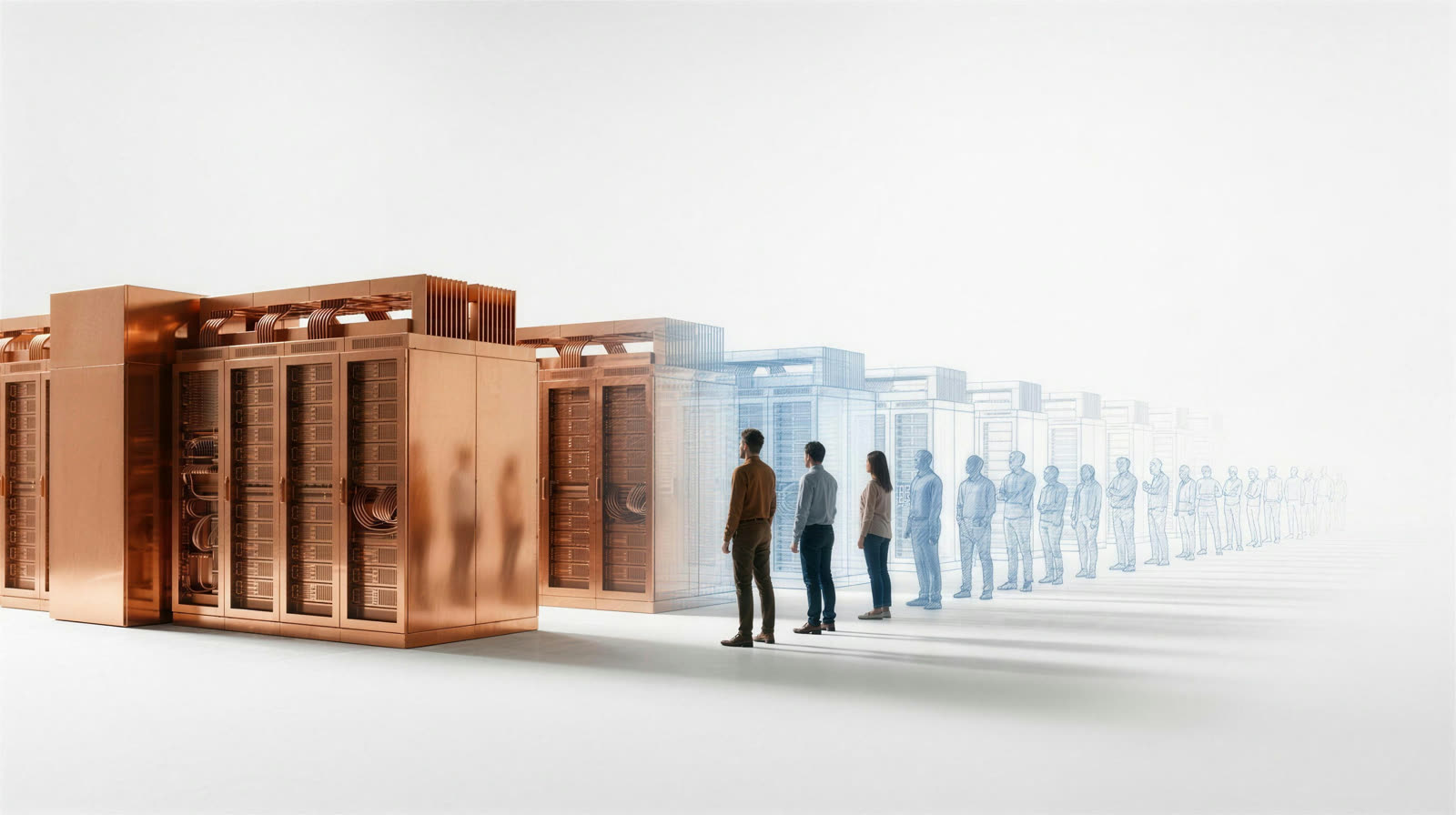
For four years, the American AI story has been told in gigawatts. Announcements. Press releases. Groundbreakings staged for cameras. Renderings of glass boxes on empty pastures. Governors cutting ribbons on projects that had no transformers ordered, no gas contracted, no tenants signed, no capital closed.
On August 3, 2026, Governor Abbott sent a letter to the PUCT and to ERCOT and told them to stop treating the interconnection queue as a promise. Within hours, ERCOT suspended Batch Zero, the very first classification step in its new large-load process, and told developers the August 7 notices would not be issued.
Everyone called it a moratorium. They should have called it an autopsy. And the coroner's report does not stop at the Texas state line.
The national numberWhat America actually asked for
Pull every public interconnection queue in the country into one place. Every ISO. ERCOT, PJM, MISO, CAISO, SPP, NYISO, ISO-NE. Then every vertically integrated utility that publishes a row-level queue, from Dominion to PacifiCorp to the AEP operating companies. Line them up and count.
That number is not real, and the queue itself tells you so. When you sort those 32,321 rows by status, the fiction is sitting right there in the data, today, not in some forecast about the future.
This is not a Texas problem that Texas discovered. It is the structure of the entire American interconnection system, and Texas is simply the first state with a governor willing to say it out loud.
A queue position is a lottery ticket held by someone who has told their investors it is a house.
The Texas cutWhere the fiction became visible
ERCOT told the Texas Senate on July 29 that its large-load queue contains more than 1,800 requests totaling 474 gigawatts, and that roughly 90 percent of that is data centers. Four hundred and seventy-four gigawatts is about seven times the peak load of the entire ERCOT system on the hottest day in Texas history.
And of all of it, ERCOT's own reporting shows just 9,042 megawatts have received approval to energize. Less than two percent of ERCOT's queue. The amount actually drawing power is smaller still. The queue was the fiction. Batch Zero was the beginning of the truth.
Underneath the headline sits a cohort of roughly 250 to 300 projects far enough along to have posted deposits, secured land, engaged EPCs, and named tenants. Those are the projects with real capital on the field. BloombergNEF put a number on the exposure: if the audit runs its course, 49.8 gigawatts of data-center load could be delayed, with $8 billion to $15 billion of revenue at risk by the first quarter of 2027. Behind that number is capex already committed, tenants already promised, boards that were given a date, and steel that is already on order.
The private gridThe answer arrived before the question
Here is what the panicked coverage keeps missing. While the queue was being padded with paper, the serious operators had already left the public grid behind.
Fermi America is building Project Matador in Amarillo, eleven gigawatts of AI campus at build-out, gas turbines already procured, behind the meter. Pacifico Energy is building five gigawatts of gas and 1.8 gigawatts of battery near Fort Stockton, behind the meter. Amazon announced a 7.65 gigawatt Texas gas plant, thirty-five turbines feeding a self-contained energy island that does not touch the utility. Crusoe is delivering Stargate at Abilene on a 900 megawatt on-site microgrid and has secured 4.5 more gigawatts of gas. Google's Armstrong County campus runs on private turbines under a state air permit.
Every one of those decisions was made before August 3. They did it because they understood something the queue-holders did not. Power is not a permitting detail. Power is the asset. An interconnection request is a request. A gas turbine order is a delivery. A substation on your own land is a piece of steel that grants you sovereignty. The operators who have built at industrial scale know the difference between a permit and a possession.
The pattern is not subtle, and it is not new. Every operator who has built real capacity at industrial scale has learned the same lesson the same way. The projects that get built are the projects that own the electron. The projects that pitch the electron end up in the queue.
The other frontThe ground is closing too
The grid is not the only thing saying no. While the interconnection queues quietly sort themselves, the permitting layer underneath them has turned, and it is moving faster than the grid.
Six hundred and fifty-eight local governments have put something in the way, from a zoning denial to a full construction pause, in forty-six states. Two hundred and twenty-seven utilities and commissions are writing new large-load rate classes, so that when a data center connects, it pays for the grid it strains rather than the household next door. And thirty-nine lawsuits are working through the courts, over water, over zoning, over environmental review, any one of which can freeze a campus for a year.
Read that as an operator reads it. The public grid is closing at the top, through interconnection reform. The ground is closing at the bottom, through local consent. A project has to survive both, and most of the 4,429 gigawatts of queued capacity was underwritten as if it had to survive neither.
The repricingDelay is not an inconvenience
Delay does not read as a schedule slip on a sponsor's model. It reads as a meter that never stops running. Watch what a single idle facility costs while it waits.

A sponsor does not read a halved IRR as a smaller return. They read it as a round of phone calls, to the tax-equity investor, the senior lender, the preferred equity partner, and the tenant, and every one of those calls reopens a deal that was supposed to be closed. Covenants get tested. Fees get repriced. Boards get uncomfortable. This is a financing event.
And the audit cannot be outrun. Even if Texas resolves cleanly by April of 2027, that is not enough time to buy and build behind-the-meter generation as a hedge, because aeroderivative gas-turbine supply chains are running 24 to 36 months, and large power transformers now carry a 128 week lead time. The turbines a developer would need to pivot were ordered by someone else in 2023. The private-grid decision is a day-one decision. You cannot bolt it on in month eight. It is a different construction strategy, and it had to be committed to eighteen months before anyone broke ground.
The patternTexas is early, not alone
FERC issued show-cause orders on June 18 to PJM, MISO, SPP, CAISO, ISO-NE, and NYISO, giving all six 60 days to justify or rewrite their large-load tariffs. Every regional grid in the country is now on the same clock as ERCOT. The specifics will differ. The direction will not. Large loads are going to face real cost allocation, real transparency, and real curtailment authority in every market that matters.
In Texas, you can already watch the standard being enforced in real time. Since the audit began, the Governor's office has published release after release as developer after developer commits to comply, QTS, Meta, OpenAI, Google, CleanSpark, Core Scientific, Vantage, one after another agreeing to fund their own infrastructure and meet the new bar. None of that looks like an industry being killed. It looks like a market raising the price of admission, and the serious operators are paying it without blinking.
Texas did not step back from AI infrastructure. Texas raised the standard for it, and the rest of the country is thirty days behind.
The buildWhat SAVRN is built for
We built SAVRN because we saw this coming. Not the specific letter on August 3. The physics that made it inevitable.
SAVRN builds AI infrastructure and a sovereign specialist-agent operating system for enterprises and institutions that need compute, power, capital, and operational sovereignty to move together. Our financing stack was designed around the assets that make a private-grid build executable: ITC monetization, tax equity, credit protection, and a takeout sized for the useful life of the asset. That stack is the construction plan, not decoration on a pitch deck.
Every project we underwrite starts with the electron. Then the site. Then the tenant. Then the capital. Then the compute. Then the agents. In that order, every time. We do not run that sequence as a marketing line. We run it because it treats power as the asset instead of the afterthought, and because a team that has learned the difference between a permit and a possession does not make that mistake twice.
There will be two tiers of AI infrastructure in America from here. Tier one will keep trusting the queue, wait for the interconnection, hedge with press releases, and hope the calendar cooperates. Tier two will own the electron, control the site, the generation, the fuel, the financing, and the operating system that runs them. Tier two will build. The market has already decided which tier it respects. Forty gigawatts of behind-the-meter gas, announced in one state in eighteen months, is not an anomaly. It is a verdict.
The queue is being audited. The build has already begun.
Do not take my word for it. Check the receipts.
Every number in this essay lives in a public tracker we built and maintain. It follows 224 named projects, 127 jurisdictional actions, 658 local restrictions, 227 utility dockets, 39 lawsuits, the securities filings, the government releases, and the full national interconnection queue. Every entry links to its documented source. It is neutral by design. It records what is happening, and it does not argue.
Open the Delay Watchlist → See all 2,600+ sources