
First Time Is Not First of a KindTwo people say “nobody has ever done this before.” One is describing the market. The other is describing himself.
First time is a fact about you; first of a kind is a fact about the world. The market can only price precedent, so it underwrites the wrong risk — and mis-reads who can actually build a new industry.
Two people say the same sentence.
"Nobody has ever done this before."
One of them is describing the market. The other is describing himself. The words are identical. The risk is not even in the same category. And almost every institution that allocates capital, writes insurance, issues permits, or signs a completion guarantee has no mechanism whatsoever for telling the two apart.
That confusion has cost more money than any technical failure I have ever watched happen.
Two sentences that sound alike
First time is a fact about you. It means you personally, or your team, or your company, has not done this thing. The knowledge exists somewhere in the world. Someone in Ulsan or Trondheim or Hsinchu has the answer and would sell it to you. Your gap is a purchasing decision you have not made yet.
First of a kind is a fact about the world. It means the configuration does not exist. There is no one to call. There is no reference plant to tour. Whatever answer eventually exists, someone is going to have to produce it, and if you are building the thing, that someone is you.
These are independent axes. That is the part people miss. You can be a complete novice standing in front of a completely solved problem — that is an apprenticeship, and it is cheap, and someone will teach you. You can be a master standing in front of a solved problem — that is execution, which is where most of the money in the world is actually made and about which almost nothing gets written.
But the interesting quadrants are the other two, and they look identical from the outside.
A person with no accumulated capability standing in front of something with no precedent. And a person with thirty years of finished, delivered, commissioned, paid-for work standing in front of something with no precedent.
Both of them say "nobody has ever done this before." Both of them are telling the truth. One of them is going to build a new industry and the other is going to spend a hundred million pounds on renderings.
The system owns one instrument for capability — precedent — so it collapses the vertical axis. In the no-precedent column the novice and the veteran get the same price. One will build a new industry; the other will spend a hundred million on renderings.
The quadrant nobody underwrites
The upper-right box is where new industries come from. It is also the box the financial system is least equipped to evaluate, because the only instrument it has for measuring capability is precedent, and by definition that box has none.
So the system does something crude. It collapses the vertical axis. It asks one question — has this been built before — and if the answer is no, it applies the same discount to everyone in the column. The novice and the veteran get the same treatment. Which means the novice is wildly overpriced as an asset and the veteran is wildly underpriced as one, and capital flows accordingly.
I want to be precise about why that is not just unfair but expensive, and the cleanest way to do it is with a man who had never been to sea.
The man who had never been to sea
Henry Kaiser started with a hardware business, moved into road construction, and worked his way up to the largest civil works on the continent. By the late 1930s his consortium had delivered Hoover Dam and Grand Coulee (Hudson Institute). Concrete, rock, water, logistics, enormous crews working a schedule in a canyon.
In December 1940 he took a contract to build ships.
He had never built a ship. Neither had his engineers. The Hudson Institute puts it bluntly: Kaiser and his team "knew nothing about shipbuilding before they started," had "never built ships in their lives," and "it's not even clear if Kaiser had ever been to sea" (Hudson Institute). The ten shipyards he would use did not exist when he signed.
The established shipbuilders knew exactly what to make of this. A road contractor. A dam man. The industry had spent a century developing the craft of laying a keel and building a hull up from it, and here was somebody who had never seen it done.
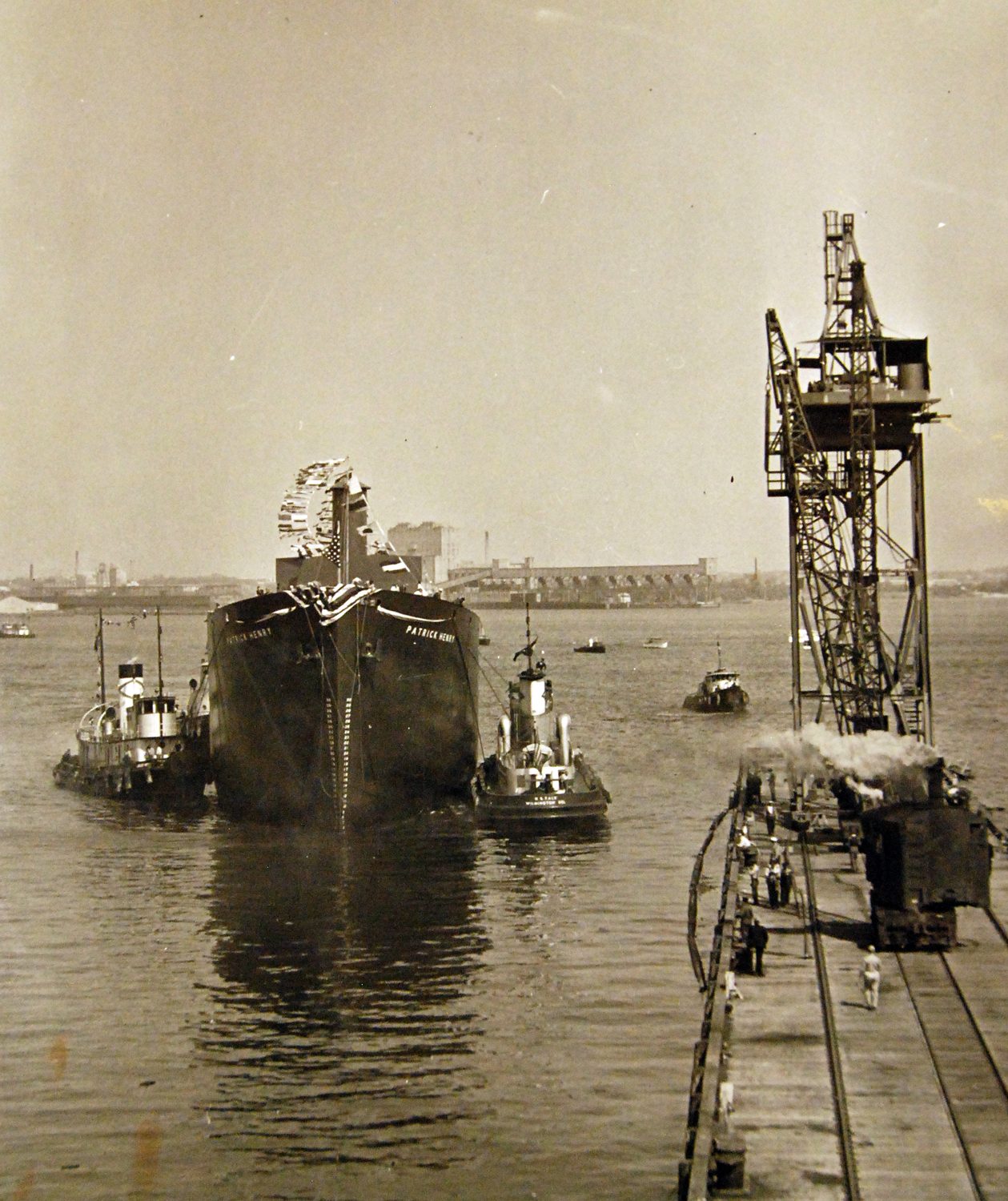
Here is what happened. The first Liberty ships took about 230 days to build. The SS Patrick Henry took 244. By 1943 the median had dropped to 39 days. Eighteen shipyards turned out 2,710 of them between 1941 and 1945 — an average of three ships every two days (Wikipedia). The publicity record was the SS Robert E. Peary, launched four days and fifteen and a half hours after her keel was laid. I will note honestly, as Wikipedia does, that this was a stunt, and a great deal of fitting-out remained after the launch (Wikipedia). The real number is the median. 230 days to 39 is a six-fold compression of an industrial process by a man who did not know how the process worked.
That was not a first time. Kaiser was not learning shipbuilding. He never learned shipbuilding.
It was first of a kind. He was doing something to hulls that had never been done to hulls, and the reason he could do it is that he arrived carrying thirty years of finished work in a completely different material.
What actually transfers
The thing people get wrong about experience is that they think it transfers as answers. It does not. Kaiser had no answers about ships.
What transferred was the shape of the problem. He had spent a career on projects where the binding constraint was never the craft. It was sequencing, prefabrication, moving enormous quantities of material to the right place at the right hour, and keeping ten thousand people productive at a face. Look at a hull through that lens and it stops being a hull. It becomes a large assembly that has been irrationally constrained — built in one location, in one orientation, in one sequence, by one trade, because that is how it has always been done.
So he built the sections elsewhere and brought them in. He welded instead of riveted so the sections would join. He hired people who had never seen a shipyard, because there was no craft tradition to unlearn, and he trained them narrowly.
None of that is shipbuilding knowledge. All of it is dam knowledge, pointed at a hull.
This is the mechanism, and I think it is the most misunderstood thing about senior operators. A lifetime of deliverables is not a filing cabinet of matching precedents you flip through until you find one that resembles the current problem. If it were, it would be nearly useless, because the problems that matter never resemble anything. It is raw material. You do not retrieve the answer. You construct the analogy that produces one.
That is a generative act, not a retrieval act, and it is the entire reason capability transfers across domains that look unrelated. The novice has nothing to construct from. He is not slower at finding the answer. He has no material.
Which gives you the real definition. Experience does not transfer as knowing what to do. It transfers as the ability to tell which questions are load-bearing.
Twenty people who had never done it
This is not a rare pattern. It is close to the normal way large changes arrive. Here are twenty, and the column that matters is the last one.
| Who | Came from | Built | What carried over |
|---|---|---|---|
| Johannes Gutenberg1450s | Goldsmith and gem cutter; his father was in the Mainz mint | Europe's first mechanized printing press | Metalwork. What was new versus European practice was the type alloy, the oil-based ink, and the press |
| John Harrison1735–1761 | Carpenter and joiner; his first clock, 1713, was made almost entirely of wood | Marine chronometer that solved longitude | Woodworking materials — oak and lignum vitae movements, and a grasshopper escapement that needed no lubrication because the pallets were wood |
| Charles Goodyear1839 | Hardware merchant; a self-taught chemist with no scientific qualification | Vulcanized rubber | A merchant's eye for a bad product. He started because existing life-preserver tubes were “not very effective nor well-made” |
| Elisha Otis1854 | Wagon driver, sawmill operator, master mechanic at a bedstead factory | The safety elevator, and with it the tall building | A railway safety brake he had built years earlier — a fail-safe catch that grips a rail |
| Alexander Graham Bell1876 | Teacher of the deaf and elocution instructor, from a family of speech teachers | The telephone | Sound and hearing, not electricity. The Smithsonian is blunt: “Bell's background was in hearing and speech, not electrical technologies” |
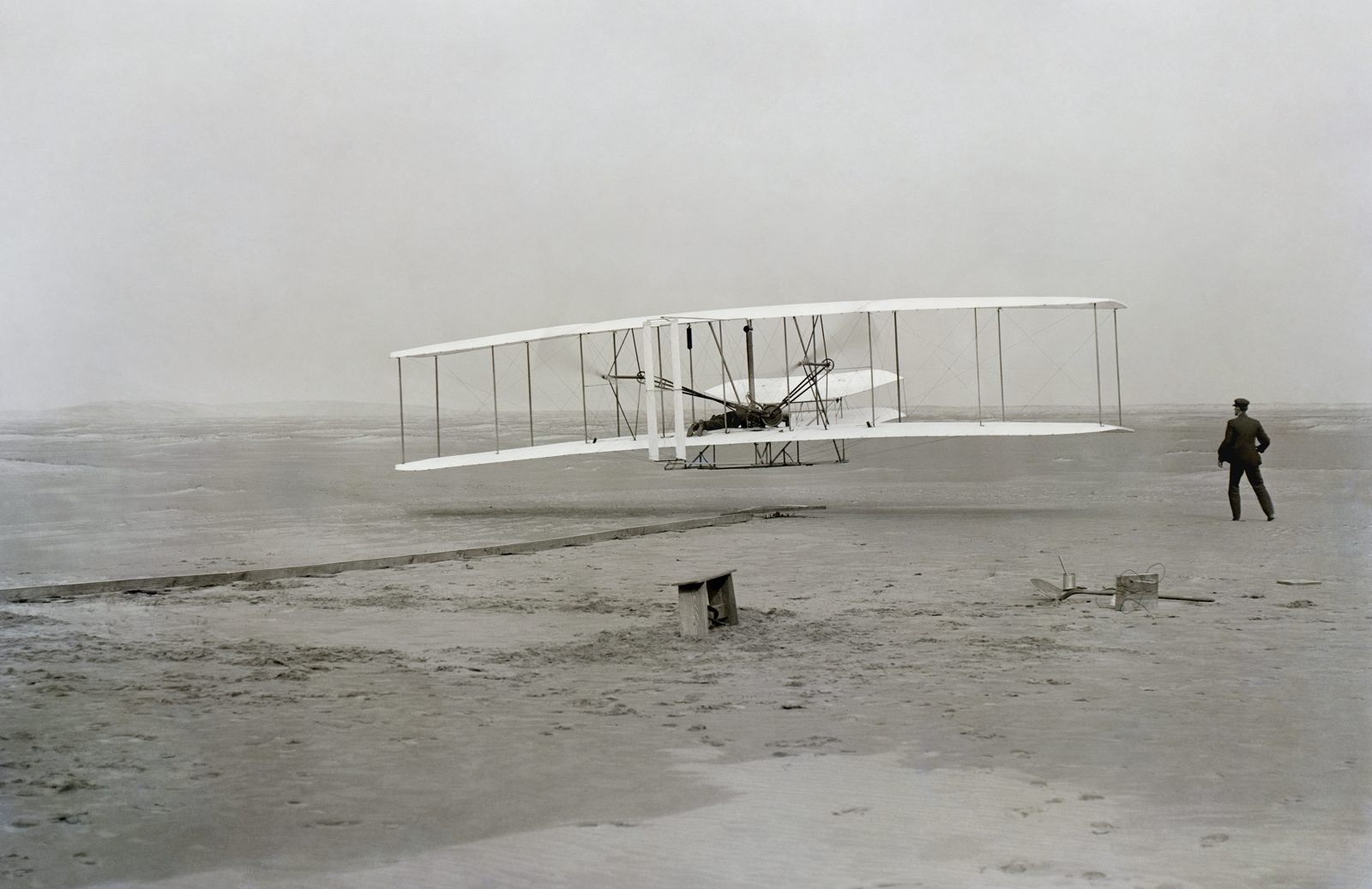
| Wilbur and Orville Wright1903 | Printers, then bicycle builders. Neither finished college | Powered flight | Bicycles taught them an unstable vehicle can be balanced by the rider. Wing-warping came from twisting an inner-tube box in the shop |
| Philo Farnsworth1927 | Idaho farm boy who rewired a washing machine and ran a failing radio-repair shop | The first working all-electronic television | Hands-on electrical repair, plus the idea of scanning an image in lines the way a field is plowed |
| Clarence Birdseye1927 | Taxidermist, government naturalist, fur trapper in Labrador | The frozen food industry | A field observation: fish frozen instantly at forty below tasted fresh, and quality was worse in mild weather. He reasoned back to crystal size |
| Henry Kaiser1941 | Hardware, roads, then Hoover Dam and Grand Coulee. Had never built a ship | 2,710 Liberty ships; median build time fell from about 230 days to 39 | Sequencing, prefabrication and mass logistics from dam building. He treated a hull as an assembly, not a craft |
| Hedy Lamarr and George Antheil1942 | Film actress with no formal training, and an avant-garde composer | A frequency-hopping torpedo guidance patent | Antheil had synchronized player pianos in Ballet Mécanique. The patent switches among 88 frequencies — the number of keys on a piano |
| Percy Spencer1945 | Orphan who never finished grammar school; taught himself radio in the Navy; ran Raytheon's magnetron division | The microwave oven | Radar. He was a world expert in magnetrons and a complete outsider to cooking |
| Frederick McKinley Jones1940 | Left school at eleven; garage mechanic, army electrician, built a town's first radio transmitter | Practical truck refrigeration, and with it the cold chain | Vibration-proof packaging of machinery for a moving vehicle. The prototype was built from junkyard salvage |
| Bette Nesmith Graham1951 | Executive secretary who could not type when hired; painted bank window displays for extra money | Liquid Paper; 25 million bottles a year by 1975 | Painters do not start over, they paint over the mistake. She mixed tempera to match the stationery and applied it with a watercolor brush |
| Kiichiro Toyoda1935 | Automatic looms. At Toyota “no one had experience in automobile manufacturing” | Toyota's first passenger car, and eventually the Toyota Production System | Chain-conveyor flow production, developed on a loom assembly line in 1927, moved to the car plant in 1938 |
| Taiichi Ohno1953 | Textile mill, then a Toyota engine shop | Just-in-time and kanban | An American grocery store. Customers withdraw from a shelf and the store replaces only what was taken |
| Walt Disney1955 | Animation and film. No park had ever been built to a single designed narrative | Disneyland | Camera craft applied to physical space: forced perspective on Main Street at three-quarter, five-eighth and half scale, a berm to block the outside world, hub-and-spoke sightlines |
| Malcom McLean1956 | Bought a used truck in 1935 and drove it himself; built a national trucking company | Containerized shipping | A trucker's insight that the box is the unit, not the vehicle. Loading cost fell from $5.86 a ton to 16 cents |
| Momofuku Ando1958 | Textiles, clothing, then a company that made salt | Instant noodles; 98 billion servings a year by 2009 | Nothing technical. Months of trial and error until flash-frying worked as dehydration |
| James Dyson1983 | Industrial designer; had made a wheelbarrow with a ball instead of a wheel | The bagless cyclonic vacuum, after 5,127 prototypes | An industrial sawmill cyclone that separated sawdust from air. He asked whether it would work small |
| Sergey Brin and Larry Page1998 | Computer-science PhD students working on academic citation analysis | PageRank and web search | Bibliometrics. A hyperlink is a citation, a citation is a vote, and ranking becomes an eigenvector problem |
Read the last column straight through: a wooden pallet, a bicycle chain, a rail brake, a player piano, a grocery shelf, a sawmill, an academic footnote. Each person carried a finished competence into a room where it had never been applied. Origin stories are polished and priority claims are contested — both caveats are examined in the text, and both strengthen the pattern rather than weaken it.
Read the last column straight through. Almost none of it is knowledge of the destination. It is a wooden pallet, a bicycle chain, a rail brake, a player piano, a grocery shelf, a sawmill, an academic footnote. In every case the person carried a fully developed competence into a room where it had never been applied, and the competence was the thing that let them see the problem in a shape that had a solution.
What this list is not saying
Two honest caveats, and the second one is more interesting than the list.
The first is that the origin stories are mostly polished. Verifying these was instructive mainly for how much of the folklore fell apart. Percy Spencer's melted chocolate bar is legend — "there are no credible primary sources that verify this story" (Wikipedia). Otis really did cut the rope in 1854, documented by the New York Tribune that May, but no contemporary account has him shouting "All safe, gentlemen," and P.T. Barnum's involvement is "unsupported by the facts discovered thus far" (Elevator World). Farnsworth's plowed-field epiphany rests on one teacher's later recollection of a sketch that was undated, unnotarized, ruled inadmissible, and drawn in March 1922 rather than the September 1921 the story usually gives (Schatzkin). Goodyear's hot stove comes from his biographers, not from contemporary evidence (review in PMC). Birdseye's Labrador revelation is Birdseye's own retelling, decades later (Boston Globe). Dyson's sawmill visit is attested only by Dyson.
Notice that every one of those myths distorts in the same direction. They convert a long grind into a flash. And the flash version is the one that supports the wrong theory — the theory that this is about a moment of genius rather than about accumulated capability meeting a problem. Strip the anecdote away and what remains is duller and much more useful. Spencer did not have a chocolate bar moment; he had two decades of magnetrons and a division that went from fifteen people to over a thousand. Dyson had 5,127 prototypes.
The second caveat is the one worth sitting with. Almost every entry on that list has a disputed priority claim, and I mean almost every one.
Gutenberg did not invent movable type; that happened in Korea in the 14th century (Britannica). Elisha Gray filed a caveat on the telephone the same morning Bell filed his application, and there is real debate about who arrived first (Wikipedia). A German technical journal noted in December 1854 that elevator safety devices like Otis's "had been employed in elevator shafts for a long time" (Elevator World). Thomas Hancock patented vulcanization in Britain eight weeks before Goodyear filed in the United States (review in PMC). Frequency hopping has open-literature prior art back to a Tesla patent of 1903, and the Lamarr–Antheil system was never deployed (Wikipedia). Chang Kuo-wen filed an instant-noodle patent in Taiwan in 1956, two years before Ando (Wikipedia). Cyclonic separation was patented in 1885 (Dyson's own account). RankDex was ranking pages before PageRank shipped (Wikipedia). Containers moved between London and Paris in 1926, thirty years before the Ideal-X (Wikipedia). Mechanically refrigerated trucks existed in 1925 for the ice cream trade (Wikipedia).
That looks at first like it demolishes the list. It does the opposite.
First of a kind almost never means first to have the idea. Ideas have long, crowded, badly documented priority queues, and if the standard is conception then almost nothing has ever been first. What these twenty have in common is not that they thought of it. It is that they finished it — into a form the world could actually use, at a scale that changed the default. McLean did not invent the container. He rebuilt ports, ships, chassis, and eventually an ISO standard around it, and released his patents royalty-free to make the standard stick. Dyson did not invent the cyclone. He shrank an industrial unit operation into an appliance and survived 5,127 attempts doing it.
Which is the entire thesis, arriving from a direction I did not expect when I started checking. The scarce thing was never the insight. It was the capability to carry it all the way to something that works, and that capability is exactly what a lifetime of finished deliverables produces and a good idea does not.
Where the transfer stops
Back to Kaiser, and to the part of his story nobody puts in the keynote — the part that makes the whole thesis honest.
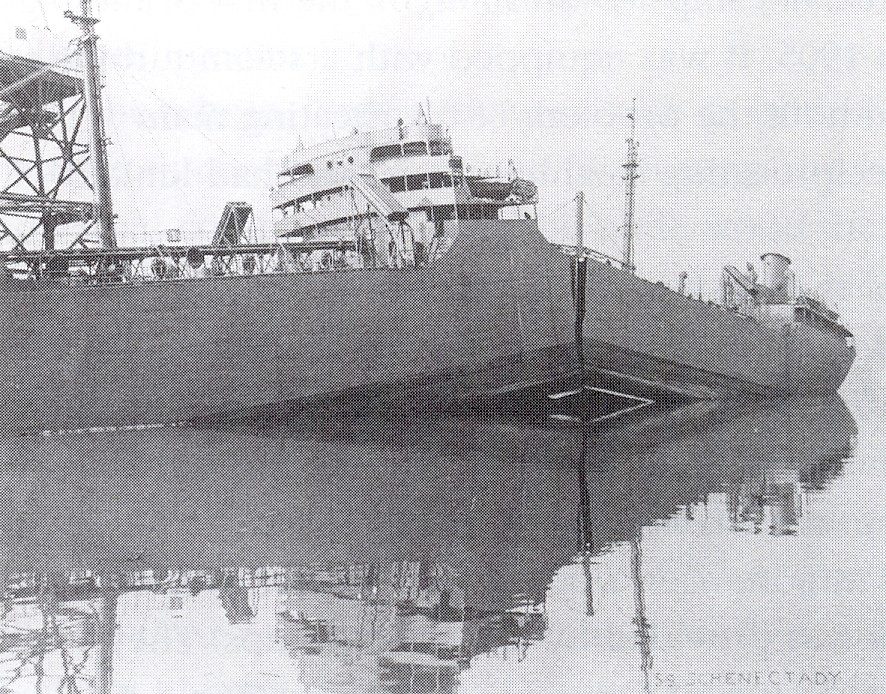
Welding was the unlock. Welding was also the failure. Riveted hulls arrest a crack at the plate boundary — the crack runs into the seam and stops. An all-welded hull is one continuous piece of steel, so a crack can run the length of it. Combine that with steel that turns brittle in cold North Atlantic water and you get a failure mode nobody had a theory for yet.
There were nearly 1,500 instances of significant brittle fracture during the war. Twelve ships broke completely in two, three of them Liberty ships (Wikipedia). The Mariners' Museum has documented the phenomenon in detail — ships splitting without warning, sometimes at anchor, sometimes in calm water (Mariners' Museum).
Read that carefully, because it is the whole argument.
Kaiser's accumulated capability carried him through every part of the problem that was merely first time for him — the yards, the labor, the sequencing, the throughput. It carried him magnificently. And then it ran out at exactly the point where the problem stopped being first-time-for-him and became first-of-a-kind-for-everyone. Fracture mechanics at that scale was not knowledge sitting in someone else's shipyard waiting to be bought. It did not exist. He walked into it because his transferred competence created it.
That is what the boundary looks like. You do not get hurt in the part you have never done. You get hurt in the part nobody has done, and a lifetime of deliverables will get you there faster, which means you meet it sooner and with more capital committed.
The lesson is not that Kaiser was reckless. He delivered 2,710 ships and the discipline of fracture mechanics advanced enormously because of what those hulls taught. The lesson is that the two kinds of unknown require completely different responses, and if you cannot tell which one you are looking at, you will spend your contingency on the wrong one.
What Kaiser did not have
There is something missing from that story, and it is the most important thing in this essay.
When Kaiser decided to weld instead of rivet, there was nobody in the room who could stop him.
That is not a criticism of the decision. The decision was right. Welding is the reason the ships existed at all, and nobody in 1941 had the theory to predict what a continuous steel hull would do in a cold sea. But look at the shape of the organization around him. Kaiser had employees. He had vendors. He had a customer with a war on. What he did not have was a peer. A second person of equivalent standing, carrying an equivalent lifetime of finished work in a different material. Someone who could look at an all-welded hull and say: I have spent thirty years watching steel behave under load, and this choice has a consequence you have not priced.
An employee cannot say that. Not in a way that lands. An employee can raise a concern and be overruled, and both parties understand going in that being overruled is the expected outcome of the exchange. A consultant cannot say it either, because a consultant is retained to answer a question you already knew to ask, and the failures at your boundary are precisely the ones you do not know to ask about. The person who catches the thing at the edge of your competence has to have arrived at the problem independently, built their own frame for it, and carry enough standing that their read survives contact with yours.
That is the argument for pairing, and it has nothing to do with workload.
Two maps with different blank spots
Think of accumulated capability as territory. There is an interior — the region where you have effectively already done this, where you can schedule tightly and price with confidence because you have been here before in a different costume. And there is an edge, past which your experience stops producing useful analogies and starts producing false ones, which is considerably more dangerous than producing none.
Every operator has both. The good ones can tell you roughly where their line sits. Nobody can see past it, because not being able to see past it is what makes it the line.
Now put two of them together. What you are buying is not twice the interior. You are buying the chance that one person's interior sits underneath the other person's edge.
Now put two of them together. What you are buying is not twice the interior. You are buying the chance that one person’s interior sits underneath the other person’s edge.
Same category and their blind spots coincide — one map paid for twice. Unrelated and they cannot argue at the speed the work needs. Adjacent is the narrow band where it works.
Which is why the categories have to be adjacent, and this is the part that gets designed wrong most often. If the two come from the same category, their boundaries coincide. They will construct the same analogy, agree quickly and confidently, and be blind in exactly the same place — you have paid twice for one map and imported an argument about authorship. If they come from unrelated categories, there is no shared vocabulary, so neither can evaluate the other's reasoning at the speed the work requires. Every disagreement resolves into deference or veto, and both of those are just one person deciding with extra steps.
Adjacent is the narrow band where it works. Enough overlap that they can argue at speed about the same object. Enough difference that the blank regions on their maps do not sit on top of each other.
The overlap is the interface. The difference is the coverage.
Nobody could bid it alone
There is a precedent for this, and it is sitting inside the Kaiser story already.
Before the ships, before the dam, there was the question of who could conceivably build the dam. The Bureau of Reclamation's terms were punishing: a two-million-dollar bid bond, a five-million-dollar performance bond for the winner — north of a hundred million in today's money — and seven years to finish or take penalties. The consortium that formed to bid it stated the reasoning without ornament: "Because of the project's immense size and the fact that it was the first dam on the Colorado River, no single contractor had the resources to make a qualified bid alone" (Wikipedia).
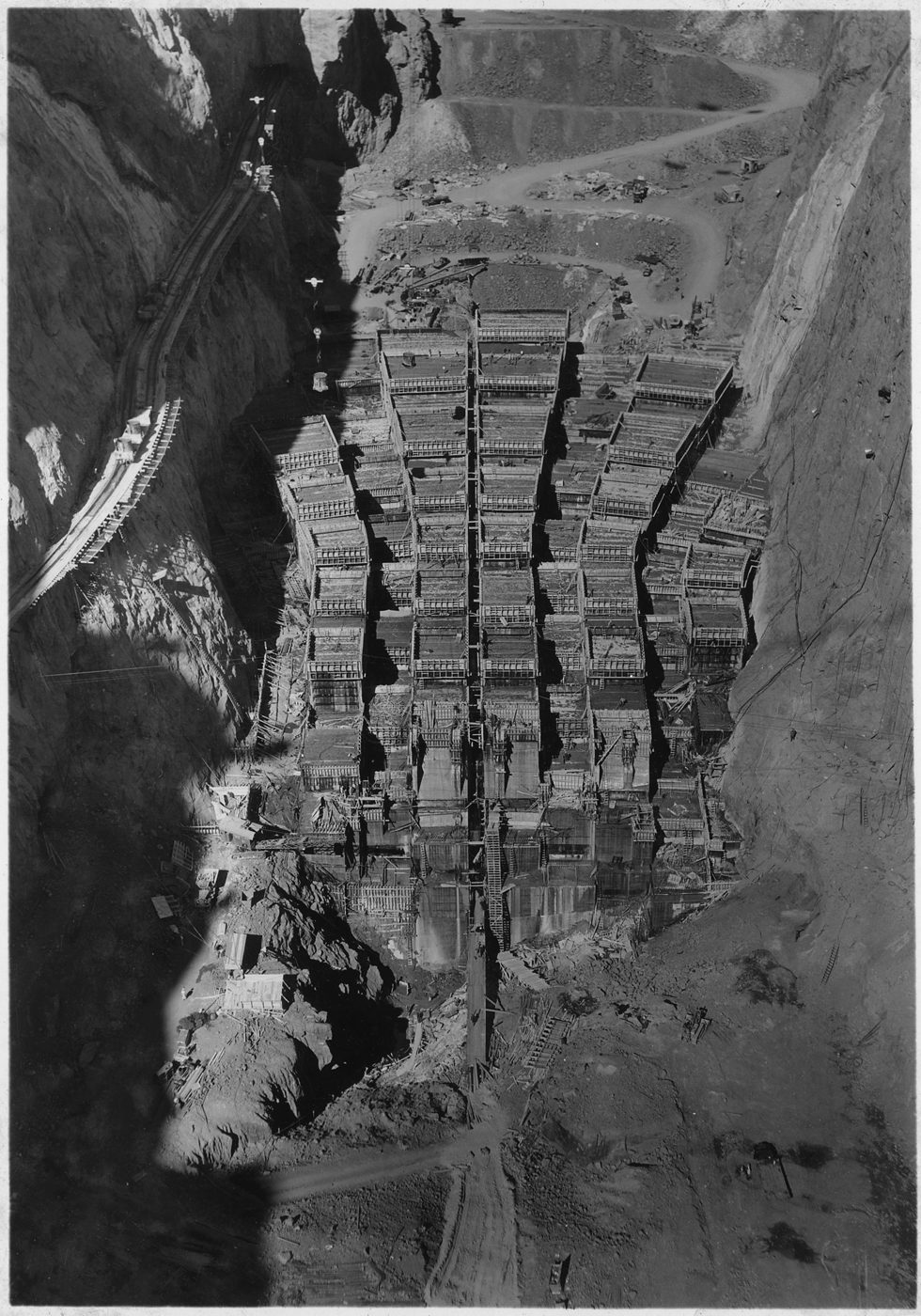
So six of them combined. PBS describes Six Companies as "the melding of ambitions of maverick individuals, each driven by a desire to transform the emerging West" (PBS American Experience). Harry Morrison of Morrison-Knudsen, who had the idea. The Wattis brothers of Utah Construction. Charlie Shea, described there as "a seat-of-the-pants builder of tunnels and sewers." Felix Kahn, who coined the name. Warren Bechtel, "a powerful old-line San Francisco contractor." And Kaiser, at that point "an ambitious young road builder from Oakland, California."
Bechtel and Kaiser took their thirty percent jointly, as a pair, inside the larger group.
Two things about that are worth holding onto. The first is that Hoover Dam is where Kaiser accumulated the capability he later spent on hulls. The lifetime of deliverables that made Liberty ships possible was itself assembled inside a partnership he could not have executed alone. The pairing was not a hedge against the risk. It was the thing that produced the operator.
The second is the governance, which is the part everybody skips on their way to the inspiring version. Six sets of principals held the equity. One man ran the work. They took Morrison-Knudsen's engineer Frank Crowe, who in 1931 became "General Construction Superintendent of the Hoover Dam construction contract" (Wikipedia). Not a committee. A name.
That is the honest complication in everything I have just argued. Two principals of equivalent standing is a deadlock machine unless you solve for it in advance. Peers do not defer by reflex — that is exactly what makes them valuable and exactly what makes them expensive to organize. Consensus between two executors is the worst available outcome, because it produces the average of two good judgments instead of the better one, and it produces it slowly.
What works is decision rights allocated by domain before the first hard call, rather than authority split by title. Each has to be able to say "that is inside your interior, you own it" without it being a negotiation. And each has to be able to say "that is my edge, I want your read" without it costing them anything. A pair that cannot do that in the easy weeks will certainly not do it in the week that matters.
Why you almost never see it
All of this is rare, and the rarity is structural rather than accidental.
Start with the base rate. The number of people who have carried something genuinely first-of-a-kind all the way to a commissioned, operating, paid-for asset is small. Now require two of them in categories close enough to interface. Now require both available in the same window. Now require both to accept a structure in which the other one can overrule them inside a domain. Every condition cuts the population by an order of magnitude, and the last one cuts hardest, because the temperament that finishes a first-of-a-kind is not generally the temperament that enjoys being overruled.
There is also a sorting effect. People who complete work like this become principals. The industry converts them into founders, not co-executors. They hire downward or they compete across, and the ecology almost never leaves two of them at the same table in non-overlapping roles.
And then there is the diligence penalty, the perverse one. Conventional wisdom says build a complementary team — and by complementary it means complementary by function: the builder and the capital, the technical and the commercial. Two executors does not read as coverage to a committee. It reads as duplication. You will be asked why you are paying twice for the same seat. And the true answer — that one of them exists to be the only person in the building who can stop the other at the exact point where nobody else can see the problem — does not fit in a diligence memo.
That penalty is a specific instance of a more general failure, and the general failure is worth looking at directly.
The market has one question, and it is the wrong one
Here is how this gets priced in the real world.
Project finance is built around precedent. A primer written for exactly these transactions states the position without embarrassment: lenders "almost never want to be the first to finance an untested technology" (Wilson Sonsini). Dentons puts the mechanism plainly — lenders are usually unwilling to assume new-technology risk, and where new technology is involved they will typically expect completion guarantees or equivalent support from the shareholders to indemnify them (Dentons).
Sit with what that actually means. The market's answer to first-of-a-kind risk is not to price it. It is to hand it back to you and ask you to sign for it personally.
And because precedent is the only accepted proxy for capability, the vertical axis does not appear anywhere in the underwriting. Nobody asks what this team has finished. Nobody asks whether it transfers. Nobody asks the one question that actually separates Kaiser from a pitch deck, which is: what have you delivered, under what clock, and what does it cost you when you are wrong.
The outcome is an inversion that would be funny if it were not so expensive. The operator with forty finished projects puts his own balance sheet behind the forty-first, because that is the only structure available to him. And the company with nothing finished gets a government pledge, because narrative is easier to underwrite than transfer.
The same machinery mangles the pair. A project carrying two operators of that kind holds the best available insurance against precisely the risk the lenders say they care about, and it will be read as a governance question and an overhead line. Nobody scores boundary coverage, because nobody scores boundaries.
The hundred-million-pound rendering
Britishvolt is the clean case. A startup proposing a first-of-a-kind battery gigafactory in Northumberland, backed by a substantial government funding pledge, with a headline capital plan in the billions. It collapsed into administration in January 2023, and the majority of its 232 staff were made redundant with immediate effect (BBC). It had never produced a commercially viable cell. The factory existed as architectural renderings. Along the way the company leased a seven-bedroom mansion valued at £2.8 million, with a swimming pool (The Guardian).
Northvolt is the harder and more instructive case, because Northvolt was not obviously a fraud and not obviously unqualified. It was Europe's best-funded startup in the sector, staffed with real people who had done real things, and it still filed for bankruptcy in Sweden in March 2025 after a Chapter 11 filing the previous November (Reuters, Northvolt).
The difference between Northvolt and Kaiser is not funding and it is not intelligence. It is that gigafactory yield at scale was, for that team, both first time and first of a kind at once, with no adjacent finished body of work deep enough to construct from. Kaiser had a canyon full of concrete to reason from. That is not a small difference. That is the whole difference.
How to tell in ten minutes
I have had to make this judgment about other people many times, and I have had to make it about myself more than once, which is harder. There is a test, and it is not the one people expect.
Do not measure confidence. Both of them are confident. The novice is confident because he cannot see the problem, and the veteran is confident because he has been here in a different costume. Confidence is noise.
Measure the resolution of the ignorance.
Ask what they do not know. Not to catch them out — to see the picture. A person with no accumulated capability gives you a short, vague list, and the reason it is short is not that there is little to fear. It is that you cannot enumerate the unknowns in a territory you have no map of. You can only name the fears you have vocabulary for.
The veteran's list is also short. But every item is specific, they are ordered by how quickly each one kills you, and at least one of them is admitted to be genuinely unsolved. He will tell you which item he is most afraid of and he will tell you he does not have the answer yet.
Then ask the second question, which is better than the first: what transfers, and what does not?
A person operating from real accumulated capability will volunteer the boundary. He will tell you the four things he has effectively already done and can therefore schedule tightly. Then he will draw a line: past this line he is in new territory, and here is how he intends to stage it, instrument it, and pay for being wrong. Someone who claims everything transfers is telling you he has not looked. Someone who claims nothing transfers is asking you to fund an education.
The signature you are looking for is a man who can tell you precisely where his own experience stops being useful. That is not modesty. That is the highest-resolution thing anyone can say about a project.
If you are evaluating a pair rather than a person, there is a version of the same test and it is faster. Ask each of them separately where the other one's judgment beats their own — specific domain, specific reason. If neither can answer with precision, they are not a pair. They are two people with the same job and a title problem. If both name the same domain, at least one of them is wrong about himself. What you want is two different answers that fit together, and what you want most is each of them naming a domain the other did not think to claim.
I have been in that box
I did not put myself on that list. But I have spent my working life in its upper-right box, and I should be honest about how I learned to read it, because it was not from a book.
The first time was a lemonade stand. I was eleven years old, and I wanted to sell inside a convention center. The company that held the concessions contract, Ogden, said no — a kid does not get to sell on their floor. So I made the argument. Part of what I sold went to charity, which meant I was not really competing with them; I was giving the building something it wanted. I won that argument. It was first of a kind for me, and there was no one to call. There was only the problem, and a way to frame it that produced a yes.
After that it became a habit, and the shape of it never changed. I wanted to work on golf courses, so I started bidding golf-course construction jobs — and then I started winning them. I wanted to build a park, so I bid landscape-construction work and built one. I wanted to write, so in 2011 I wrote for a national magazine — Garden Center Magazine — for a year, and once I had done it, I moved on. Every time, the move was the same. I did not go find the person who already knew. I sat down, worked out what the real problems were, and solved them in my own way.
None of those were first of a kind for the world. Golf courses and parks and magazines all existed; someone could have taught me. They were first of a kind for me, and that is the point. Each one left behind a finished thing and a piece of transferable competence I did not have before I started. Spread thirty years of that on a table and you do not get a filing cabinet of matching precedents. You get raw material.
So here we are again, in front of an industry that is slow to decide, brutally capital-intensive, thick with competition, and leaving communities across the country furious. I have been exactly here before.
It was Rockdale, Texas. Alcoa had closed the aluminum smelter there in 2005. A bigger, far better-funded bitcoin company had already come to the same site and failed to execute what it had designed — in 2019 Wired wrote the town's obituary, “The Hard-Luck Texas Town That Bet on Bitcoin—and Lost” (Wired). That article is the reason I got in the car. Everyone read it as proof that Rockdale was a bad bet. I read it as a greenfield with power and a town that had already paid for the hard lessons. So I convinced Alcoa to lease that greenfield to a company that had, quite literally, no resources. In the beginning we ran on fumes. What we built there — Whinstone — became the largest bitcoin mine in North America (Washington Post).
But the facility is not the part I am proud of. The town is. We created jobs. We rebuilt the local dog shelter. We put lights on the high school fields. We backed the first swim team the town ever had and bought their supplies. When an organization reached out, we did not just write a check — and it was not because we had the money, because we did not. I cared more about what we could do for that community than about almost anything else, because I knew that if we chose doing the right thing over everything else, we would be successful. There is not a person who toured that facility who will not tell you Whinstone was an amazing place — the people who lived it filmed what it felt like.
Earlier this week, on a bitcoin thread that had nothing to do with me, Brad Cuddy — an energy and bitcoin operator I respect — left a comment: “Chad Everett Harris was ahead of his time — greatest example of how to get a community behind a project.” I almost never respond to anything anymore; I would rather people not know what I am working on. This time I did.
People don't want companies. They want leaders who actually care about what happens in their town. It's not a press release or a photo for social media. They want a dog shelter fixed, playgrounds clean and safe, education programs to re-skill their neighbors, community centers that teach small-business owners how to use AI — and they need to be told the truth from day one.
So when I tell you I have been here before, I do not only mean I have stood in front of a first-of-a-kind build. I mean I charted the course for how it goes when you do it right — and the course runs through the town, not around it.
What our team built at SAVRN is the same move at a different scale. A facility on a small footprint that draws nothing contested from its host. One that re-skills American workers instead of importing a finished crew, and partners with a university and community colleges so the capability stays local. One built on value and culture rather than on profit as the first term. Every one of those is the lemonade stand again. Find the thing everyone treats as fixed, and refuse to treat it as fixed.
What this means for the people building AI factories
Now the uncomfortable application, because this industry is making the error at scale right now.
Everyone building an AI factory is in the no-precedent column. Nobody has operated a gigawatt of synchronized accelerated compute through a full refresh cycle, because the refresh cycles have not happened yet and the hardware changes underneath the concrete. That part is not in dispute. The question is which row you are in, and the industry is sorting on entirely the wrong signal.
The accepted proxy is: have you built a data center. Which sounds reasonable and is nearly useless, because it selects for precedent in a configuration that no longer exists. A team with ten delivered colocation halls has deep accumulated capability in a load profile of five to fifteen kilowatts a rack, air cooling, a tenant mix, and a leasing motion. Almost none of that is the binding constraint on a facility taking hundreds of kilowatts a rack on liquid, with a single tenant, a single workload, and a power draw that moves in synchronized steps.
Meanwhile the competencies that actually decide these projects were accumulated at scale in industries this one does not consider adjacent. Medium- and high-voltage interconnect. Thermal transport at density. Construction logistics under a hard clock. Power procurement and curtailment economics. Commissioning large electrical plant. Running crews at a face. Utility EPC. Heavy industrial. Semiconductor fabs. And, whether the sector wants to say it out loud or not, industrial-scale bitcoin mining. It spent a decade solving power siting, curtailment contracting, rapid modular deployment, and high-density cooling economics — while the data-center establishment declined to regard it as a real business. A great deal of what is now being rediscovered at consulting rates was operating at scale years ago, in buildings nobody wanted to tour.
I am not arguing those operators are automatically right. I am arguing they are in the upper row and being underwritten as though they are in the lower. Meanwhile teams with genuine precedent in the wrong thing are being underwritten as though they are in the upper.
Which also tells you what the right pairing looks like here — and it is not the one the sector keeps assembling. The default is a builder next to a capital partner. That is complementary by function, and it leaves the whole technical boundary uncovered. The configuration that actually matters is two operators who have each independently delivered something with no precedent — one from the power side, one from the compute-and-deployment side. Adjacent enough to argue about the same interconnect in the same vocabulary. Different enough that the thing one of them cannot see is sitting in the middle of the other one's map. Those two people exist. They are almost never in the same company, because nothing about how this industry forms teams is designed to put them there.
And there is a second-order version of the same error. Recall the Kaiser boundary — you get hurt where the problem is first of a kind for everybody. In this industry that place is not cooling. Cooling is solved; IBM was water-cooling mainframes decades ago and HPC never stopped. The genuinely unsolved thing is what tens of thousands of GPUs do to a grid when they move in lockstep. SemiAnalysis has written about gigawatt-scale training load fluctuations as a blackout risk (SemiAnalysis). Stanford researchers are publishing on mitigating datacenter-scale power transients (Stanford SING). Microsoft Research is working the same problem (Microsoft Research).
That is the welded hull. It is the thing our transferred competence is carrying us toward faster than our understanding of it is developing. It deserves the contingency and the instrumentation, and instead most of the contingency in this industry is being spent on problems Cray solved in the 1980s.
What I am screening for
All of this collapses into a hiring position, which is where I have ended up on nearly every question that matters.
I do not weight resume adjacency very highly. Someone who has done this exact thing twice is useful, and I will hire them, and they will be right about a great many details. But they are optimized for a configuration that is about to change, and the deeper their precedent runs the more likely they are to defend it past the point where it is true.
What I want is somebody who has finished three hard things in three unrelated fields and can tell me, without being prompted, which parts of each one transfer and which parts do not. That person has raw material and knows the shape of their own boundary. Give them a problem with no precedent and they will build the frame that produces an answer, and they will tell you in the first week which item on the list is the one that might kill you.
And the rarest hire is not a subordinate with a skill I lack. It is a peer who can overrule me inside the domain where my own experience runs out — and who will actually do it. Everyone says they want that. Very few people build a structure in which it can happen, because it requires deciding in advance, and in writing, which rooms you do not get the last word in. I have come to think that is the single highest-leverage decision available on a project with no precedent. The most useful ten minutes of any week is the one where somebody with no reporting line to me explains why a decision I have already made is wrong, for a reason I did not have.
Which is the same thing I have said before about the duct tape and the ballpoint pen. I am not looking for someone who has the answer. There is no answer. I am looking for someone who has finished enough hard things to know what finishing costs, and who is honest enough to draw the line where their own experience runs out.
So when somebody tells me nobody has ever done this before, I have stopped hearing it as a warning or a boast. It is an incomplete sentence. The rest of it is: and here is everything I have finished that says I can.
If they cannot say the second half, they are not describing the market. They are describing themselves.
Chad Everett Harris is the founder of SAVRN.
Sources
Standalone sources pageEvery source on one page — grouped, linked, citableEvery figure and quotation in this essay is drawn from a primary or reported source — 48 in all, grouped by section. Tap a section to expand.
Kaiser & the Liberty ships
- Hudson Institute ↗ — Kaiser 'knew nothing about shipbuilding'; wartime Liberty ship production surge
- Wikipedia ↗ — Liberty ship build time ~230→39 days; 2,710 ships; Robert E. Peary; brittle fracture, 12 broke in two
- The Mariners' Museum and Park ↗ — Liberty ship brittle fracture / hulls splitting in two
- Wikipedia ↗ — SS Patrick Henry, first Liberty ship
Hoover Dam & Six Companies
- Wikipedia ↗ — No single contractor could bid alone; $2M bid bond / $5M performance bond
- PBS American Experience ↗ — 'Melding of ambitions of maverick individuals'
- Wikipedia ↗ — Frank Crowe, General Construction Superintendent of Hoover Dam (1931)
The twenty builders
- Encyclopaedia Britannica ↗ — Johannes Gutenberg (movable type / printing press)
- Royal Museums Greenwich ↗ — John Harrison, marine chronometer / longitude
- Wikipedia ↗ — Charles Goodyear, vulcanized rubber
- Wikipedia ↗ — Elisha Otis, safety elevator
- Library of Congress ↗ — Alexander Graham Bell, telephone
- Smithsonian, National Museum of American History ↗ — 'Bell's background was in hearing and speech, not electrical technologies'
- Encyclopaedia Britannica ↗ — Wright brothers, first powered flight
- Wikipedia ↗ — Wright brothers wing-warping / bicycle background
- Wikipedia ↗ — Philo Farnsworth, all-electronic television
- Wikipedia ↗ — Clarence Birdseye, frozen food
- Wikipedia ↗ — Hedy Lamarr / George Antheil, frequency-hopping patent
- Wikipedia ↗ — Percy Spencer, microwave oven
- National Inventors Hall of Fame ↗ — Frederick McKinley Jones, mobile/truck refrigeration
- Wikipedia ↗ — Bette Nesmith Graham, Liquid Paper
- Wikipedia ↗ — Kiichiro Toyoda; 'no one had experience in automobile manufacturing'
- Toyota (75 Years of Toyota) ↗ — Chain-conveyor / flow production; Toyota Production System origins
- Wikipedia ↗ — Taiichi Ohno, just-in-time and kanban
- Lean Enterprise Institute ↗ — Supermarket / grocery-store origin of the pull system
- Wikipedia ↗ — Walt Disney, Disneyland
- Wikipedia ↗ — Malcom McLean, containerization; loading cost $5.86/ton to 16 cents
- Wikipedia ↗ — Momofuku Ando, instant noodles
- Encyclopaedia Britannica ↗ — James Dyson, dual cyclone, 5,127 prototypes; sawmill-cyclone inspiration
- Wikipedia ↗ — Sergey Brin & Larry Page, PageRank
Myths and disputed priority
- Wikipedia ↗ — Spencer melted-chocolate-bar story lacks credible primary sources
- Elevator World ↗ — Otis 1854 Crystal Palace demonstration; 'All safe, gentlemen' / Barnum myths
- Encyclopaedia Britannica ↗ — Movable type invented in Korea in the 14th century
- Wikipedia ↗ — Elisha Gray telephone caveat filed same day as Bell
- Wikipedia ↗ — Thomas Hancock patented vulcanization in Britain before Goodyear
- Wikipedia ↗ — Chang Kuo-wen instant-noodle patent 1956 (before Ando)
- Wikipedia ↗ — RankDex ranked pages via link analysis before PageRank
Project finance & failed gigafactories
- Wilson Sonsini ↗ — Lenders 'almost never want to be the first to finance an untested technology'
- Dentons ↗ — New-technology risk; completion guarantees expected from shareholders
- BBC ↗ — Britishvolt collapses into administration, January 2023 (232 staff)
- The Guardian ↗ — Britishvolt £2.8m seven-bedroom mansion / lavish spending
- Reuters ↗ — Northvolt files for Chapter 11 bankruptcy (Nov 2024; Sweden bankruptcy March 2025)
The unsolved problem — grid transients
- SemiAnalysis ↗ — Gigawatt-scale AI training load fluctuations as a grid / blackout risk
- Stanford SING ↗ — Mitigating datacenter-scale power transients
- Microsoft Research ↗ — Power stabilization for AI training datacenters
Rockdale & Whinstone
- Washington Post ↗ — Whinstone finds a welcome in Rockdale; community investments
- Wired ↗ — 'The Hard-Luck Texas Town That Bet on Bitcoin—and Lost' (2019)
- Fortune ↗ — Whinstone / Riot / Rockdale mining, CEO Chad Everett Harris
Frequently asked questions
What is the difference between “first time” and “first of a kind”?›
“First time” is a fact about you: you have not done the thing, but the knowledge exists somewhere in the world and can be bought. “First of a kind” is a fact about the world: the configuration does not exist, there is no reference to tour, and whoever is building it has to produce the answer. They are independent axes, and confusing them mis-prices capability.
What is the thesis of the essay?›
The market measures capability with only one instrument — precedent — so it collapses the axis that separates a novice from a veteran in the no-precedent column. That overprices the newcomer and underprices the operator with a lifetime of finished, unrelated work, whose competence is exactly what transfers to a first-of-a-kind build.
Why Henry Kaiser and the Liberty ships?›
Kaiser had never built a ship, yet compressed Liberty-ship build time from about 230 days to 39 by treating a hull as an assembly rather than a craft — dam knowledge, pointed at a hull. His story also carries the honest counter (the welded hulls fractured, a failure mode nobody had a theory for) and the pairing precedent (Hoover Dam's Six Companies), so it holds the whole argument at once.
How does experience actually transfer across unrelated fields?›
Not as answers. It transfers as the ability to tell which questions are load-bearing. A lifetime of deliverables is not a filing cabinet of matching precedents; it is raw material from which you construct the analogy that produces an answer. That is a generative act, not a retrieval act — which is why capability moves between domains that look unrelated.
What does this mean for companies building AI factories?›
Everyone is in the no-precedent column, but the industry sorts on the wrong signal — “have you built a data center,” which selects for precedent in a configuration that no longer exists. The competence that decides these projects was accumulated in utility EPC, heavy industrial, semiconductor fabs, and industrial-scale power operations. And the genuinely unsolved problem is not cooling; it is what tens of thousands of GPUs do to a grid when they move in lockstep.
How can you tell a novice from a veteran in ten minutes?›
Do not measure confidence — both are confident. Measure the resolution of the ignorance. The veteran gives a short, specific list of unknowns, ordered by how fast each one kills you, and admits at least one is genuinely unsolved. Then ask what transfers and what does not: a real operator volunteers the exact line where his experience stops being useful.