Data Center Moratorium Tracker Update: August 24, 2026
68 state-level measures across 39 states and 280 local jurisdictions, each linked to its primary source.
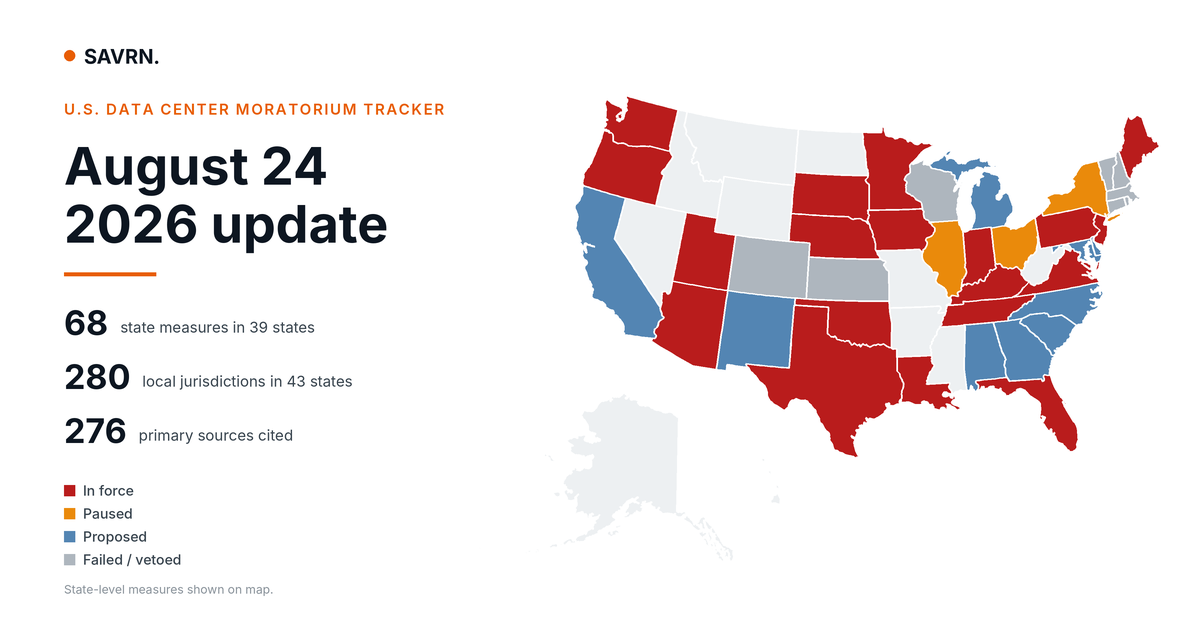
The U.S. Data Center Moratorium Tracker was refreshed on August 24, 2026. This is the record of what changed since the previous refresh on August 24, 2026. Every entry below links to the primary source behind it.
Where the count stands
| Measure | Previous | Current | Change |
|---|---|---|---|
| State-level measures | 46 | 68 | +22 |
| States with state-level action | 36 | 39 | +3 |
| Local jurisdictions | 242 | 280 | +38 |
| States with local action | 43 | 43 | 0 |
| Primary sources cited | 246 | 276 | +30 |
Of the 39 states with a state-level measure on the tracker, 19 have a restriction in force, 3 are under an active administrative pause, 9 have a measure pending, and 8 saw their most advanced measure fail or be vetoed.
Newly verified state measures from earlier periods
These actions were taken before this reporting period and were added once a primary source was confirmed. They are research gains, not new activity.
- Alabama, SB 270: PSC review of large-load data center contracts. Would require the Public Service Commission to ensure that utility contracts with data centers of 150 MW or more provide for cost recovery and demonstrable ratepayer benefit. Introduced; pending. Source
- Arizona, HB 2756: Rules for extra high load factor customers. Would direct the Corporation Commission to adopt rules for extra high load factor customers, including review of contracts before execution and cost-of-service studies. Introduced; pending. Source
- California, SB 886: Data center tariff and ratepayer protection. Sen. Steve Padilla’s bill would establish a tariff regime for data centers with 25 MW or more of peak demand, require them to pay transmission and distribution costs, and mandate onsite zero-carbon storage and demand response participation. Passed the Senate floor and moved to the Assembly. Source
- Delaware, HB 233 (Substitute 1): Large energy-use facilities bear their own infrastructure costs. Would require large energy-use facilities such as data centers to fully bear the cost of any new transmission or distribution infrastructure needed to serve them and bar shifting those costs to residential customers or small businesses. Passed the House on June 17, 2026 and moved to the Senate. Source
- Delaware, HB 445: 100% new energy requirement for large energy-use facilities. Would require large energy-use facilities to produce or procure enough new energy to meet 100% of their annual electricity needs within 10 years of beginning operations. Passed the House on June 17, 2026 and moved to the Senate. Source
- Florida, SB 484: Data center ratepayer, water and local-authority law. Signed by Gov. DeSantis and effective July 1, 2026. Defines a large-scale data center as a site with an anticipated monthly peak load of 50 MW or more, bars utilities from passing data center costs including electricity onto residential and small business customers, requires large users to pay their full cost of service, protects water resources, requires public disclosure of data center development deals, and preserves local government authority to set stricter standards or deny a project. Source
- Georgia, SB 476: Elimination of state tax credits reaching data centers. Would eliminate nearly all state-sponsored tax credits, precluding new data center tax credits. Passed the State Senate on Feb. 12, 2026; did not become law. Source
- Illinois, SB 4016 / HB 5513: Hyperscale self-generation and water transparency. Would require hyperscale data centers of 50 MW or more to fund their own energy generation from renewables, mandate water usage transparency and efficiency standards, and require environmental impact assessments. Before the Senate Artificial Intelligence and Social Media Subcommittee. Source
- Indiana, HEA 1210: Local payment in lieu of taxes from data centers. Signed March 12, 2026 and effective July 1, 2026. For a qualified data center whose local permit and transaction certificate are issued after June 30, 2026, the host county or municipality may require a quarterly payment of no more than 1% of the state sales and use tax not paid on the center’s electricity bill. The enacted version was narrowed from earlier proposals that would have set higher percentages. Source
- Maine, LD 713: Data centers excluded from state tax incentive programs. Signed by Gov. Mills on April 23, 2026. Defines data centers and excludes them from the Business Equipment Tax Exemption and the Dirigo Business Incentives Program, and directs the Department of Economic and Community Development to study financial incentives for data centers. Signed the day before Mills vetoed LD 307, the temporary moratorium bill. Source
- Maryland, SB 596: Demand response and storage for large-load customers. Would incentivize large-load customers of 25 MW or more to participate in demand response and onsite power storage programs. Introduced; pending. Source
- Minnesota, HF 16 (2025 1st Special Session): Data center energy, environmental and tax law. Effective June 15, 2025. Repealed the sales tax exemption on electricity purchases for qualified data centers as of July 1, 2025, authorized the Public Utilities Commission to create a very large customer class and to review and approve electric service agreements between such customers and a utility, added environmental and energy requirements, and imposed prevailing wage on construction of qualified large-scale data centers. Source
- New York, A 10141 / S 9144: Three-year halt on data center construction. Would halt all data center construction for a minimum of three years while regulators adopt rules to minimize impacts. Introduced in 2025; pending. Distinct from S10642/A11560, the one-year permitting pause the Legislature passed in 2026. Source
- North Carolina, H 1063: Ratepayer and Resource Protection Act. Would require all data centers in the state to publicly report electricity consumption, peak demand, water consumption, cooling systems and any emissions-free generation. Defines a large data center as one with projected peak demand of at least 40 MW and projected annual water use above 1 billion liters, and would bar such a center from beginning operation without on-site clean generation sufficient to offset at least 25% of projected peak demand, operational on day one, with off-site renewable energy credits and virtual power purchase agreements expressly not counting toward it. Filed April 2026. Source
- Oklahoma, HB 2992: Data Center Customer Ratepayer Protection Act of 2026. Authored by Rep. Brad Boles and Sen. Grant Green, signed in May 2026 and effective July 1, 2026. Defines large load customers as new facilities adding 75 MW or more of demand, requires electric suppliers to set separate rate structures and conditions for them so that families, small businesses and traditional industrial customers do not absorb their infrastructure costs, and requires developers to notify adjoining landowners, county commissioners and the Corporation Commission within 60 days of acquiring land for a qualifying project. Source
- Oklahoma, HB 4424: Sunset of data center tax incentives. Would end certain tax incentives for data centers not operational by Jan. 1, 2027. Introduced; pending. Source
- Pennsylvania, HB 2496: Municipal authority to pause data center proposals. Rep. Paul Friel’s bill would amend the Municipalities Planning Code to let an individual municipality pause consideration of data center proposals for six months while it drafts land use ordinances. The House passed it 201-1 on June 24, 2026. It was referred to Senate Local Government on June 25, reported as amended and re-referred to Rules and Executive Nominations on June 30, 2026, where it awaits action. Source
- South Carolina, S 867: Data Center Development Act. Would create a Data Center Development Office within the Department of Environmental Services and require a state-issued siting permit before any new data center could begin operations. The Senate Agriculture and Natural Resources Committee gave it a favorable report on April 28, 2026, sending it to the full Senate. Source
- South Carolina, S 902: Data center siting permits through the PSC. A companion approach to S 867 that would task the Public Service Commission with overseeing data center permitting statewide. It carries weaker ratepayer provisions than S 867 and omits the brownfield site provisions. Source
- South Dakota, SB 135: Data Center Bill of Rights for Citizens. Signed by Gov. Rhoden on March 30, 2026 and effective July 1, 2026. Requires data centers with peak electrical demand of 10 MW or greater to pay for any rate increases they cause, adds water use regulation, and prohibits the state from limiting local governments’ authority to regulate or ban data centers. Lawmakers passed it after rejecting the SB 232 statewide moratorium, moving that decision to localities instead. Source
- Tennessee, HB 1847 / SB 2128: Data Center Cost Responsibility Act. Signed by Gov. Lee on May 7, 2026 and effective on signing. Requires owners and operators of proposed and existing data centers to pay the full cost of the utility infrastructure needed to serve them and bars electric utilities from raising other customers’ rates to support data centers. The Senate passed it unanimously; the House passed it 76-14. Source
- Washington, HB 2515: Clean energy procurement and cost obligations. Would set clean energy procurement targets, place cost-shifting obligations on large-load customers, and restrict utilities’ use of cap-and-invest allowances for data center customers. Introduced; pending. Source
New local measures this period
- Westover, AL: Six-month moratorium on data centers. The City Council voted unanimously on Aug. 18, 2026 for a six-month moratorium on data centers after residents objected to a proposed campus on more than 450 acres along Highway 280. Mayor Bobby Pardue said the pause gives the city time to change its rules; the Planning Commission is reviewing zoning and development standards. Source
- Palm Springs, CA: Proposed temporary data center moratorium. The City Council placed a temporary moratorium on new data center development on its Aug. 26, 2026 agenda for consideration. No vote had been taken as of this update. Source
- Washington County, FL: One-year moratorium on data center applications. The Board of County Commissioners approved a one-year moratorium on accepting, processing, reviewing and approving applications for data centers and large-scale data processing facilities in unincorporated Washington County at its Aug. 20, 2026 meeting. The county will study impacts and update its Land Development Code and Comprehensive Plan. Source
- Ypsilanti Township, MI: 180-day moratorium on major electric utility infrastructure. The Board of Trustees voted unanimously on Aug. 18, 2026 for a six-month moratorium on major electric utility infrastructure serving high-energy-demand uses, expressly including hyperscale and mid-sized data centers and AI computing facilities. The township, which had already paused water service for data centers, is seeking to slow a proposed University of Michigan and Los Alamos computing project and an associated 110 MW DTE substation. Source
- Town of Mohawk, NY: Six-month moratorium on data center permitting. The Town Board adopted a local law imposing a six-month moratorium on permitting or installing data centers, running through Feb. 13, 2027, while officials draft zoning laws. Town officials acted after concluding the state’s hyperscale threshold of 50 MW did not reach the scale of project they were concerned about. Source
- Town of Tonawanda, NY: One-year moratorium on data centers of 20 MW or more. The Town Board voted unanimously on Aug. 4, 2026 for a one-year moratorium barring new applications for data centers requiring 20 MW or more. Supervisor John Flynn said the local measure mirrors Executive Order 62 but reaches below the state order’s 50 MW threshold. Source
- Gregg Township (Union County), PA: 180-day moratorium on data center applications. Supervisors adopted Resolution 2026-03 at a special meeting on Aug. 20, 2026, barring the acceptance, processing and approval of new data center or ‘technical development’ applications for a period not to exceed 180 days or until the board terminates it. The pending PNK Group application is excluded and continues to be processed separately. Source
Newly verified local measures from earlier periods
These actions were taken before this reporting period and were added once a primary source was confirmed. They are research gains, not new activity.
- Birmingham, AL: Six-month pause on large data center applications. The City Council voted on March 3, 2026 for a six-month moratorium on new or expanding data centers drawing more than 20 MW. In June 2026 the council passed a zoning ordinance, on a 6-3 vote, setting conditions for hyperscale facilities that takes effect when the moratorium lifts. Source
- Chelsea, AL: One-year moratorium on data center licenses and permits. The City Council voted unanimously on July 21, 2026 for a one-year moratorium on new business licenses and construction permits for data centers, paired with a parallel moratorium on residential rental developments. Council Vice President Chris Gace said the city’s zoning ordinance does not adequately address the use and that no project had been proposed. Source
- Homewood, AL: Twelve-month moratorium on new data center applications. The City Council approved a 12-month moratorium on new data center development applications on June 22, 2026, with an option to extend it a further six months. No applications were pending. City staff and the Planning Commission are to study whether zoning, operational, buffering or infrastructure standards should be adopted first. Source
- Leeds, AL: One-year moratorium on data center development. Ordinance 2026-06-02, adopted unanimously on June 8, 2026, pauses acceptance, processing and approval of applications for new data centers or expansions of existing facilities for one year. The council cited energy and water consumption, cooling and generator noise, and compatibility with surrounding land uses. No project was pending at adoption. Source
- Springville, AL: Moratorium on data centers. The City Council placed a moratorium on data centers at its July 6, 2026 meeting, joining nearby Leeds. Council members questioned the employment case for the facilities while the city reviews its zoning rules. Source
- Armada Township, MI: Local moratorium on data center approvals. Adopted Jan. 14, 2026 for 180 days. Recorded in WKAR’s Michigan data center tracker of local moratoria. Source
- Big Rapids Township, MI: Local moratorium on data center approvals. Adopted Feb. 23, 2026 for one year. Recorded in WKAR’s Michigan data center tracker of local moratoria. Source
- Clark Township, MI: Local moratorium on data center approvals. Adopted June 2025 for one year. Recorded in WKAR’s Michigan data center tracker of local moratoria. Source
- Dundee Township, MI: Local moratorium on data center approvals. A 90-day moratorium adopted and then extended as of October 2025. Recorded in WKAR’s Michigan data center tracker of local moratoria. Source
- Eagle Township (Clinton County), MI: One-year data center moratorium and interim zoning ordinance. Adopted Feb. 18, 2026 and running through Feb. 17, 2027, paired with an interim zoning ordinance while the township completes regulatory studies. Source
- Grand Blanc Township, MI: Local moratorium on data center approvals. Adopted Jan. 21, 2026 for one year. Recorded in WKAR’s Michigan data center tracker of local moratoria. Source
- Green Charter Township, MI: Local moratorium on data center approvals. Adopted Dec. 9, 2025 for one year. Recorded in WKAR’s Michigan data center tracker of local moratoria. Source
- Hayes Township, MI: Local moratorium on data center approvals. Adopted Feb. 10, 2026 for 180 days. Recorded in WKAR’s Michigan data center tracker of local moratoria. Source
- Howell Township, MI: Local moratorium on data center approvals. Adopted Nov. 20, 2025 for six months. Recorded in WKAR’s Michigan data center tracker of local moratoria. Source
- Lenox Township, MI: Local moratorium on data center approvals. Adopted Feb. 2, 2026 for four months with an extension option; the board described it as a lawful pause to study zoning rather than a ban. Recorded in WKAR’s Michigan data center tracker of local moratoria. Source
- Lodi Township, MI: Local moratorium on data center approvals. Adopted Feb. 3, 2026 for 180 days. Recorded in WKAR’s Michigan data center tracker of local moratoria. Source
- Manchester Township, MI: Local moratorium on data center approvals. Adopted Oct. 14, 2025 for two years. Recorded in WKAR’s Michigan data center tracker of local moratoria. Source
- Mason, MI: Data center moratorium lifted after zoning adopted. Mason enacted a moratorium on Jan. 6, 2026 and lifted it on Feb. 3, 2026 after adopting new zoning rules for data centers. The pause is no longer in force; the replacement zoning is. Source
- Northville, MI: Local moratorium on data center approvals. Adopted Jan. 6, 2026 for 12 months. Recorded in WKAR’s Michigan data center tracker of local moratoria. Source
- Pittsfield Township, MI: Local moratorium on data center approvals. Adopted Nov. 18, 2025 for 180 days. Recorded in WKAR’s Michigan data center tracker of local moratoria. Source
- Saginaw, MI: Local moratorium on data center approvals. Adopted Jan. 13, 2026 for six months. Recorded in WKAR’s Michigan data center tracker of local moratoria. Source
- Saline, MI: Local moratorium on data center approvals. Adopted Jan. 12, 2026 for 12 months. Recorded in WKAR’s Michigan data center tracker of local moratoria. Source
- Solon Township, MI: Local moratorium on data center approvals. Adopted in early February 2026 for six months. Recorded in WKAR’s Michigan data center tracker of local moratoria. Source
- South Lyon, MI: Local moratorium on data center approvals. Adopted Feb. 10, 2026 for 12 months. Recorded in WKAR’s Michigan data center tracker of local moratoria. Source
- Sylvan Township, MI: Local moratorium on data center approvals. Adopted Jan. 22, 2026 for six months. Recorded in WKAR’s Michigan data center tracker of local moratoria. Source
- Taylor, MI: Local moratorium on data center approvals. Adopted January 2026 for one year. Recorded in WKAR’s Michigan data center tracker of local moratoria. Source
- Tyrone Township, MI: Local moratorium on data center approvals. Adopted Dec. 2, 2025 for six months. Recorded in WKAR’s Michigan data center tracker of local moratoria. Source
- Village of Romeo, MI: Local moratorium on data center approvals. Adopted Jan. 26, 2026; the tracker lists the duration as unverified. Recorded in WKAR’s Michigan data center tracker of local moratoria. Source
- York Township, MI: Local moratorium on data center approvals. Adopted Feb. 12, 2026 for six months. Recorded in WKAR’s Michigan data center tracker of local moratoria. Source
- Town of East Greenbush, NY: Six-month moratorium on data center land use approvals. The Town Board voted unanimously on July 15, 2026 for a local law imposing a six-month moratorium on applications for permits, site plans and other land use approvals for data centers, with an authorized six-month extension. The town cited water use and quality, infrastructure, noise and community character. Source
- Port Washington, WI: Referendum requiring a public vote on large tax incentives. Voters approved the nation’s first anti-data-center referendum in April 2026 with roughly 66% support, requiring that approval of tax incremental financing for any project with a base value or cost above $10 million be put to a community vote. It followed Vantage Data Centers’ announcement of a $15 billion AI campus with OpenAI and Oracle; the referendum does not stop that project, which was already under construction with $458 million in approved tax benefits. Source
Status changes
No entry on the tracker changed status during this period.
Removals
No entries were removed. The tracker merges forward: a sourced entry stays on the list unless a new source shows its status changed or it was formally repealed.
How this tracker is maintained
The tracker is refreshed weekly. Every entry requires a verifiable primary source: a legislature page, a governor’s office, a local government record, or established news reporting. Entries are merged rather than replaced, so a measure verified in an earlier week is not dropped because a later pass did not resurface it. Where a measure is single-sourced or a date could not be independently confirmed, the entry says so.
The full dataset, with a filterable map and all 276 citations, is at the U.S. Data Center Moratorium Tracker. The complete source list is at the tracker’s sources page.
Would you like the weekly update?
Every week we re-verify every state and local measure on this map and publish what changed. You get one email when it goes out. Nothing else.
One email when it publishes. Unsubscribe in one click. Privacy