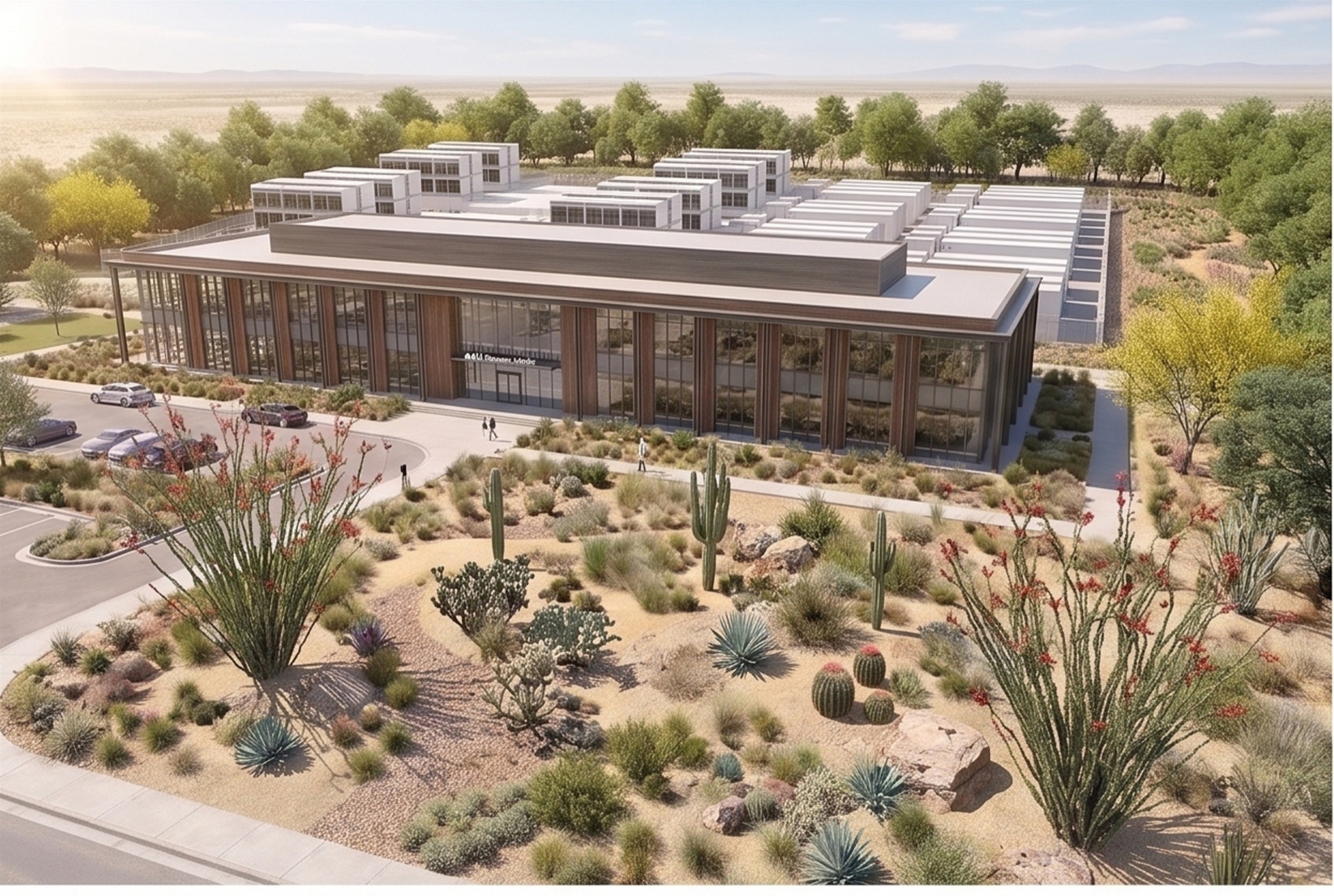
The SAVRN Imperial Valley Intelligence Center is a locally operated intelligence and learning campus, built on the site of a retired biomass power plant — a brownfield idle since 2008, brought back to work with new on-site generation. The campus's power operates under the site's own existing water rights — and the data center itself uses no water to cool its computers, only ordinary human water for restrooms and handwashing. It opens with a Community Learning Center — because the point is not to put a building in the Valley. It is to put the Valley in the AI economy.

Imperial County has the talent and the training institutions. What it has lacked is a place where that training leads to durable, well-paid technical work at home. That is the gap this campus is designed to close — not with a slogan about jobs, but with a school, a paycheck, and a ladder.
Imperial Valley College already teaches electrical technology, HVAC/R, welding, water treatment, industrial automation, computer networking, and cybersecurity. The Intelligence Center connects that existing pipeline to real paid roles on a real campus — instead of importing its workforce.
Residents are already debating a very different proposal nearby — a roughly 950,000-square-foot, water-cooled facility that asks the community to supply hundreds of megawatts of new grid service and, per public accounts, up to 750,000 gallons of water per day. The questions being asked of that project are fair. Here is how this project answers them.
A physical Community Learning Center on campus from Phase 1 — classrooms, a secure computing lab, simulation workstations, and a workbench floor — with a locally recruited, paid pathway into power-plant operations, electrical, controls, networking, security, and AI-infrastructure careers. Curriculum co-designed with Imperial Valley College within 120 days of the project's final investment decision.
Secure compute, data, and recovery services that Valley institutions can actually use — for agriculture, water, education, emergency preparedness, and industrial operations. No school district or water agency should have to hand its data to a distant cloud to benefit from AI.
On-site power at a redeveloped brownfield energy site, operating under its own existing water rights. A data center that uses no water for cooling — its only water use is human. Traffic and access improvements funded by the project, not the public. Biological monitoring and mitigation — including protections for the burrowing owls documented in regional surveys — paid for by the project.
Construction, energy-site redevelopment, and operating procurement that gives qualified Valley firms a real path to compete: a published bid calendar, at least four local supplier workshops, a local-vendor registry, and public reporting of the share of addressable spend awarded locally.
Dual-enrollment and career-exposure pathways with Valley high schools, feeding into the Institute.
A stackable certificate (288–528 clock hours) with a paid placement on the operating campus.
Certificates stack into associate-degree pathways delivered with Imperial Valley College — which also offers a four-year B.S. in Industrial Automation.
SDSU Imperial Valley operates in Calexico and Brawley — criminal justice, public administration, nursing, public health, and graduate programs including homeland security.
Every rung of the ladder is inside Imperial County. A student can climb from a high-school classroom to a paid technical career — and on to a bachelor's degree — without ever leaving the Valley. That is the gap this campus closes: not the absence of talent, but the absence of a ladder. Explore The Orbital — the full ladder, in depth →
The Community Learning Center delivers the SAVRN Institute — the workforce school SAVRN ships with every campus it builds. A complete AI-infrastructure curriculum exists today: departments, courses, hands-on lab procedures written against real AI-factory systems, stackable certificates, and associate-degree pathways — adapted with Imperial Valley College for the Valley.
Certificates earned one at a time build into associate-degree pathways: Critical Facilities Operations, Electrical Power & Protection, Liquid-Cooled Mechanical Systems, and AI / Compute Operations. A student can stop at a paying credential — or keep stacking toward a degree.
The curriculum prepares students for credentials employers everywhere recognize — so a graduate's options grow, whether they stay on campus or not.

Counts are drawn from the live SAVRN Institute curriculum system — 344 mapped weekly sessions across the 34 courses. State licensure pathways are adapted to California requirements for the Imperial Valley campus.
A defined annual pool of computing, lab time, and technical support — beginning at a $250,000-per-year in-kind allocation once Phase 1 operates — is reserved for Imperial Valley College, schools, nonprofits, public-interest research, and qualified local institutions. Governed, secure, and reviewed annually with a community advisory group. Priority goes to projects with a clear local beneficiary:
The Lithium Valley priority is deliberate: the county's own initiative to recover lithium from Salton Sea geothermal brine is one of the most important economic efforts in the region. Protected research environments on this campus can give university and public-sector researchers a place to run that work — geothermal modeling, brine chemistry, environmental monitoring — inside the county it belongs to.
Most AI infrastructure asks a community to send everything away — its power, its water, its data, its talent — and trust that value comes back. A sovereign campus is built on the opposite principle: what the Valley produces, the Valley keeps.
Qualified Imperial County public institutions — the County, cities, school districts, water and irrigation agencies — can run AI workloads in governed environments that are processed locally, auditable, never mined, never sold, and never used to train anyone else's models. That covers the records that legally can't wander: student data, health data, justice data, water and grid telemetry.
The campus generates its own power and runs its own compute — so it can hold backup and disaster-recovery capacity for qualified local agencies, and priority emergency compute when grid or cloud services fail. The security watch floor is staffed through the Institute's own security and cyber track: local students trained here, defending the Valley's institutions.
Imperial County agriculture is a multi-billion-dollar economy, and farm data — irrigation, yields, soil, water orders — is exactly what growers should never have to surrender to distant platforms. If Valley agriculture wants it, this campus will host and support a grower-governed data cooperative: pooled analytics for irrigation and crop planning, with ownership retained by the growers and access rules set by the growers.
More than four in five Imperial County residents are Hispanic, in one of the most heavily Spanish-speaking regions in California. Sovereign, locally run models can be tuned and evaluated for bilingual service delivery — county service navigation, school tutoring support, health-access interpretation — running on the Valley's own infrastructure instead of a generic distant cloud.
"We will earn the right to operate here by protecting local resources, paying for our own impacts, and reporting what we deliver."
Commitments without measurement are marketing. Each community commitment is paired with the public evidence that shows whether it was kept — published annually, explained when a target is missed.
On-site generation and reliability, any grid imports or exports, emissions and permit compliance, traffic improvements completed, and environmental compliance — in plain language, every year.
Enrollment, completions, paid placements, job offers, wage bands, and retention at 12 and 24 months. Local-resident share of hires and promotion rates for the operating team.
The published allocation, approved projects, student and resident users, lab utilization, and outcomes — reviewed with the advisory group. No sensitive customer or agency data is ever disclosed.
IVC, workforce, County and municipal, water and energy, and community representatives advise on curriculum, Commons eligibility, and the annual report — with two public briefings a year during development and the first three years of operations.
The Valley should never be asked to accept a full build-out on faith. The campus grows in phases, and each phase opens only after the previous one has published its results — for the infrastructure and for the community benefits alike.
The project pays for its own parcel studies, forms the IVC working group, designs the Learning Center, and publishes its principles — before asking for anything.
The energy plant is commissioned; the Community Learning Center, paid placements, Compute Commons, local procurement program, and first public dashboard all open with it.
Cohorts, local hiring, and community compute scale only after Phase 1 results are published and every community commitment is in good standing.
Expanded research partnerships and capacity — with audited community benefits as a standing condition of growth, not a launch-day press release.
The full education-to-career ladder in depth — dual enrollment, certificates with paid placement, degrees, all in-county.
Climb The Orbital →The whole pictureThe master document — the site, the energy platform, the operating model, and how every part fits together.
Open the strategy →