Behind the Meter AI Power: The 2026 Operator's Field Guide
Own the watt before the utility owns the wire. Why behind-the-meter power is how an AI campus ships this year instead of waiting five — and how it keeps a town's grid untouched.
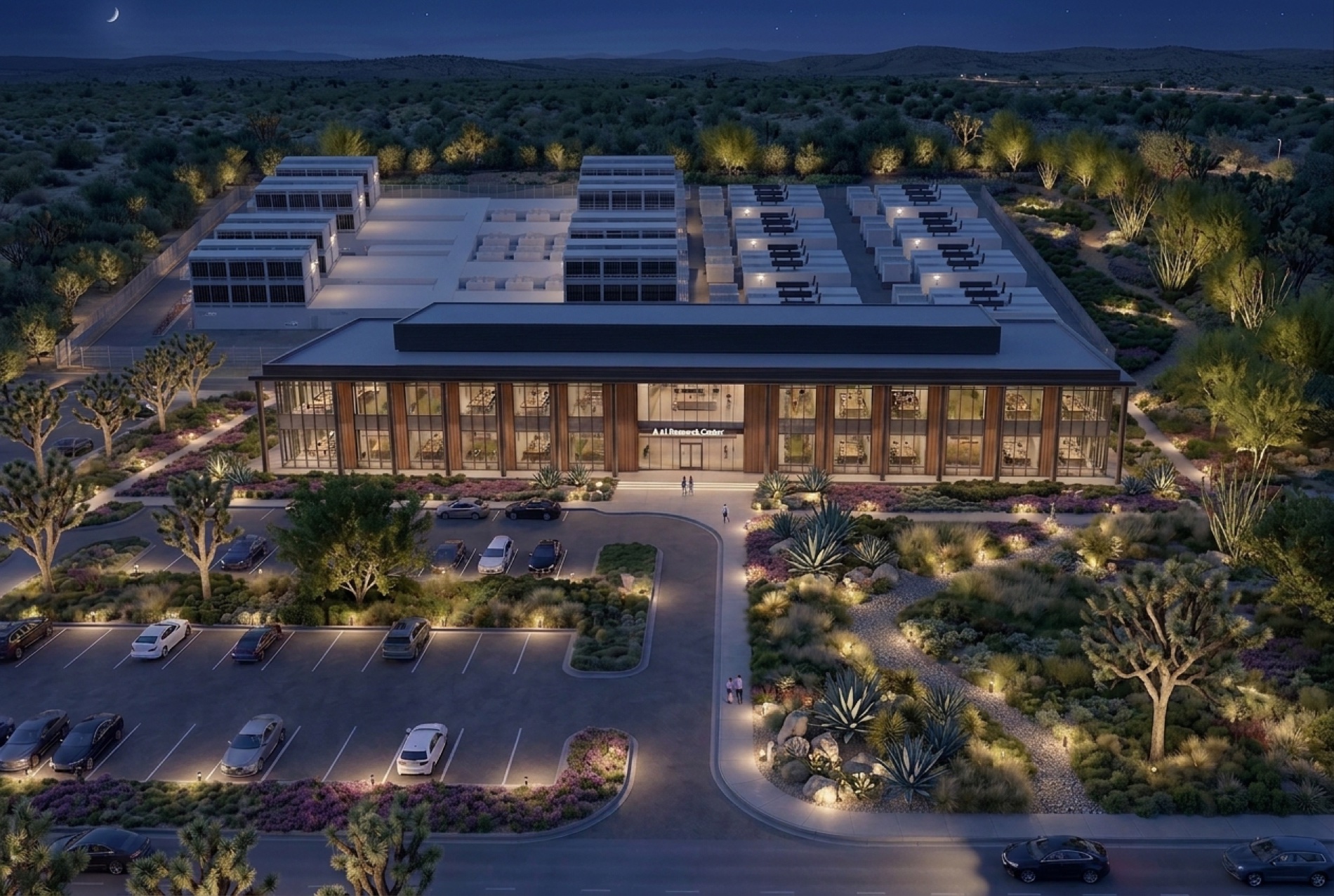
Here is the whole idea in one line: own the watt before the utility owns the wire. That is behind the meter AI power — generation sited on your own campus, ahead of the utility’s revenue meter, dispatched straight to the load. In 2026, it is the single decision that separates an AI campus that ships this year from one that waits half a decade for permission.
I have watched the alternative up close. A grid-connected build now waits roughly five years for a high-voltage interconnection, and the median wait has roughly doubled over the last decade. Worse, about four in five queued projects never get built at all, per RMI’s Queued Up 2024 analysis. So a developer who joins the queue today is signing up for a five-year clock and a four-in-five chance of failure. Behind-the-meter power skips both. You generate on site, you island from the grid, and the utility’s calendar stops being your calendar.
The full data behind this guide — queues, deals, and generation costs — lives on our behind-the-meter research page.
Why the grid stopped being the fast path
The grid is no longer where electrons come from quickly, and the numbers are not close. For example, that same analysis puts roughly 2,600 gigawatts of capacity stuck in study limbo across U.S. grids — more than twice the country’s entire installed fleet, standing in line. Meanwhile, demand is going vertical. Goldman Sachs Research projects data-center power demand rising on the order of 165% by 2030, and the BloombergNEF now flags AI as the fastest-growing electricity load in the advanced economies.
Put those two facts side by side and the conclusion is unavoidable. Demand is exploding at the exact moment the on-ramp to the grid is seizing up. Therefore every gigawatt a builder can stand up behind the meter is a gigawatt that ships years sooner than its grid-tied twin — and in this market, years sooner is the entire ballgame.
The deals that proved it
You do not have to take my word that this is the new default. Instead, watch what the largest buyers in the world actually did. For example, when Microsoft needed firm power for AI, it signed a long-term deal tied to restarting a reactor at Three Mile Island, as Reuters reported. Similarly, when Amazon needed it, it bought a data-center campus beside the Susquehanna nuclear plant and contracted the power directly, in its deal with Talen Energy. Meanwhile, Meta and Google have moved the same way, chasing on-site and adjacent generation at a scale nobody attempted three years ago.
Notably, these are the companies with the most political weight and the deepest benches for grinding through a utility queue. If anyone could have muscled through interconnection, it was them. Instead, they went around it. When the hyperscalers stop waiting for the grid, the signal for everyone else is not subtle.
The generation stack, and what each is good for
Behind-the-meter is a decision about where the power is made. The next decision is how, and there is no single right answer — only the right fit for a site and a timeline.
Natural-gas reciprocating engines and aeroderivative turbines are the workhorses of fast, firm, dispatchable power today. Because they site and permit relatively quickly and ramp on demand, they are how most large behind-the-meter projects actually get electrons in 2026.
Solar plus long-duration storage is the clean-baseload play, and it improves every year. However, it carries land and capacity-factor constraints, so on most campuses it pairs with firm generation rather than standing alone.
Small modular reactors, by contrast, are the late-decade answer — genuinely promising for dense, firm, carbon-free power, but not a 2026 delivery option. Notably, anyone selling you an SMR-powered campus this year is selling a slide, not a schedule.
Finally, fuel cells, hydrogen, and hybrid topologies fill specific niches, especially where emissions limits or fuel logistics favor them. Increasingly, the real-world answer is a hybrid: firm generation for the floor, storage for the swings, and renewables for the carbon profile.
The math nobody runs correctly
People reach for levelized cost of energy and hold it up against the blended grid rate. That comparison is not wrong; it is incomplete. The comparison that actually decides the project is between power you can have in twelve months and power you might have in five years, if the queue clears at all.
Two costs get left out of the naive model. First, the time cost. A campus that earns eighteen months sooner has a completely different return than one that does not, regardless of cents per kilowatt-hour. Second, the queue cost. A large grid request frequently triggers network-upgrade studies worth hundreds of millions of dollars — often more than the load itself. Factor both in, and on-site generation wins on a basis the spreadsheet never showed.
One more number the brochures skip: the watt you generate is not all sellable. Heat rejection and cooling overhead take their cut. That is precisely why the generation and the liquid-cooling loop have to be engineered as one system rather than bought from two vendors and married on site.
What it actually takes to run it
On-site generation is a permitting and operations problem, not just a procurement one. Specifically, combustion generation pulls in federal review where there is a federal nexus, EPA Title V air permits, and state air permits; moreover, siting brings noise and visual-impact questions a community will, rightly, ask about. None of this is exotic, but all of it is real work, and notably, an operator who waves it away has never built one.
There is also a fork in how the plant runs. Island-mode means the campus stands fully apart from the grid. Parallel means it synchronizes with the grid for backup or export, which buys flexibility but pulls you back into interconnection and market rules. Importantly, island-mode is also where the community benefit lives. Because the campus runs islanded, it adds no new load to the public grid — so the town’s rates, its reliability, and its queue position are untouched by our arrival. The same decision that frees us from the queue is the decision that makes us a good neighbor.
When the grid still wins, and when behind-the-meter wins decisively
I am not going to tell you on-site power is always the answer. For example, for a small load on a site that already has spare grid capacity, or for a short-lived project, the grid is simpler and probably cheaper. By contrast, behind-the-meter wins decisively in the other cases: a large new load, a site with no grid headroom, a buyer who cannot afford a five-year wait, or an operator who wants to own reliability instead of renting it. Finally, where a grid connection exists but is slow, the hybrid case is often best — behind-the-meter as the primary source, with a parallel grid tie for backup.
How we do it
SAVRN owns its generation, so interconnection is never the gate. Specifically, we pre-identify sites where power and offtake are already lined up, build the liquid-cooled pods on a line in Fort Worth, and assemble the campus while a conventional project is still in its interconnection study. As a result, the timeline collapses from 24-to-48 months to 6-to-12. It is the same integrated model behind every campus we build — see the AI factory playbook for how the power, the cooling, and the compute fit together as one machine.
Why we make this the default
Behind-the-meter is usually sold as a speed play, and it is one. However, for us it is also the engineering that lets us keep a promise. Specifically, my grandparents’ rule was that you give more than you take, and the cleanest way to take nothing a community needs is to never reach for its grid in the first place. As a result, we generate our own power and island it, so the town’s electricity stays the town’s. Speed and good-neighbor design are not two strategies here; they are the same decision. If you want the wider picture, read the rest of the SAVRN model or our other field notes.
Frequently asked questions
Does behind-the-meter power mean the campus is fully off-grid?
Not necessarily. A campus can run in island-mode, fully apart from the grid, or in parallel, synchronized to it for backup. Specifically, the choice is an engineering and regulatory decision per site, not a fixed property of the model.
What happens during generation maintenance — is there a single point of failure?
No, when it is designed correctly. Firm on-site plants are built with redundancy — N+1 generation, storage to ride through swings, and, where it exists, a parallel grid tie as a backstop. Therefore scheduled maintenance does not mean a dark campus.
Can the campus sell excess power back to the grid?
Sometimes, in a parallel configuration and where market rules allow. However, export pulls you into interconnection and wholesale-market obligations, so it is a deliberate trade-off rather than a free upside.
Does behind-the-meter power trigger FERC or wholesale-market rules?
Pure island-mode generally avoids them, because you are not transacting on the grid. By contrast, parallel operation and any export can trigger them, which is one more reason the island-versus-parallel decision is made early and on purpose.
Is on-site power actually cheaper than grid power?
Sometimes on levelized cost, but that is not where the real advantage sits. The decisive savings are time and control — shipping years sooner, and avoiding the network-upgrade studies a large grid request can trigger.
Does behind-the-meter power solve the AI water problem?
No, and it is important not to conflate the two. Behind-the-meter solves power siting; it does nothing about cooling water on its own. The water question is solved separately, by a closed-loop cooling system that draws no municipal supply.
Is behind-the-meter power suitable for defense or air-gapped workloads?
Yes, and it is often the point. Because the campus generates and islands its own power, it can operate independent of public infrastructure, which is exactly what defense-grade and air-gapped deployments require.
What is the emissions profile of on-site generation?
It depends entirely on the stack. Gas generation carries emissions and the permits that go with them, while hybrids that lean on storage and renewables cut that profile substantially. In all cases the plant is engineered to meet the applicable air-quality standards, not to skirt them.
Can an existing grid-tied data center add behind-the-meter power?
Sometimes, as an augmentation to relieve a constrained grid connection. That said, bolting generation onto a building that was not designed for it usually underperforms a purpose-built campus where power, cooling, and compute were integrated from the start.
Realistically, how fast can behind-the-meter power deploy?
Standalone gas or solar-plus-storage typically lands in the 12-to-24-month range. Within our integrated model, where the generation and the compute are built in parallel, a campus reaches token-bearing operation in 6 to 12 months.