AI Campus Colocation: The Integrated Model
Renting a cage in a shared hall was built for 15-kilowatt racks. AI needs ten times that. Here's colocation reimagined as an owned, integrated campus — on power and water a town keeps.
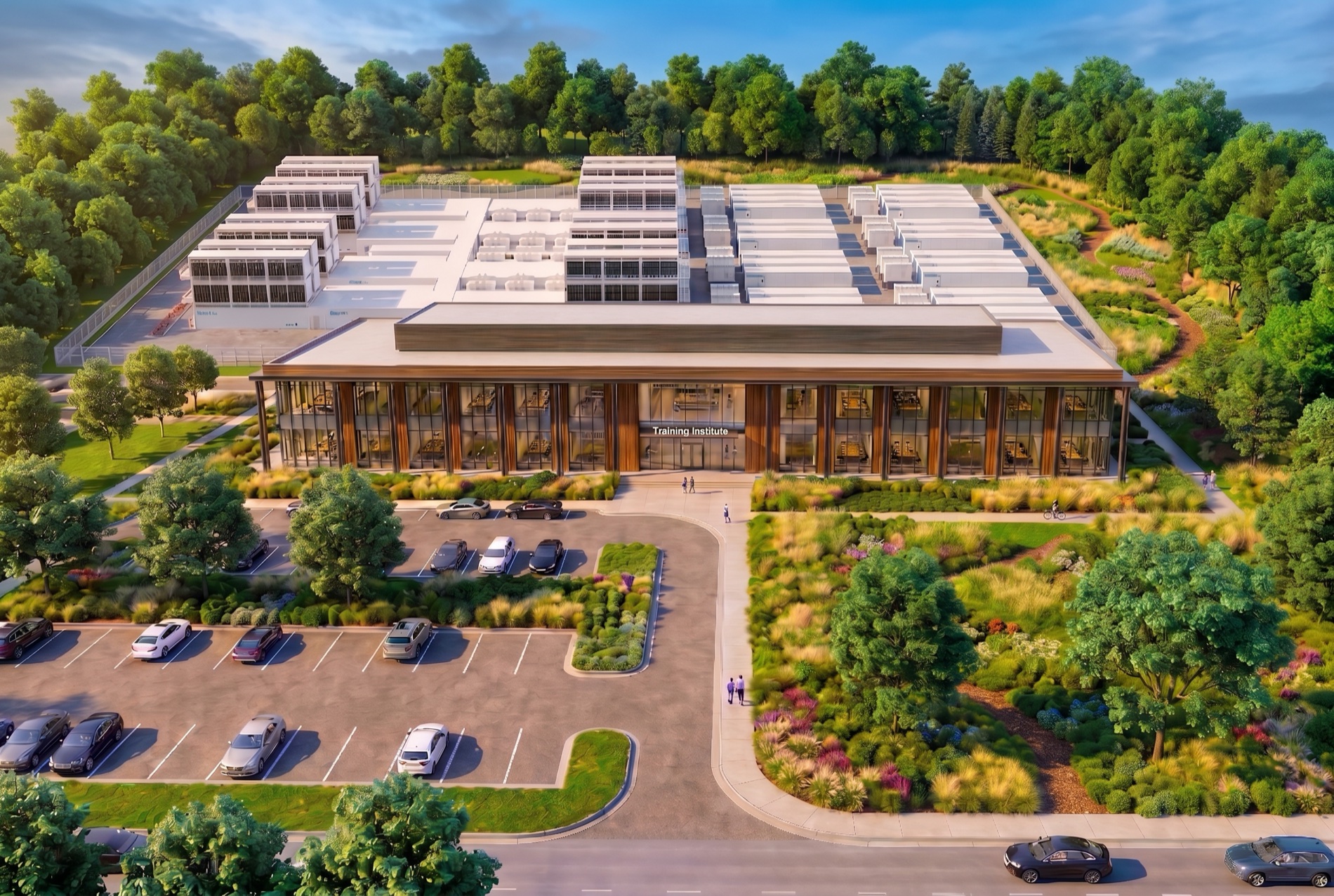
AI campus colocation is what colocation has to become when the workload is AI. The old model — rent a cage and some power in someone else’s shared hall — was built for a world of 10-to-15-kilowatt air-cooled racks and utility power. That world is gone. So this is the version that actually carries AI: an owned, integrated campus where the power, the cooling, and the compute are designed and operated as one, rather than rented in pieces.
The reason is physical, not philosophical. IDC’s infrastructure research documents densities and power demands that the traditional shared hall was never built to hold, and Morgan Stanley projects AI driving data-center power demand sharply higher through 2030. When the rack draws ten times what the building was designed for and the power has to come from the campus itself, “rent a cage” stops being an answer.
Every figure here is sourced in full on our colocation research page.
Why traditional colocation cannot carry AI
Traditional colocation optimized for a specific rack: around 10 to 15 kilowatts, cooled by air, fed by a utility power-purchase agreement, in a hall shared by many tenants. Each of those assumptions breaks under AI. Specifically, an AI training rack draws 80 to 130 kilowatts, which air cannot cool; the campus needs firm power the local utility often cannot deliver on any useful timeline, on a grid the U.S. Department of Energy reports is under mounting strain; and the data and density of a serious AI workload do not belong in a shared environment. Therefore an AI workload in a traditional colocation hall is a compromise on every axis at once.
What AI campus colocation actually is
Therefore the fix is integration, and ownership. An AI campus colocation site is not a shared hall with denser racks bolted in. Rather, it is a campus where on-site power generation, liquid cooling, and high-density compute are engineered together as a single system, and where the buyer holds the asset instead of renting space in it. Because the three systems are designed as one, the campus reaches densities and efficiencies a retrofit hall cannot, and because it is owned, the buyer keeps the control and the value that renting gives away.
The power architecture is the dividing line
Specifically, power is where the two models part ways completely. Traditional colocation passes through a utility bill and the utility’s queue; an AI campus generates its own power on site and islands it from the grid. Consequently, it skips the multi-year interconnection wait, and — this is the part that matters to the host town — it draws no capacity from the public grid at all. The same decision that gives the buyer firm, fast power is the decision that takes nothing from the community’s grid. The power field guide walks the engineering in full.
Cooling and density decide the rest
Moreover, once the power is owned, the cooling has to match the density. Because AI racks run far past the air ceiling, an AI campus uses liquid cooling as the default — and because the loop is closed, it draws no municipal water. Refusal and gift, again, in the plumbing: take no town water, keep the heat, run the density AI actually needs.
Why the integrated, owned model wins
Ultimately, put the pieces together and the case is plain. An owned, integrated campus delivers the density, the firm power, the data control, and the unit economics that a shared rented hall cannot — and it does it on power and water the community keeps. For most serious buyers — enterprises, institutions, regulated operators — that is the deciding combination. The traditional colocation hall remains fine for low-density, short-horizon workloads; it simply is not where production AI belongs.
Why I build it this way
I will be plain about the part that matters to me. Notably, renting space in a far-off shared hall sends the jobs, the power demand, and the value somewhere else. An owned, integrated campus keeps them where the work is — local power we generate, local water we never take, local people we train to run it. My grandparents taught me to give more than you take, and an integrated campus is how a buyer owns its compute and a community keeps the upside. See how the systems fit together in the AI factory playbook, or read our other field notes.
Frequently asked questions
How is AI campus colocation different from traditional colocation?
Traditional colocation rents you space and power in a shared, air-cooled hall built for low-density racks. AI campus colocation is an owned, integrated campus — power, cooling, and compute engineered as one — built for AI density. In short, one is a lease, the other is an asset.
Why can't I just put AI racks in my existing colocation space?
Because the hall was built for about 15 kilowatts a rack and air cooling, and AI racks draw far more than air can remove. Therefore the racks either throttle or overheat, and the power the campus needs usually exceeds what the building and its utility feed can deliver.
Does AI campus colocation require owning the power?
In practice, yes. Because firm power at AI scale is the binding constraint, generating it on site is what makes the model work and what removes the interconnection queue. Renting power leaves you exposed to the same grid delays that stall conventional builds.
Who should choose AI campus colocation over a shared hall?
Buyers with sustained, high-density, or sensitive workloads — enterprises, institutions, and regulated operators. By contrast, a short-horizon or low-density workload may still be fine in a traditional hall; the integrated campus is for production AI.
How do I evaluate an AI campus colocation partner?
Ask who owns the power, whether the cooling is built for 80-plus kilowatts, and whether the campus is integrated or a retrofit. Notably, the single best tell is owned on-site generation, because without it the partner is quoting you into the same grid queue everyone else is in.
Is an owned campus more expensive than renting colocation?
Higher up front, lower over its life. Because renting pays a margin on every kilowatt forever while owning amortizes a campus you keep, sustained AI workloads cross over in the owner’s favor — and owned power widens that gap.
What about data control and compliance?
An owned, integrated campus keeps the data path inside a perimeter you control, which makes residency and isolation design facts rather than contract terms. For regulated workloads, that is frequently the deciding factor over a shared environment.
Can an AI campus scale as my needs grow?
Yes, by adding modular blocks rather than renegotiating a lease. Consequently, capacity ramps with demand, and the campus you own grows with the workload instead of capping it at a landlord’s terms.
How fast can an AI campus colocation site come online?
Six to twelve months when the power is owned and the blocks are factory-built, versus the years a grid-dependent build takes. The speed comes from generating power on site and building the compute in parallel with the civil work.
Does an AI campus colocation site affect the host community's utilities?
By design, it should not. Because the campus generates its own power and runs a closed water loop, it draws no grid capacity and no municipal water — the opposite of the strain a large grid-tied tenant places on a town.