The Engineered Solution: Why Liquid Immersion Cooling Dominates Modern AI Infrastructure
The Thermal Challenge Reshaping Data Centers Modern data center cooling represents far more than operational maintenance—it’s becoming the defining factor in competitive AI infrastructure. As enterprises deploy increasingly powerful AI workloads, including large language models (LLMs) and real-time inference pipelines, traditional cooling approaches face fundamental limitations. NVIDIA’s H100 GPU demands up to 700 watts per […]
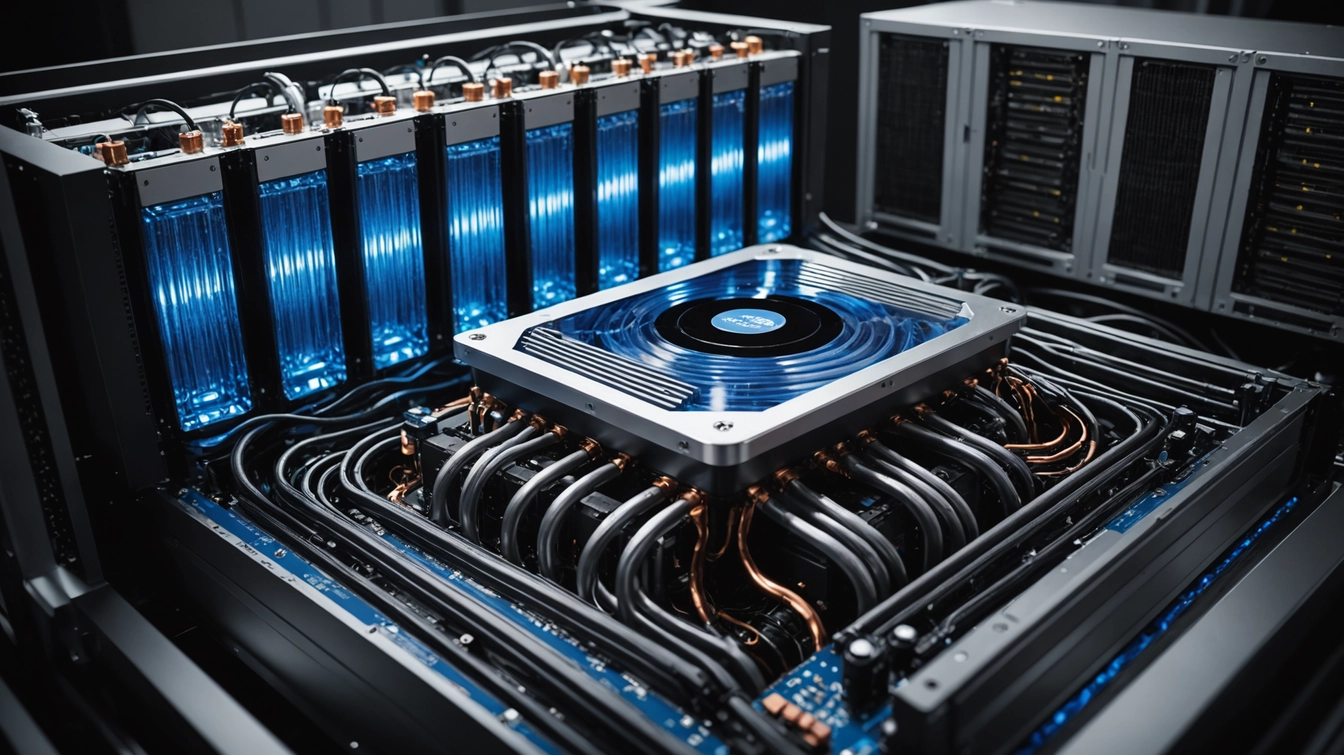
The Thermal Challenge Reshaping Data Centers
Modern data center cooling represents far more than operational maintenance—it’s becoming the defining factor in competitive AI infrastructure. As enterprises deploy increasingly powerful AI workloads, including large language models (LLMs) and real-time inference pipelines, traditional cooling approaches face fundamental limitations. NVIDIA’s H100 GPU demands up to 700 watts per unit TRG Datacenters, creating thermal densities that legacy systems simply cannot manage effectively.
Furthermore, the rapid expansion of AI infrastructure has created unprecedented challenges. The Global Data Center Liquid Immersion Cooling Market is projected to reach USD 6,947.9 Million by 2034, up from USD 1,305.2 Million in 2024, growing at a CAGR of 18.20% Market.us. This explosive growth signals a fundamental shift in how enterprises approach thermal management.
Understanding Modern Cooling Technologies
Forced Air Cooling: The Legacy Limitation
Traditional forced air cooling operates through Computer Room Air Conditioning (CRAC) units that push chilled air through raised floor environments. However, this approach faces critical constraints when supporting modern AI workloads. Most importantly, air cooling struggles with rack densities above 30 kW, creating operational bottlenecks that limit infrastructure scalability.
Additionally, the inefficiencies become stark when examining power consumption. Facilities using liquid cooling achieve PUE scores below 1.2, compared to 1.4–1.6 for air-cooled centers Persistence Market Research. These efficiency gaps translate directly into higher operational costs and environmental impact, making air cooling increasingly unsustainable for AI-intensive operations.
Direct-to-Chip Liquid Cooling: The Incremental Step
Direct-to-chip cooling represents an evolutionary improvement, pumping coolant through plates attached directly to processors. Nevertheless, this approach provides only partial thermal management. While it addresses CPU and GPU heat, it neglects critical components including memory modules, storage systems, and power distribution units.
Moreover, implementation complexity remains a significant barrier. Server fan power consumption decreased by 41% between Study 1 and Study 2, and 80% between Study 1 and Study 4 Vertiv when transitioning to liquid cooling, yet direct-to-chip systems still require extensive retrofitting and specialized maintenance expertise.
Liquid Immersion Cooling: The Engineered Standard
Immersion cooling fundamentally reimagines thermal management by submerging entire servers in dielectric, non-conductive fluids. Consequently, this approach delivers comprehensive cooling across all components while enabling remarkable efficiency gains. Two-phase immersion cooling technology can make the data center PUE reach 1.05–1.07 Stet-review, representing near-perfect energy utilization.
Furthermore, the technology enables extraordinary density improvements. Google’s use of immersion-cooled TPU pods illustrates how large providers are standardizing liquid technologies to curtail real-estate requirements and capex for building expansion Mordor Intelligence. Modern immersion systems support rack densities exceeding 100 kW, effectively multiplying computational capacity within existing footprints.
The Science Behind Superior Performance
Thermal Conductivity Advantages
The physics underlying immersion cooling’s superiority stems from fundamental material properties. Liquid immersion cooling can conduct heat away from servers 1,200 times more efficiently than air cooling GR Cooling. This dramatic difference enables consistent thermal management even under maximum computational loads.
Subsequently, this efficiency translates into tangible operational benefits. KDDI’s field trials reported a 94% electricity reduction and a Power Usage Effectiveness (PUE) of 1.05 using liquid cooling OpenPR, demonstrating real-world validation of theoretical advantages.
Component Longevity and Reliability
Beyond immediate cooling benefits, immersion technology significantly extends hardware lifespan. Since components operate at stable, optimal temperatures without exposure to dust, humidity, or thermal cycling, failure rates decrease substantially. Additionally, the absence of mechanical fans eliminates vibration-related wear and reduces maintenance requirements.
Economic Analysis: Understanding Total Cost of Ownership
Initial Investment Considerations
While immersion cooling requires higher upfront investment for specialized tanks and dielectric fluids, the long-term economics prove compelling. The technology offers long-term savings through reduced cooling costs, increased hardware lifespan (due to less thermal stress), and lower maintenance needs Grand View Research.
Moreover, market dynamics are improving accessibility. The single-phase immersion cooling segment is anticipated to grow at a CAGR of 20.9% during the forecast period due to its lower cost, simpler design, and ease of integration into existing data center infrastructures Grand View Research, making entry more feasible for mid-sized operations.
Operational Savings Analysis
The operational economics of immersion cooling demonstrate clear advantages over traditional approaches. Liquid immersion cooling like GRC’s can cut the electrical expenses for cooling by an amazing 95% GR Cooling. These savings compound over facility lifespans, often achieving positive ROI within 24-36 months.
Furthermore, energy efficiency improvements extend beyond cooling systems. RackCDU™ could annually save California ratepayers up to 2,400 gigawatt hours of electricity and $340 million CA, illustrating the massive scale of potential savings across broader deployments.
Implementation Strategies for Modern Facilities
Greenfield Deployments
For new construction, immersion cooling integration from initial design phases maximizes benefits. Architects can optimize layouts specifically for immersion tanks, eliminating unnecessary air handling infrastructure. Consequently, facilities achieve smaller footprints, lower construction costs, and faster deployment timelines.
Retrofit Considerations
Existing facilities can adopt immersion cooling through phased implementation strategies. Initially, operators might deploy immersion systems for highest-density racks while maintaining air cooling for legacy equipment. Subsequently, as hardware refresh cycles progress, complete transitions become feasible without operational disruption.
Future-Proofing AI Infrastructure
Scaling for Next-Generation Hardware
As AI hardware continues advancing, thermal requirements will only intensify. NVIDIA’s roadmap indicates future GPUs exceeding 1000W TDP, making liquid cooling essential rather than optional. Therefore, enterprises investing in immersion cooling today position themselves advantageously for tomorrow’s computational demands.
Additionally, News from last October’s annual OCP Global Summit that Intel and Submer had perfected a milestone Forced Convection Heat Sink (FCHS) package for single-phase immersion cooling of data center chips above 1000W TDP Data Center Frontier confirms industry preparation for these higher thermal loads.
Sustainability and Regulatory Compliance
Environmental considerations increasingly influence infrastructure decisions. In August 2024, Microsoft introduced a water-free AI-optimized data center design, saving over 125 million liters of water annually per facility through chip-level cooling Persistence Market Research. As regulations tighten around water usage and carbon emissions, immersion cooling provides compliance pathways while maintaining performance.
Making the Transition: Practical Considerations
Transitioning to immersion cooling requires careful planning but delivers transformative results. Organizations should evaluate current infrastructure limitations, projected growth trajectories, and sustainability commitments. Furthermore, partnering with experienced providers ensures smooth implementations and optimized configurations.
Most importantly, the question isn’t whether to adopt liquid cooling, but how quickly organizations can implement it. As AI workloads continue expanding and traditional cooling reaches physical limits, immersion technology represents not just an upgrade, but an operational necessity.
Recommended Related Articles
- “Optimizing PUE: A Comprehensive Guide to Data Center Energy Efficiency”
- “NVIDIA H100 vs. Next-Generation GPUs: Planning Your AI Infrastructure Investment”
- “The Economics of Sustainable Data Centers: Carbon Credits and Green Computing”
- “Edge Computing Thermal Management: Scaling AI Beyond the Core”
- “Data Center Construction Trends: Building for 100kW+ Rack Densities”
Conclusion
The transition to liquid immersion cooling represents more than technological advancement—it’s a strategic imperative for organizations serious about AI infrastructure. With proven efficiency gains, dramatic density improvements, and compelling economics, immersion cooling has evolved from experimental technology to engineered standard. As your organization evaluates infrastructure investments, consider not just current requirements but future scalability. The enterprises leading tomorrow’s AI revolution will be those that engineer their cooling infrastructure today.
Sources:
- Data Center Frontier: Liquid Immersion Cooling Advancements
- Market.us: Data Center Liquid Immersion Cooling Market Analysis
- Science and Technology for Energy Transition: Immersion Cooling Technology Status
- NVIDIA H100 Power Consumption Guide
- Mordor Intelligence: Immersion Cooling Market Report
- Vertiv: PUE Analysis of Liquid Cooling Implementation
- Green Revolution Cooling: Operational Cost Reduction
- California Energy Commission: Low-Cost Data Center Cooling