Data Center Moratorium: 12 States, 2026 Map, The Fix
Update — 2026-05-08. MultiState’s May 7 ballot tracker reports voters in 14 jurisdictions are now targeting data centers with local or statewide ballot measures, in addition to the 12 active state moratorium bills covered below. Maine’s L.D. 307 was vetoed April 24. Georgia’s one-year ban moves on July 1. Sanders and Ocasio-Cortez introduced the federal […]
Update — 2026-05-08. MultiState’s May 7 ballot tracker reports voters in 14 jurisdictions are now targeting data centers with local or statewide ballot measures, in addition to the 12 active state moratorium bills covered below. Maine’s L.D. 307 was vetoed April 24. Georgia’s one-year ban moves on July 1. Sanders and Ocasio-Cortez introduced the federal AI Data Center Moratorium Act in March. Denmark paused new connections on May 4 (CNBC). The architecture below is what does not trigger any of these laws.
About SAVRN. SAVRN is the operator of an off-grid sovereign AI infrastructure campus model — owned power generation, owned compute, closed-loop liquid cooling — deployed in 6 to 12 months versus the 24-to-48-month industry standard, with active developments in California, Texas, Colorado, Nebraska, Panama, and Barbados.
Data center moratorium bills are spreading. More than a dozen U.S. states introduced them in 2026. The architecture they target has more in common across these bills than the politics that produced them. First, here is the architecture that does not trigger any of them.
Meet the SAVRN Atom by Intelliflex
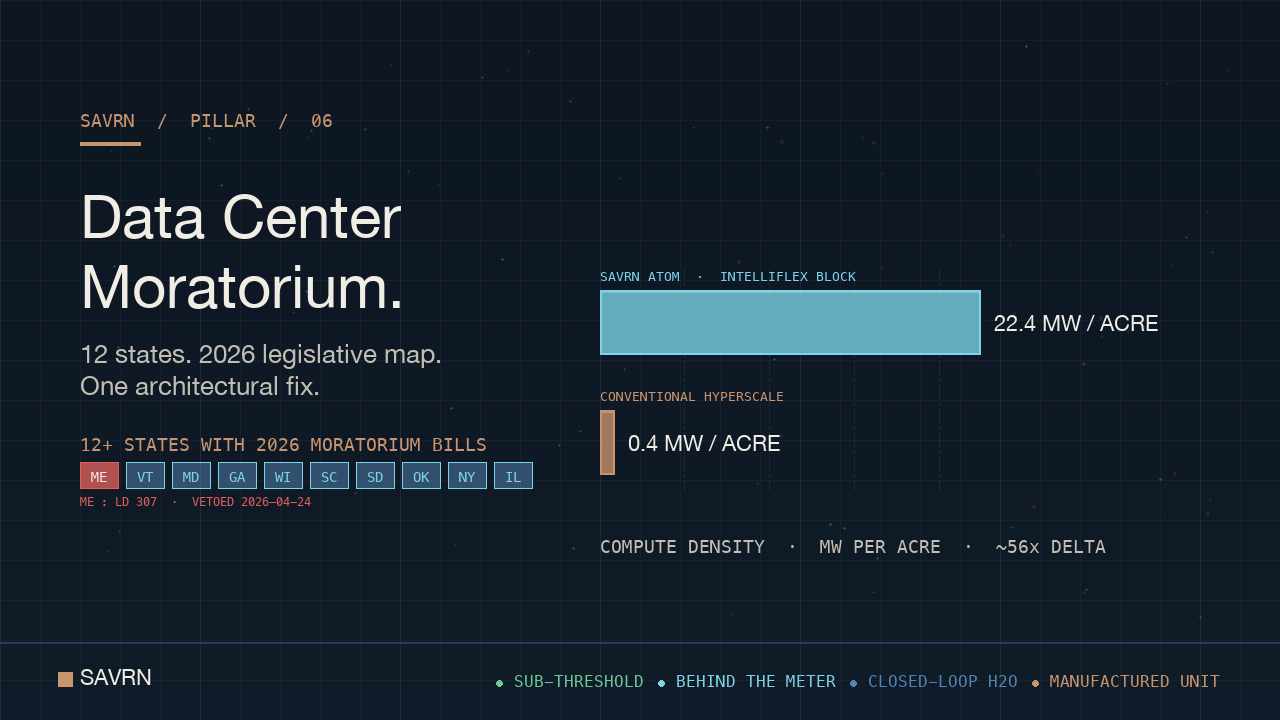
The Atom is a factory-built unit, not a construction project. Notably, power is part of the unit. Likewise, cooling is closed-loop. The standard config runs 13.2 MW base load with 8.8 MW of IT load. Likewise, the footprint is 23,250 square feet. That works out to 22.4 MW per acre. By contrast, a typical hyperscale gets roughly 0.4 MW per acre. That number includes site, setbacks, substation, water plant, security, and parking. The smallest Atom config is 6.1 MW base with 4.4 MW IT. Both sizes sit below the MW thresholds the most aggressive data center moratorium bills now use as a trigger.
In short, the rest of this piece walks the law map. It tracks what drives each bill. It draws the line the bills imply. Therefore, enterprise siting committees should now treat architecture as a buying choice rather than a deployment detail.
The 2026 data center moratorium wave: a 12-state law map
Until April 2026, no U.S. state had a data center moratorium on the books. Now that is no longer true in spirit. Soon it may not be true in law. At least twelve states filed moratorium bills in 2026. Furthermore, the volume is rising month over month. Bills differ in mechanism. A few pause permits. Others pause builds. Yet others pause AI-only sites. However, they share a clear pattern in what they treat as the harm.
Maine LD 307: the bill that almost defined the data center moratorium category
Maine’s LD 307 would have banned new data center facilities over 20 MW. A pause was set to run until November 2027. The Maine Senate enacted it on April 14, 2026. However, Governor Janet Mills vetoed it on April 24. She cited economic-development concerns. Even so, the law path it cleared is now the template several other states are studying. Importantly, threshold language matters. Therefore, the 20 MW trigger is now part of the public record.
Vermont, Maryland, Georgia, and the bills still in motion
Vermont’s S.205 sets a pause on AI data centers. A pause runs through July 1, 2030. It is the longest pause window of any 2026 bill. Maryland HB 120 would prohibit new construction. A pause holds until the General Assembly enacts co-location-with-power-generation law. In other words, the underlying anxiety is grid coupling. Georgia HB 1012 would bar counties and cities from issuing any data center construction permits. Notably, a pause runs until March 1, 2027. Furthermore, Wisconsin, South Carolina, South Dakota, Oklahoma, New York, and Illinois have filed similar language. Several remain alive in their respective sessions.
Why this data center moratorium movement is bipartisan, and why that matters
GOP lawmakers cite tax issues. They also cite grid strain. By contrast, Democratic sponsors cite green issues. They also cite water and equity. However, those framings reach the same conclusion through different doors. Indeed, the bipartisan alignment is rare in 2026 politics. Hence, this category of law has structural durability rather than partisan transience. A moratorium bill can be framed two ways. It works as a fiscal-conservative cost-control measure. It also works as a progressive environmental measure. Therefore, it has two-sided cover. As a result, that coverage turns introduced bills into enacted law over many sessions, even when each vetoes succeed.
What the data center moratorium bills in fact target
Every data center moratorium bill in 2026 reduces to four impacts. In fact, the bills name three of them. The press names the fourth. Read end to end, the bills are not anti-data-center. Rather, they are anti-grid-coupled, anti-evaporative, anti-construction-disruption, and anti-tax-incentive-arbitrage. Hence, the architectural implication is downstream of that reading.
Power: the $4.3 billion ratepayer cost shift driving the data center moratorium backlash
Ratepayers in seven PJM states now carry a $4.3 billion cost. That figure covers transmission projects approved in 2024 to connect data center load. In fact, some PJM-territory residents saw a 267 percent monthly power price spike. The spike covered 2020 to 2025. Large-load tariffs reshaped capacity auctions. Therefore, that is the number behind every “we don’t want to subsidize hyperscalers” floor speech. When a senator says “cost shifting onto households,” they mean this mechanism. Therefore, a moratorium becomes a state’s blunt tool to halt the cost-shift.
Water: 64 percent of opponents cite consumption
Surveys find that 64 percent of organized data center opponents list water as a top concern. In particular, community wells running dry near data center sites have entered the law testimony record. That has happened in three of the twelve states with active bills. Notably, open-loop evaporative cooling at hyperscale draws water on a scale local hydrology cannot absorb. Hence, the impact lands directly on the community. The 49-billion-gallon mirage piece walks the math.
Noise and physical footprint: 41 percent of pushback is acoustic and visual
Furthermore, 41 percent of organized opponents cite noise as a top reason. Property-value impact and green-space loss are two more drivers. These are unglamorous reasons. However, they carry decisive weight at the township and county level. That is exactly where the permit-pause bills like Georgia HB 1012 intervene. In fact, the community-impact bucket turns a proposed data center into a zoning fight. As a result, contested hearings turn a single bill into a statewide public signal.
Tax incentives under bipartisan scrutiny
The fourth driver is criticism of tax abatements offered to attract hyperscalers. In particular, legislators are now publishing the math. Jobs created per million dollars of foregone revenue do not flatter the conventional model. Therefore, a moratorium gives a state cover to rewrite the abatement deal. That happens before the next round of mega projects locks in another decade of exemptions. Even where the moratorium itself fails to pass, the law fight reshapes the next abatement bill that does.
The community impact data behind the moratorium movement
The 2026 bills did not arrive in a vacuum. Rather, they followed three years of rising pushback. The data sources below now quantify it. In short, the impact data overall explains why moratorium language is the next move legislators reach for.
$64 billion in projects blocked or delayed
Data Center Watch tracks community pushback to data center projects. As of early 2026, roughly $64 billion of projects have been blocked or delayed. The number is conservative. In fact, it counts only projects with documented pushback events, not projects withdrawn quietly. Moreover, the dataset shows pushback is no longer concentrated in old hotspots. Instead, it is now distributed across more than thirty states. Hence, the moratorium movement now has a national rather than regional character.
The 267 percent rate-spike pattern in PJM territories
The most-cited number in floor speeches is the 267 percent rate spike. It was observed in some PJM-territory submarkets between 2020 and 2025. Furthermore, that figure has appeared in hearings in at least four 2026 moratorium bills. Whatever its statistical generality, it is the number constituents quote when they call their state representatives. Therefore, a moratorium is the answer that legislator gives the constituent who just received a doubled utility bill.
Why rural America became the data center moratorium front line
Rural counties offer cheap land and available substations. In addition, their tax structures long welcomed industry. Hyperscale siting plans chose them on those grounds. However, the same traits make these counties uniquely sensitive. In fact, small electric cooperatives, single-source water utilities, and low population density amplify any one large facility’s footprint. Therefore, the strongest constituency for the moratorium movement is rural lawmakers. They watched their counties get sold a low jobs number against a high utility bill.
Why hyperscale design triggers every data center moratorium criterion
The conventional hyperscale data center is a different object from what the 2026 bills imagine. In fact, three architectural commitments produce every impact the bills target. They are grid coupling, open-loop cooling, and on-site construction. Hence, the architecture is not incidental to the impacts. Rather, the impacts follow directly from the architecture.
The grid-coupling problem: large-load rates and capacity queues
A 200 MW hyperscale enters the regional grid as a large-load customer. Therefore, the grid must allocate capacity and route transmission for it. Notably, the interconnection study alone runs 18 to 24 months. Moreover, every megawatt the hyperscale draws flows through the regional auction. Its presence shifts the clearing price upward. Therefore, ratepayer cost shift is not a side effect. It is the mechanical result of putting a 200 MW load into a system priced by the marginal megawatt. Power delivery for AI walks the alternative.
The water profile that comes with open-loop evaporative cooling
Open-loop evaporative cooling still dominates hyperscale cooling. Hence, large sites draw on the order of millions of gallons per day. The community-well stories in hearings follow directly from this design choice. By contrast, closed-loop and direct-to-chip architectures eliminate the draw entirely. However, they require different capex commitments. Hyperscales rarely adopt them because the impact lands on the community, not the operator. The direct-to-chip and immersion approach is the engineering option.
The construction-project model and its 24-to-36-month window
A conventional hyperscale arrives as a construction project. In fact, the work covers site prep, foundation, structure, mechanical buildout, and commissioning. Specifically, the window from groundbreaking to first workload often runs 24 to 36 months. During that window, the local community lives with construction traffic, noise, and dust. What’s more, they live with the experience of a site they did not vote for becoming the largest neighbor they have. Eventually, by the time the facility runs, pushback has already organized. Therefore, the construction window itself manufactures the political pushback that drives the moratorium movement.
The architectural distinction: what a data center moratorium does and doesn’t ban
Read the bills carefully and a clearer picture emerges. The data center moratorium bills do not ban computation. Rather, they ban a specific setup of land use, grid draw, water draw, and construction footprint. In fact, the bills implicitly endorse a specific setup. That setup is sub-threshold, behind-the-meter, factory-built, not constructed, and closed-loop on water. In other words, the category opens for a different kind of object.
Reading the bills: facility size, MW thresholds, water-draw triggers
Maine LD 307 used a 20 MW threshold. Furthermore, several other 2026 bills use larger thresholds. Some run at 50 MW, some at 100 MW. Others trigger on combined water draw, on parcel size, or on grid request size. However, almost none of them define “data center” by computational throughput, by tenant model, or by ownership. As a result, the law imagination of “the thing being banned” is a large physical facility. It has large grid draws and large water draws. By contrast, “computation occurring on a server” is not the target.
What gets exempted: behind-the-meter, factory-built, sub-threshold
Where the 2026 bills include exemption language, three categories appear repeatedly. First, behind-the-meter facilities qualify. Those generate their own power and do not draw from the regional grid. Second, facilities below the MW threshold qualify. Third, modular or factory-built builds qualify. In fact, the bills treat them as product rather than as a construction project. These exemptions are not accidental. Rather, they reflect a law attempt. The attempt preserves a different category of compute infra. That category does not yet have a vocabulary.
Why “data center” is the wrong category for a sovereign unit
The word “data center” still does work in 2026. However, it is doing less of it every quarter. A factory-built, behind-the-meter, sub-threshold, closed-loop AI compute unit is not a data center. At least not in the sense the bills mean. Rather, it is a different product with a different impact. Hence, the law thresholds are inadvertently drawing the boundary of the category. This is the architectural distinction the rest of this piece is built on. Therefore, a data center moratorium does not bind a sovereign unit the same way it binds a hyperscale.
The SAVRN Atom: a design that does not trigger the data center moratorium criteria
The SAVRN Atom by Intelliflex was engineered against the same physical constraints the data center moratorium bills now formalize. The match is not retrospective marketing. Rather, it is the consequence of a sovereign thesis. That thesis always treated grid dependence, open-loop water, and construction-project deployment as design failures. Therefore, the four design choices below map one-to-one against the four ban drivers above.
Factory-built, not constructed: removing the 24-to-36-month window
SAVRN builds the Atom offsite as a factory-built product. Then crews deliver it to the deployment location as a finished unit. Hence, there is no 24-month construction window for the local community to organize against. Moreover, there is no permit-by-permit chokepoint a moratorium bill can use. From a permitting view, the deployment looks closer to receiving industrial equipment. It does not look like siting a data center. The Intelliflex Block page walks the factory-built-product model in detail.
On-site sovereign power: no grid queue, no ratepayer cost shift
Power for the Atom is on-site and source-agnostic by design. In fact, the unit matches local site conditions rather than committing to a single fixed generation method. The deployable architectures span natural gas tri-generation, biomass-to-AI, and closed-loop hydro. In every case, the unit runs behind-the-meter. As a result, there is no large-load interconnection request. There is no PJM capacity-auction footprint. There is no transmission-upgrade cost flowing to ratepayers. Therefore, this rule does not apply to a unit that is not coupled. The full power architecture menu is at SAVRN Power.
Closed-loop thermal management: no community water draw
Thermal management in the Atom is closed-loop. Direct-to-chip and immersion options apply by workload density. Hence, the unit does not draw on the local water utility for evaporative cooling. The community-well failure mode that drives the water-related testimony in moratorium hearings is structurally absent. Therefore, this rule does not apply either.
Subdivisible deployment: siting at the load, not above the threshold
The standard Atom carries 13.2 MW base load with 8.8 MW IT. The smallest config carries 6.1 MW base with 4.4 MW IT. Both sit beneath the 20 MW Maine threshold. In addition, both sit far beneath the 50 to 100 MW thresholds in larger bills. Where greater capacity is required, additional Atoms can be sited at separate parcels at the load. By contrast, a single mega-site would re-trigger the threshold language. Therefore, the architectural unit is subdivisible. Hence, the data center moratorium thresholds do not bind this deployment pattern. Capacity grows by adding small units near the load.
What the moratorium movement means for enterprise siting choices
The siting implications run deeper than “avoid the banned states.” Even a failed bill shifts the risk. The reshape lasts for years. Therefore, enterprise siting committees that still treat “what state” as a tax-incentive question are underweighting. Therefore, that variable has now changed category from financial to existential.
The siting committee question that just changed
“Which state offers the best abatement?” was the first question for a 2018 siting choice. However, in 2026 the first question is different. In fact, the new question is different. Which design will not get banned, in the state with the best abatement, two years out? Risk that a permitted facility is shut down mid-build is no longer theory. Rather, it is the precise outcome the introduced moratorium bills signal for the next session.
The political risk you cannot price into a 5-year capacity bet
AI capacity runs on 5- to 7-year horizons. The data center moratorium movement has bipartisan footing and an rising bill count. Hence, it will shape the rules around over exactly that window. Therefore, architectures robust to whatever the bills become carry a political-risk premium. In fact, sub-threshold, behind-the-meter, factory-built units clear the bar. By contrast, grid-coupled hyperscale designs cannot match that premium at any abatement level. The economics of the abatement do not survive the risk being priced correctly.
Why architecture is now a buying criterion, not a deployment detail
Five years ago, infra design was a build-team concern. Today it is a board issue. In particular, the state in which a facility sits is no longer stable. Rather, the only stable factor is the design itself. As a result, a SAVRN Atom is the same architectural object in California, Texas, Colorado, Nebraska, Panama, or Barbados. The law environment around it varies. The unit does not. That is the buying promise the data center moratorium era now puts a price on. The SAVRN Doctrine develops the broader thesis.
Frequently asked questions
Which states have a data center moratorium in 2026?
At least twelve states introduced data center moratorium bills in their 2026 sessions. In fact, the list includes Maine (LD 307, vetoed April 24, 2026). It also includes Vermont (S.205), Maryland (HB 120), and Georgia (HB 1012). Furthermore, Wisconsin, South Carolina, South Dakota, Oklahoma, New York, and Illinois all filed bills. The list is moving as bills are amended. Hence, the NCSL law tracker and datacenterbans.com maintain current state-by-state status.
Did Maine pass a data center moratorium?
The Maine Legislature enacted LD 307 in April 2026. In particular, the bill would have paused new data centers above 20 MW until November 2027. However, Governor Janet Mills vetoed the bill on April 24, 2026. Therefore, the veto blocked enactment. Even so, the law pattern is now public. The 20 MW threshold is part of the template other states adapt.
What is the SAVRN Atom?
The SAVRN Atom is a factory-built unit. SAVRN produces it under the Intelliflex Block program. In fact, SAVRN builds it offsite. Crews then deliver it to the site as a finished product. The unit ships air gapped with on-site power. A standard Atom carries 13.2 MW base load with 8.8 MW of IT load. Each unit covers 23,250 square feet. That works out to 22.4 MW per acre. By contrast, the smallest config runs 6.1 MW base with 4.4 MW IT.
Does a SAVRN Atom count as a data center under these bills?
Most 2026 moratorium bills define their target by MW threshold. Often the threshold is 20 MW or higher. Other bills trigger on grid request size or on parcel size. The standard Atom runs 13.2 MW base load. Therefore, it sits below the most aggressive thresholds. Moreover, it is behind-the-meter, which removes the grid-interconnection trigger. Where a bill uses different criteria, the architectural distinction still maps to its exemption category.
Can SAVRN deploy in a state with a moratorium?
The architectural answer is that the Atom will fall outside the criteria most moratorium bills use. However, the legal answer in any specific state depends on the precise bill language. It also depends on the deployment setup chosen, and on local zoning overlays. Notably, SAVRN does not currently publish a state-by-state matrix. Hence, siting choices go through the engagement process at SAVRN engage.
The data center moratorium era is here. The architecture that survives it already exists.
Twelve states moved from “considering” to “introduced.” One moved further. It went from “introduced” to “enacted, then vetoed.” That is a category change in the rules around around AI compute. In short, the architectures that respond to it are the ones engineered against the impacts the bills target. In fact, those impacts are grid coupling, open-loop water, construction-project deployment, and mega-site footprint. As a result, the SAVRN Atom is the operational form of that response. The data center moratorium era is not a problem the AI buildout has to solve. Rather, it is the state of the world the next infra decision is being made into.
In short, the broader thesis lives at the Doctrine. Likewise, on-site power lives at Power. Similarly, the factory model lives at the Intelliflex Block. Furthermore, compute details live at Compute. Finally, a sovereign engagement begins at Infrastructure Assessment.
Sources & Citations
Every quantitative claim in this piece traces to a named, verified primary source. URLs verified at time of publication. The full audit-grade citation record, with claim-by-claim source mapping and “cite this article” snippets, is maintained on the dedicated SAVRN sources page for this piece.
Primary research cited in this data center moratorium brief
- National Conference of State Legislatures — Which States Are Banning Data Centers. National Conference of State Legislatures law tracker for state-by-state legislation banning or restricting data center construction.
- MultiState Associates — state legislative tracker. MultiState Associates legislative tracker — AI / data center matrix used as the live cross-state tracking source.
Supporting frameworks, regulators, and industry data
- Data Center Watch — Industry Report. Data Center Watch report on community opposition and regulatory restrictions across U.S. jurisdictions.
- datacenterbans.com. datacenterbans.com — independent state-by-state matrix tracking municipal and state-level data center bans.